
How has conveyor belt technology changed horticulture?
Conveyor belt technology has quietly transformed the way horticulture businesses operate, shifting the industry away from labour-intensive manual processes towards smarter, faster, and more ergonomic workflows. For nurseries, greenhouses, and distribution centres, the question is no longer whether automation makes sense, but how to implement it in a way that fits the specific demands of growing and processing plants.
Understanding how conveyor belt technology works in a horticultural context, and what it can realistically deliver, helps growers and operations managers make confident decisions. This article answers the most important questions about conveyor belt horticulture, from the basics to practical next steps.
What is conveyor belt technology in horticulture?
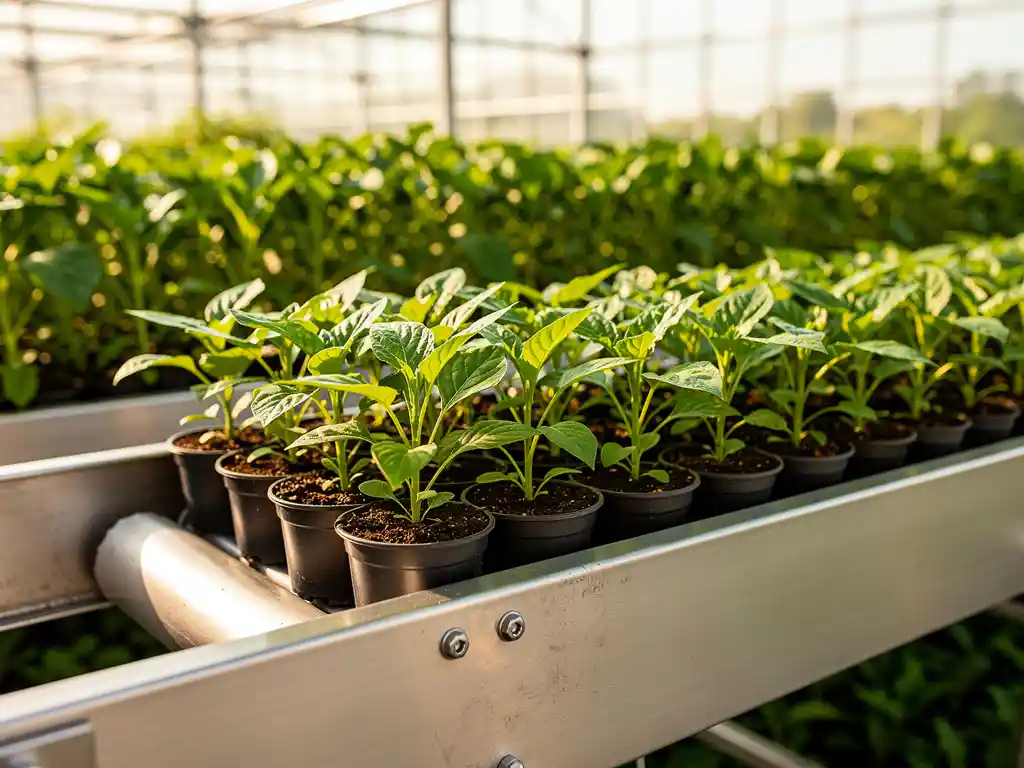
Conveyor belt technology in horticulture is the use of automated transport systems, including flat belts, roller conveyors, buffer belts, and elevator belts, to move plants, pots, soil, and products through a greenhouse, nursery, or processing facility without manual carrying or pushing. These systems are purpose-built for the wet, soil-heavy, and physically demanding conditions of horticultural production environments.
Unlike general industrial conveyor systems, horticultural conveyor solutions are designed to handle fragile plant material, function reliably in high-humidity greenhouse conditions, and integrate smoothly with other equipment, such as potting machines, sorting lines, and watering stations. The goal is to create a continuous flow of material through the production process, reducing the physical burden on workers and eliminating bottlenecks that slow output.
How has internal transport in horticulture traditionally worked?
Traditionally, internal transport in horticulture relied almost entirely on manual labour. Workers carried trays, pushed trolleys, and walked long distances across greenhouse floors to move plants from one workstation to the next. In larger operations, this meant employees covering several kilometres per shift, spending a significant portion of their working day simply moving material rather than adding value to it.
This approach created a range of persistent problems. Physical strain from repetitive lifting and carrying led to musculoskeletal complaints and higher rates of absenteeism. Production flow was uneven, with bottlenecks forming wherever manual hand-offs slowed things down. Scaling up output was difficult because it required proportionally more staff, and finding and retaining reliable workers in physically demanding roles became increasingly challenging over time.
What are the main types of conveyor systems used in greenhouses?
The main types of conveyor systems used in greenhouses include mobile conveyor belts, fixed conveyor belts, buffer belts, roller conveyors, ground-level soil conveyors, and elevator belts. Each type serves a distinct function within a production or processing line, and many operations use a combination of several types to create a complete internal transport solution.
Mobile conveyor belts
Mobile conveyor belts are flexible, freestanding units that can be repositioned across the greenhouse floor as operational needs change. They are particularly useful for seasonal growers or businesses that want to trial automation before committing to a fixed installation. Mobile systems like the EasyMax and Wevab that we produce are built to handle the wet and muddy conditions typical of active growing environments.
Fixed conveyor belts and specialised systems
Fixed conveyor belts are permanently installed along production lines and provide consistent, high-capacity transport between defined points in a facility. Buffer belts act as temporary holding areas within the line, absorbing pace differences between workstations and preventing queues from forming. Roller conveyors work well for heavier loads or products that need to be easily accessed from the side, while elevator belts move material between different height levels, connecting floor-level processes with raised workstations or storage areas.
How does conveyor belt automation improve efficiency in horticulture?
Conveyor belt automation improves efficiency in horticulture by creating a continuous, controlled flow of material through the production process, reducing idle time, eliminating unnecessary walking, and allowing workers to focus entirely on value-adding tasks at their workstation. The result is faster throughput, lower labour costs per unit, and more consistent output quality.
The efficiency gains operate on several levels at once. When plants move automatically from potting to spacing to watering, each workstation receives a steady supply of material without waiting for a colleague to deliver the next batch. Workers no longer walk away from their position to collect or deposit trays, which means more productive minutes per hour. Over a full working day across an entire team, these time savings compound significantly. Beyond speed, automation also reduces physical strain, which leads to fewer injuries, lower absenteeism, and a more sustainable working environment for staff.
What should you consider when choosing a conveyor system for a nursery?
When choosing a conveyor system for a nursery, the most important factors to consider are the specific crop and production process, the physical layout of the facility, whether a mobile or fixed solution is more appropriate, the environmental conditions, such as humidity and soil exposure, and whether the system can integrate with existing equipment, like potting machines or sorting lines.
- Production process compatibility: The conveyor system needs to match the pace, product type, and workflow of your specific operation, whether that is pot plant production, vegetable processing, or cut flower handling.
- Facility layout: The dimensions of aisles, the distance between workstations, and the presence of level changes all influence which type of system is practical.
- Fixed versus mobile: Fixed systems offer higher capacity and seamless integration, while mobile systems provide flexibility and a lower initial commitment.
- Material durability: Systems must be built from materials that resist moisture, soil, fertilisers, and the wear of daily horticultural use.
- Integration potential: A conveyor that cannot connect to your potting machine or sorting line creates new bottlenecks rather than solving old ones.
- Service and support: Downtime in a production environment is costly, so local service availability and access to spare parts matter as much as the initial product quality.
It is also worth thinking carefully about scalability. A system that meets today’s needs but cannot be extended as the business grows will require replacement sooner than expected, making the total cost of ownership higher than it first appeared.
How can a business get started with conveyor belt automation?
The most practical way to get started with conveyor belt automation in horticulture is to begin with a clear assessment of where the biggest inefficiencies in your current internal transport process are, then explore whether a mobile or fixed solution best fits your situation. For businesses that are uncertain, renting a conveyor system before purchasing is a low-risk way to experience the operational impact first-hand.
We offer rental as a direct entry point for growers who want to evaluate automation without an immediate capital commitment. This approach allows operations managers to measure real productivity improvements in their own facility, with their own team, before making a long-term investment decision. From there, a full installation can be planned and engineered around the specific layout and workflow of the business, with our own technicians handling installation and commissioning from start to finish.
Starting small and scaling up is a perfectly sound strategy. A single mobile belt added to one part of the production line can demonstrate measurable value quickly, building the internal case for broader automation. The key is to treat the first step not as a final solution, but as the beginning of an ongoing process of improving how your facility moves material, supports your team, and grows its capacity over time.
Frequently Asked Questions
How long does it typically take to see a return on investment after installing a conveyor system in a nursery or greenhouse?
Most horticultural businesses begin to see measurable returns within the first growing season, with full ROI typically achieved within one to three years depending on the scale of the installation and the labour costs it replaces. The clearest gains come from reduced hours spent on internal transport, lower absenteeism due to fewer physical strain injuries, and higher throughput per shift. Tracking output per worker before and after installation gives you the clearest picture of actual financial impact in your specific operation.
Can conveyor systems handle different pot sizes and plant types on the same line?
Yes, most purpose-built horticultural conveyor systems are designed to accommodate a range of pot sizes, tray formats, and plant types within the same line, though some adjustments or modular add-ons may be needed for particularly wide variation. Belt width, side guides, and conveyor speed are typically configurable to suit different products. If your operation handles a broad mix of crops or container sizes, it is worth discussing this explicitly with your supplier during the design phase so the system is engineered for that flexibility from the outset.
What happens if a conveyor belt breaks down during a busy production period — how quickly can it be repaired?
Downtime risk is one of the most valid concerns when introducing any automated system into a production environment, and it is why local service availability and spare parts access should be a key factor in your supplier selection. Reputable horticultural conveyor manufacturers maintain service technicians and stocked spare parts to respond quickly, often within the same working day for critical issues. Choosing a supplier with a strong service network in your region significantly reduces the operational risk of an unexpected breakdown.
Is it possible to integrate a conveyor system with existing potting machines or other equipment we already have?
In most cases, yes — modern horticultural conveyor systems are designed with integration in mind and can be connected to potting machines, spacing robots, watering systems, and sorting lines from a range of manufacturers. The key is to share detailed specifications of your existing equipment with your conveyor supplier early in the planning process so that connection points, belt heights, and feed speeds can be matched correctly. Poorly matched integration is one of the most common causes of new bottlenecks, so this step should never be skipped.
What maintenance does a horticultural conveyor system require, and can our own team handle it?
Routine maintenance for horticultural conveyor systems typically includes regular cleaning to remove soil and plant debris, periodic inspection of belt tension and drive components, and lubrication of moving parts according to the manufacturer's schedule. Most of these tasks are straightforward enough for an in-house maintenance team to handle with basic training and the right guidance from the supplier. Establishing a simple weekly and monthly maintenance routine from day one significantly extends equipment lifespan and reduces the likelihood of unexpected failures.
We are a smaller nursery — is conveyor automation only cost-effective for large-scale operations?
Conveyor automation can deliver real value at a range of scales, and smaller nurseries are often surprised by how quickly even a single mobile belt improves daily workflow. The key is to focus on the specific bottleneck that costs you the most time or causes the most physical strain, rather than trying to automate everything at once. Mobile conveyor systems and rental options make it practical for smaller operations to start with a modest investment, prove the value in their own environment, and expand from there as the business grows.
How do we prepare our team for the transition to a more automated production process?
Successful adoption of conveyor automation depends as much on people as it does on equipment, and involving your team early in the process makes a significant difference to how smoothly the transition goes. Explain clearly how the system will change daily tasks, emphasise the reduction in physical strain, and give workers hands-on time with the equipment before full production begins. Most teams adapt quickly once they experience the practical benefits themselves, and operators who previously spent energy on manual transport often find their work becomes more focused and less exhausting within the first few weeks.