
What are the benefits of conveyor belts in horticulture?
Conveyor belts have quietly transformed how modern horticultural businesses operate. What once required teams of workers walking kilometres per shift to move plants, trays, and produce can now be handled smoothly, consistently, and with far less physical strain. If you are considering automation for your greenhouse or distribution centre, understanding the real benefits of conveyor belt horticulture is the right place to start.
This article answers the most common questions growers and operations managers ask before investing in internal transport automation. Each section gives you a direct, practical answer so you can make informed decisions for your business.
What are conveyor belts in horticulture and how do they work?
Conveyor belts in horticulture are mechanised transport systems designed to move plants, pots, trays, and harvested produce along a defined path within a greenhouse, packing centre, or distribution facility. They replace manual carrying and pushing by creating a continuous, controlled flow of materials from one workstation to the next.
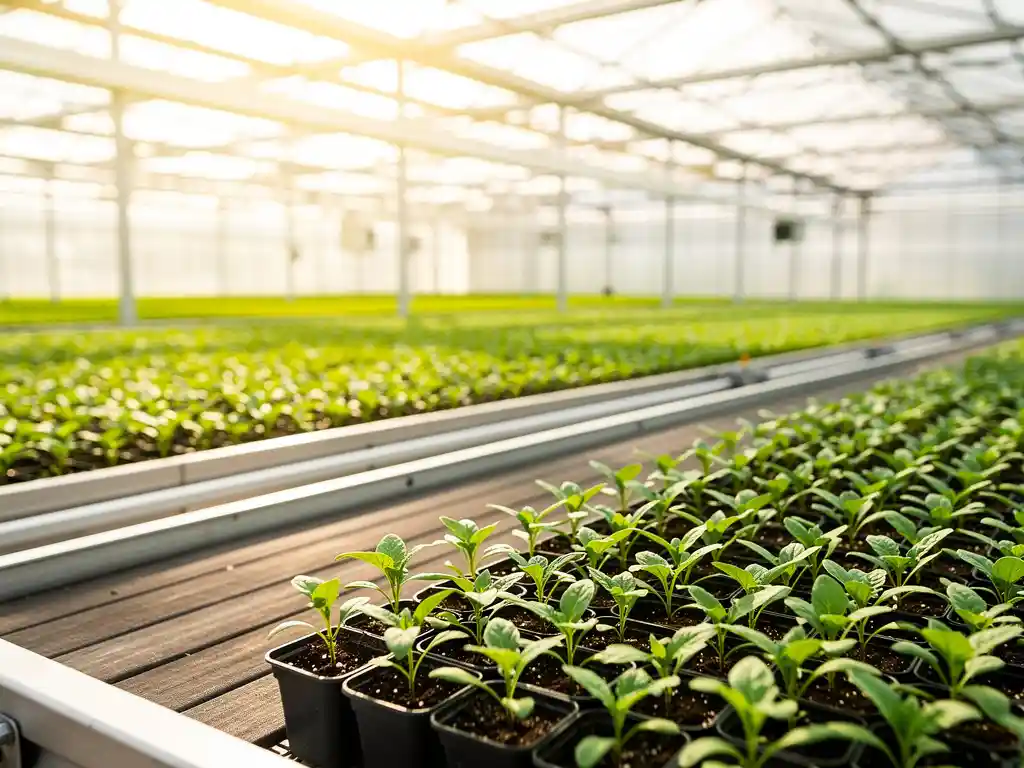
Unlike general industrial conveyor systems, horticultural conveyor belts are purpose-built for the specific demands of greenhouse environments. They need to withstand moisture, soil, and the constant movement of delicate plant material without damaging crops or breaking down in humid conditions. Systems typically include a motorised belt or roller surface, a supporting frame, and speed controls that can be adjusted to match the pace of the work.
In practice, a conveyor belt in a greenhouse might transport freshly potted plants from a potting machine to a growing area, carry harvested vegetables from the field to a packing line, or move finished products through a sorting and weighing station. The key principle is simple: the product moves to the worker, not the other way around.
What are the main benefits of conveyor belts in horticulture?
The main benefits of conveyor belts in horticulture are reduced physical labour, improved throughput speed, fewer handling errors, better ergonomics for workers, and a more consistent production flow. Together, these advantages make internal transport faster, safer, and significantly more cost-effective than manual alternatives.
Each of these benefits builds on the others. When workers no longer spend their shift walking back and forth carrying heavy trays, they can focus entirely on value-adding tasks like potting, grading, or packaging. This increases output per person-hour without increasing physical demand. At the same time, a steady conveyor flow eliminates the bottlenecks and waiting times that are common in manual operations, where one slow step holds up the entire line.
Ergonomics is another area where the impact is tangible. Repetitive carrying and bending are among the leading causes of musculoskeletal complaints in greenhouse work. By bringing the product to a fixed, comfortable working height, conveyor systems actively reduce the physical load on employees, which in turn reduces sick leave and staff turnover.
How do conveyor belts reduce labour costs in greenhouse operations?
Conveyor belts reduce labour costs in greenhouse operations by eliminating the need for workers to manually transport materials between workstations. This frees up staff for productive tasks, reduces the total number of people needed for internal transport, and lowers costs associated with physical injury and absenteeism.
In a typical greenhouse without automation, a significant portion of working hours is spent simply moving materials from A to B. Workers push carts, carry trays, and walk long distances between growing areas and processing stations. None of this movement adds direct value to the product. A well-designed conveyor system removes this entirely, meaning the same team can handle a higher volume of work in the same time.
The indirect savings are equally important. Reduced physical strain means fewer injuries and lower rates of sick leave, both of which carry real financial costs. Over time, businesses that invest in conveyor automation typically find they can maintain or increase production capacity without proportionally increasing headcount, which has a direct positive effect on their cost per unit.
What is the difference between fixed and mobile conveyor systems?
Fixed conveyor systems are permanently installed along a set route within a facility, while mobile conveyor systems are freestanding, wheeled units that can be repositioned as needed. Fixed systems suit high-volume, stable production flows, whereas mobile systems offer flexibility for businesses with changing layouts or seasonal demand.
Fixed conveyor systems
Fixed systems are designed for operations where the transport route does not change. They are integrated into the building structure or production line and typically handle larger volumes continuously. Because they are permanently positioned, they can be connected directly to other automated equipment such as potting machines, sorting lines, or packaging stations. Fixed systems are the right choice when the production process is consistent and the investment can be justified by sustained throughput.
Mobile conveyor systems
Mobile systems, such as the EasyMax and Wevab systems we produce, are mounted on wheels and can be moved wherever they are needed on the nursery floor. This makes them ideal for smaller operations, businesses that grow a variety of crops with different handling requirements, or companies that want to start with automation before committing to a full fixed installation. For businesses that are unsure which approach suits them best, renting a mobile system first is a practical, low-risk way to experience the benefits before purchasing.
When should a horticultural business invest in conveyor belt automation?
A horticultural business should invest in conveyor belt automation when manual internal transport is consuming a significant share of labour hours, when physical strain is causing absenteeism, when production bottlenecks are limiting output, or when the business is scaling up and needs to increase throughput without proportionally increasing headcount.
There is no single trigger point, but several warning signs suggest the time is right. If workers are regularly walking more than a kilometre per shift just to move materials, productive time is being lost. If your packing or potting line frequently stalls because product is not arriving fast enough, a conveyor system directly addresses that constraint. If you are struggling to retain staff due to the physical demands of the work, improving ergonomics through automation is both a welfare and a business decision.
Businesses that are expanding their growing area or adding new product lines are also well positioned to invest, since a new installation can be designed from the start to support the intended scale rather than retrofitted to an existing layout. Smaller operations that are not ready for a full installation can start with a rental arrangement to assess the impact before committing to a purchase.
How do conveyor belts integrate with other greenhouse automation systems?
Conveyor belts integrate with other greenhouse automation systems by acting as the connective layer between individual machines. They link potting machines, robots, weighing stations, sorting lines, and packaging equipment into a single, continuous production flow, eliminating the manual handoffs that would otherwise slow the process down.
Integration is where the real productivity gains become visible. A potting machine that outputs plants at a consistent rate needs a conveyor to carry those plants away without interruption. A sorting robot needs a steady, controlled input stream to operate at full capacity. When conveyor systems are designed alongside the other equipment in a facility rather than added as an afterthought, the entire line runs more efficiently and with fewer stoppages.
We design and produce conveyor systems that are fully compatible with each other and with third-party equipment. Buffer belts, roller tracks, elevator belts, and ground belts can all be connected into a single integrated line, with worktables, scales, and lighting added where needed. Because our engineering team handles the full installation and commissioning, integration between systems is managed through a single point of contact, which simplifies both the project and ongoing maintenance.
Frequently Asked Questions
How long does it typically take to see a return on investment after installing a conveyor system?
Most horticultural businesses begin to see measurable returns within 12 to 24 months of installation, depending on the scale of the operation and the volume of manual labour replaced. The clearest indicators are reduced labour hours per unit produced, lower absenteeism costs, and increased throughput capacity. Businesses that start with a rental arrangement can often calculate their expected ROI based on real operational data before committing to a full purchase, which removes much of the financial uncertainty from the decision.
What maintenance does a horticultural conveyor system require, and how disruptive is it?
Horticultural conveyor systems are designed for demanding environments, but they do require routine maintenance such as belt tension checks, lubrication of moving parts, cleaning of rollers, and periodic inspection of motors and speed controls. Most maintenance tasks are straightforward and can be carried out by in-house staff with basic mechanical knowledge. Scheduling maintenance during off-peak periods or shift changes minimises disruption to production, and working with a supplier who offers on-site support ensures that any unexpected issues are resolved quickly.
Can conveyor systems handle delicate or irregularly shaped plants without causing damage?
Yes, modern horticultural conveyor systems are specifically engineered to handle fragile plant material safely. Belt speed, surface texture, and incline angles are all adjustable to suit different crop types, pot sizes, and tray formats. For particularly delicate products, softer belt materials or cushioned roller surfaces can be specified during the design phase. The key is working with a supplier who understands horticultural requirements and can tailor the system to your specific crops rather than applying a generic industrial solution.
What should I look for when choosing a conveyor system supplier for my greenhouse?
Look for a supplier with direct experience in horticultural environments rather than general industrial conveyor manufacturers, as the moisture, soil, and biological conditions in a greenhouse place very different demands on equipment. Equally important is whether the supplier can handle design, installation, commissioning, and ongoing maintenance as a single point of contact, since fragmented responsibility across multiple contractors often leads to integration problems and slower fault resolution. Ask for references from comparable operations and, where possible, visit an existing installation to see the system performing under real working conditions.
Is it possible to expand or reconfigure a conveyor system as my business grows?
Yes, well-designed conveyor systems are modular by nature, meaning additional belt sections, buffer zones, worktables, or connections to new equipment can be added as your operation scales. This is particularly important for growing businesses, as it means the initial investment does not become obsolete when production volumes increase or the facility layout changes. When planning your first installation, it is worth discussing future expansion requirements with your supplier so that the initial design accommodates growth without requiring a complete rebuild.
How do I get started if I am not sure which type of conveyor system is right for my operation?
The most practical starting point is a site assessment with a specialist supplier who can evaluate your current workflow, identify where manual transport is consuming the most time and labour, and recommend a system that matches your volume, layout, and budget. If you are uncertain about committing to a fixed installation, renting a mobile conveyor system is a low-risk way to experience the operational benefits firsthand and gather the data you need to make a confident purchasing decision. Many businesses find that a short rental period quickly demonstrates the efficiency gains and makes the investment case straightforward.
Do conveyor systems require significant structural changes to an existing greenhouse?
Fixed conveyor systems may require some structural preparation, such as floor anchoring points or overhead mounting brackets, but this is typically planned in detail during the design phase to minimise disruption to existing infrastructure. Mobile conveyor systems require no structural modifications at all, making them an ideal first step for businesses in existing facilities. In both cases, an experienced installation team will assess your building before specifying the system to ensure the solution is practical and avoids unnecessary construction work.