

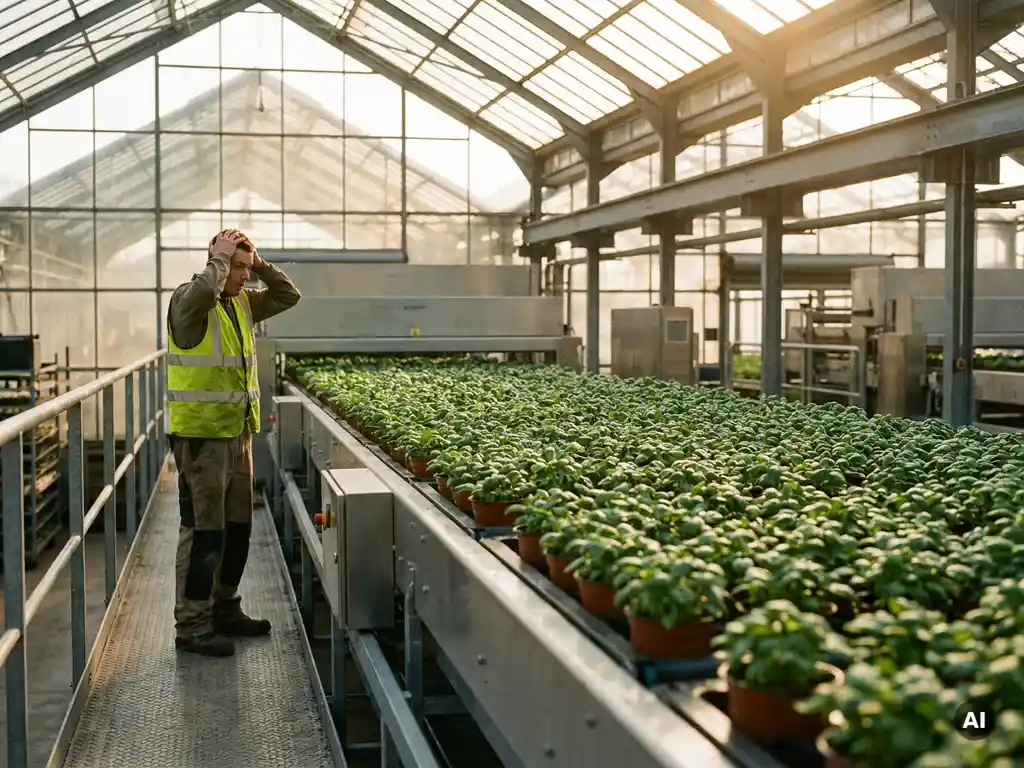
At what hourly production target does automation become necessary?
Automation becomes necessary when your potting operation consistently exceeds around 500 to 800 pots per hour on a sustained basis. At that volume, manual potting can no longer keep pace with demand reliably, and the physical strain on workers compounds the output problem. The questions below unpack exactly where those thresholds sit, what machines can do, and how to make the transition.
How many pots per hour can a person realistically pot by hand?
A skilled worker potting by hand can typically manage between 150 and 300 pots per hour under normal working conditions. That figure drops significantly over the course of a full shift as fatigue sets in, and it varies considerably between individuals depending on pot size, soil mix, and workstation ergonomics.
The practical ceiling for a single person is rarely sustained above 250 pots per hour once you account for filling, tamping, and placing each pot correctly. With a small team of three or four people working together, you can push output to 600 to 900 pots per hour, but coordination overhead, inconsistent fill density, and physical fatigue quickly become limiting factors. During peak season, when speed and consistency matter most, manual potting tends to expose its limits at precisely the wrong moment.
At what output volume does manual potting start to break down?
Manual potting starts to break down reliably above 500 to 800 pots per hour as a sustained daily target. Below that threshold, a small, well-organized team can often manage, though not without physical cost. Above it, the combination of volume pressure, quality inconsistency, and staffing dependency makes manual methods increasingly unsustainable.
The breakdown is rarely sudden. It shows up first as quality variation: different workers fill pots to different densities, which affects root development and ultimately the uniformity of the crop. Then it shows up as capacity gaps during seasonal peaks, when demand spikes but skilled workers are hard to find and retain. Finally, it shows up as injury risk, because repetitive bending and lifting at high pace put real strain on workers over time. Any one of these issues is a warning sign. All three together signal that automation has moved from optional to necessary.
What production speeds do automated potting machines reach?
Automated potting machines reach production speeds of up to 8,000 pots per hour, depending on the model, pot size, and configuration. Even entry-level automated machines comfortably deliver 2,000 to 4,000 pots per hour, which represents a step change compared to what any manual team can sustain.
Crucially, automated machines maintain that speed consistently across a full working day without fatigue-related slowdowns or quality drift. The fill density stays uniform from the first pot to the last, which matters enormously for crop consistency and presentation at auction. For growers working with tight seasonal windows, that reliability is often worth as much as the raw speed gain itself.
What’s the difference between a basic and a professional potting machine?
The key difference between a basic and a professional potting machine lies in automation depth, consistency control, and ease of operation. A basic machine handles the core potting action mechanically, while a professional model adds intelligent features that reduce operator involvement and improve output quality.
In practical terms, a professional machine like the Stolze 3030 PRO includes automatic soil detection, which ensures every pot receives a precise and consistent fill regardless of variations in the soil mix. It also runs more quietly, requires less maintenance, and uses a fully guided chain for greater mechanical stability at high speeds. A touchscreen interface allows operators to pre-program settings for different pot sizes, drilling depths, soil feed rates, and rotation speeds, so switching between configurations takes minutes rather than requiring manual adjustment.
A basic machine is a strong starting point for growers moving away from fully manual potting. A professional machine is the right choice when consistency, uptime, and lower operator dependency are priorities, particularly for larger operations or those running multiple shifts.
Should you buy or rent a potting machine first?
Renting first is a sensible approach for growers who are making their first move into automated potting. It removes the upfront investment risk, allows you to test the machine in your actual production environment, and confirms that the output and integration match your expectations before committing to a purchase.
Buying makes more sense when you already have operational experience with automated potting, know the configuration you need, and are running volumes where the machine will pay for itself within a predictable timeframe. For established growers upgrading from an older machine, the case for buying outright is usually straightforward.
We offer both options, including a trial period, which means you can start with a rental and convert to ownership once you have confidence in the setup. That flexibility is particularly useful for growers who are hesitant about committing to a specific model without seeing it run in their own facility first.
How does a potting machine integrate with the rest of the production line?
A potting machine integrates into a production line by connecting directly with upstream soil supply and downstream transport and sorting systems. The machine sits at the centre of the process, receiving empty pots, filling and drilling them, and passing them on to the next stage without manual intervention between steps.
In a fully configured line, a potting machine works alongside conveyor belts that carry filled pots away from the machine, topping machines that add a layer of cover soil, tray fillers, and sorting lines that direct pots to the right destination. The result is a continuous, largely automated flow from empty pot to finished product, with fewer touchpoints and significantly less manual handling at each stage.
Because all components in a well-designed line communicate with each other in terms of speed and throughput, it is important that the potting machine and the surrounding equipment are matched correctly. Mismatches in belt speed or buffer capacity create bottlenecks that undermine the efficiency gains automation is supposed to deliver.
How Martin Stolze helps you find the right potting capacity
We help growers identify the right potting machine configuration for their specific crop, soil mix, and production volume, and we back that up with full in-house production, installation, and after-sales support. Here is what that looks like in practice:
- Capacity matching: We assess your current and projected output targets to recommend whether the Stolze 3030 or 3030 PRO fits your operation best.
- Full line integration: Our machines connect seamlessly with conveyor belts, topping machines, and sorting lines, all of which we design and produce ourselves.
- Flexible entry: Buying and renting are both available, including a trial period so you can validate the machine in your own environment before committing.
- Training and support: We train your team in operation and maintenance at our demo and training facility in De Lier, and our own technicians handle installation and service.
Whether you are potting 1,000 or 8,000 pots per hour, the right setup makes a measurable difference to your output, your workforce, and your crop consistency. Get in touch with us to discuss your situation and find the configuration that fits.
Frequently Asked Questions
How long does it typically take to recoup the investment in a potting machine?
The payback period for a potting machine depends on your production volume, labour costs, and whether you buy or rent, but most growers operating above 2,000 pots per hour see a return within one to three growing seasons. The calculation should factor in not just machine cost but also reduced labour hours, lower injury-related absenteeism, and the value of improved crop uniformity at auction. Running a simple cost-per-pot comparison between your current manual setup and an automated line is a practical starting point for building the business case.
What pot sizes and soil types can automated potting machines handle?
Most professional potting machines are designed to handle a wide range of pot sizes, typically from small 9 cm containers up to larger 17 cm or 19 cm pots, with settings adjustable via the machine’s control interface. Soil type compatibility is broad, covering standard potting mixes, peat-based substrates, and coir blends, though very coarse or fibrous mixes may require specific feed rate adjustments. It is always worth discussing your exact soil specification with the machine supplier before purchase or rental to confirm the configuration suits your mix without causing feed inconsistencies.
How many operators does an automated potting machine require to run efficiently?
An entry-level automated potting machine typically requires one to two operators: one to manage soil supply and monitor the machine, and optionally one to handle pot placement or output if the line is not fully automated. A professional machine with touchscreen pre-programming and automatic soil detection can often be managed by a single trained operator for extended periods, significantly reducing your labour dependency compared to a manual team. As you add downstream equipment such as conveyors and sorting lines, the total crew size stays relatively flat because automation absorbs the handling tasks that would otherwise require additional hands.
What are the most common mistakes growers make when switching to automated potting for the first time?
The most common mistake is underestimating the importance of line integration: buying a potting machine without ensuring the surrounding conveyor belts, buffers, and sorting equipment are matched to its output speed, which creates bottlenecks that cancel out the efficiency gains. A second frequent error is skipping operator training, assuming the machine is intuitive enough to run without it, which leads to incorrect settings, inconsistent fill quality, and unnecessary downtime. Starting with a rental or trial period and investing time in proper setup and staff training at the outset will prevent most of the issues growers encounter in the first weeks of operation.
How much maintenance does a potting machine require, and can our own team handle it?
Routine maintenance on a professional potting machine is relatively straightforward and includes tasks such as cleaning soil build-up from the feed mechanism, checking chain tension and lubrication, and inspecting wear parts at regular intervals. Most of these tasks can be carried out by an in-house technician with proper training, and suppliers like Martin Stolze provide that training as part of the installation process. For more complex servicing or unexpected faults, having a supplier with their own technicians available for on-site support is an important factor to consider when choosing which machine to invest in.
Can a potting machine be adjusted quickly when switching between different crop or pot configurations?
Yes, on a professional potting machine with pre-programmed settings, switching between pot sizes, drilling depths, and soil feed rates can typically be done in a matter of minutes by loading the relevant configuration from the touchscreen interface. This makes it practical to run different crops or container sizes across the same shift without significant downtime between changeovers. Basic machines require more manual adjustment for each configuration change, so if your operation regularly switches between multiple setups, a professional model with saved programmes offers a meaningful operational advantage.
Is automated potting suitable for smaller or seasonal operations, or only for large year-round growers?
Automated potting is viable for smaller and seasonal operations, particularly through rental or trial arrangements that avoid a large upfront commitment during uncertain or variable production periods. If your peak season consistently pushes your manual team beyond its comfortable output ceiling, even a short-term rental of an automated machine during that window can recover costs through faster throughput and reduced labour strain. The key is matching the machine’s capacity to your realistic peak volume rather than your average, so you get the benefit exactly when you need it most without over-investing in capacity that sits idle for months at a time.