

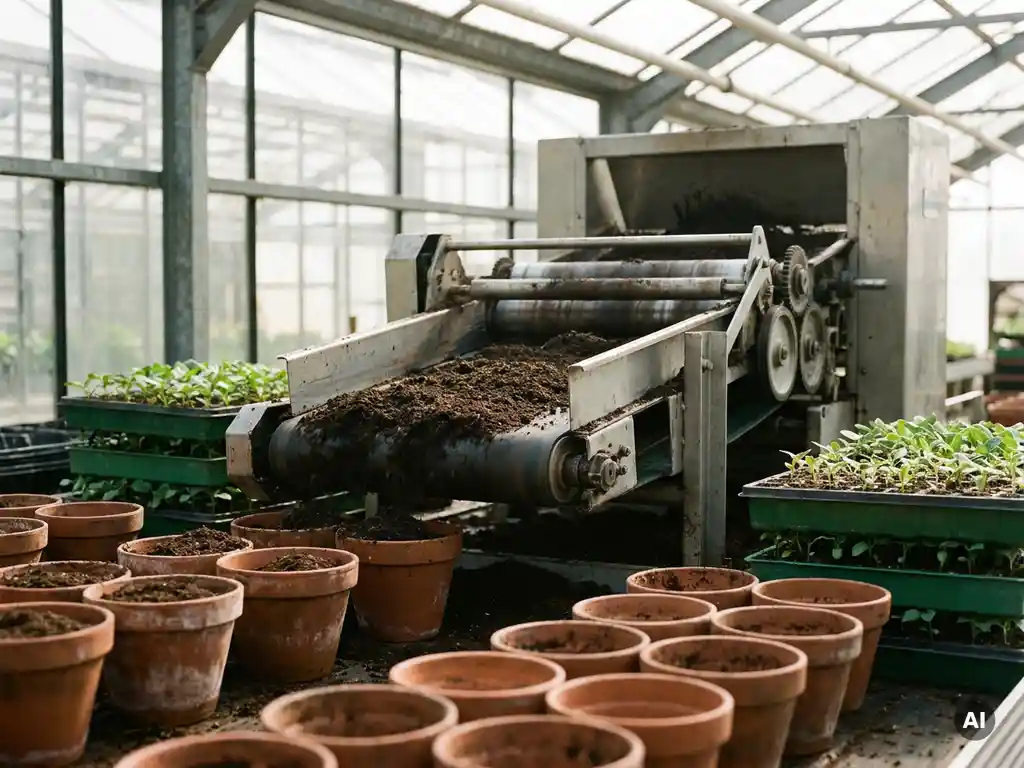
At what production volume does a topping machine become useful?
A potting machine becomes useful at around 500 to 1,000 pots per hour, the point where manual labour costs, inconsistency, and physical strain start to outweigh the investment. For most professional nurseries, that threshold arrives faster than expected. Below, we answer the most common questions growers ask before making the switch.
How many plants per hour justify a potting machine?
A potting machine is worth considering once your operation regularly exceeds 500 pots per hour. At that volume, the combined cost of labour, physical fatigue, and inconsistent results makes automation economically rational. For growers pushing 2,000 pots per hour or more, a potting machine is not a luxury, it is a production necessity.
The exact threshold depends on a few factors: how many workers you currently deploy for potting, whether you run seasonal peaks, and how much variation you can tolerate in pot density. A small ornamental nursery with steady, low-volume output may manage fine with manual work. But the moment you are scheduling extra staff just to keep up, or turning down orders because potting is the bottleneck, the economics shift decisively in favour of automation.
It is also worth thinking in annual terms rather than hourly rates. A machine running at 3,000 to 8,000 pots per hour across a full growing season represents an enormous cumulative output, output that would require multiple full-time employees to match manually, at significantly higher ongoing cost.
What are the hidden costs of manual potting at scale?
The hidden costs of manual potting at scale include repetitive strain injuries, high staff turnover, training overhead, and inconsistent pot quality that affects downstream sales. These costs rarely appear on a single invoice, but they accumulate steadily and are often underestimated when comparing manual labour against machine investment.
Physical strain is the most immediate issue. Potting is a repetitive, low-position task that puts sustained pressure on workers’ backs, wrists, and shoulders. Injury-related absenteeism and workers’ compensation costs are real operational risks, particularly during peak season when you can least afford to be short-staffed.
Then there is the consistency problem. When multiple workers pot by hand, pot density and fill level vary from person to person and shift to shift. That variation affects plant growth, presentation at the auction, and customer satisfaction. At scale, even small inconsistencies compound into meaningful quality problems.
Finally, manual potting is simply slow relative to what automation can achieve. Every hour your team spends on repetitive potting tasks is an hour not spent on higher-value work like plant care, quality control, or customer orders. The opportunity cost is real, even if it never shows up as a line item.
How does a potting machine affect output consistency?
A potting machine dramatically improves output consistency by delivering the same soil volume, fill depth, and compaction level to every pot, regardless of operator, time of day, or production speed. This mechanical precision eliminates the human variation that makes manual potting unreliable at scale.
Consistency matters most in two areas: root development and presentation. When every pot receives the same amount of substrate at the same density, plants grow under identical conditions, which means more uniform crop timing, fewer outliers, and a more predictable harvest. For growers selling through auctions or to retail chains, that uniformity directly supports pricing and buyer confidence.
Advanced machines take this further with automatic soil detection, which adjusts filling in real time to compensate for variations in substrate moisture or bulk density. This means that even when your soil mix changes between batches, the machine maintains consistent results without manual recalibration.
What’s the difference between a standard and a PRO potting machine?
The key difference between a standard potting machine and a PRO version lies in automation depth, operating comfort, and maintenance demand. A standard machine handles the core task reliably; a PRO model adds features that reduce operator intervention, improve precision, and lower long-term running costs.
Our Stolze 3030 is a robust, PLC-controlled potting machine with a touchscreen interface, suitable for pots from 7 to 30 cm and capable of up to 8,000 pots per hour. It runs single, double, or alternating configurations and handles a wide range of growing conditions.
The Stolze 3030 PRO builds on that foundation with three meaningful upgrades:
- Automatic soil detection, the machine reads each pot and adjusts fill levels in real time, ensuring consistent results even when substrate conditions vary
- Fully guided chain, delivers greater mechanical stability at high speeds, reducing wear and the risk of misalignment
- Quieter operation and lower maintenance, designed for demanding environments where downtime is costly and noise levels matter
For growers running high daily volumes or dealing with variable substrate mixes, the PRO version pays for the upgrade through reduced stoppages and more reliable output. For operations with stable conditions and moderate volumes, the standard 3030 delivers excellent performance at a lower entry point.
Should you buy or rent a potting machine for your nursery?
Buying makes sense if potting is a year-round activity central to your production process. Renting is the smarter choice if you need a machine for a defined seasonal peak, want to trial a model before committing, or are not yet certain which configuration fits your operation best.
Renting removes the upfront investment risk and lets you evaluate real-world performance in your own facility with your own substrate. If the machine delivers the output and consistency you need, you have a much clearer basis for a purchase decision. If your needs change, you are not locked into a capital asset.
Buying, on the other hand, gives you full availability, the ability to customise the machine to your specific line, and long-term cost efficiency once the investment is amortised. For established growers who already know their volume and configuration requirements, ownership is usually the better financial outcome over a three-to-five-year horizon.
The right answer depends on your production calendar, your current certainty about the right model, and your capital flexibility. Both routes are valid, and the ability to start with a rental and convert to a purchase is a practical middle path many growers take.
How does a potting machine integrate with existing transport lines?
A potting machine integrates with existing transport lines through standardised conveyor connections that allow it to feed directly into downstream processes such as topping, labelling, sorting, and dispatch. Most professional potting machines are designed with this integration in mind, making them a central node in a broader automated production line.
In practice, the potting machine sits at the start of the line. Filled pots move from the machine onto conveyor belts that carry them to the next station, whether that is a topping machine for covering substrate, a watering station, or a sorting and spacing system. The key is matching belt speeds, pot dimensions, and throughput rates so that no single station becomes a bottleneck.
Integration also means thinking about soil supply. A ground conveyor feeding substrate directly to the potting machine removes the need for manual refilling, which at high volumes becomes its own labour and interruption risk. A well-designed line handles everything from empty pot input to finished, spaced plant output with minimal manual handling in between.
How MartinStolze helps you find the right potting solution
We have been developing and producing potting machines in our own facility in De Lier since 1991. That means every machine we deliver is built, programmed, and installed by our own team, and supported by our own service engineers after the fact. Here is what that means in practice for you:
- Tailored configuration, we help you choose the right machine model, pot size range, and line setup for your specific crop and substrate
- Full line integration, our potting machines connect directly with our conveyor systems, topping machines, and sorting lines for a seamless production flow
- Training and demonstration, our demo and training facility in De Lier lets you see machines running before you commit
- Buy or rent, both options are available, including trial periods that let you test performance in your own operation
- Worldwide support, through our dealer network and international team, we serve growers from the Netherlands to Mexico
If you are weighing up whether a potting machine is the right step for your nursery, or deciding between models, we are happy to think it through with you. Get in touch with our team and we will help you find the configuration that fits your production goals.
Frequently Asked Questions
How long does it typically take to install and commission a potting machine?
Installation and commissioning of a potting machine typically takes one to two days for a standalone unit, and slightly longer when integrating into a full production line with conveyors, topping machines, or sorting systems. Most professional suppliers, including MartinStolze, handle installation with their own engineers to ensure the machine is correctly calibrated for your pot sizes and substrate before handover. Planning installation during a quieter period in your production calendar helps avoid disruption to ongoing operations.
What substrates and soil mixes can a potting machine handle?
Most professional potting machines are designed to handle a wide range of substrates, including peat-based mixes, coir, bark, perlite blends, and compost. The main variable is moisture content and bulk density, as overly wet or compacted substrate can affect fill consistency and cause blockages. PRO-level machines with automatic soil detection adjust fill levels in real time to compensate for batch-to-batch variation in substrate conditions, making them particularly well-suited for operations that switch between different mixes.
What maintenance does a potting machine require, and how much downtime should I expect?
Routine maintenance on a potting machine typically includes daily cleaning to remove substrate buildup, regular lubrication of moving parts, and periodic inspection of belts, chains, and filling components. Most modern machines are designed for quick access to wear parts to minimise downtime during servicing. PRO models with fully guided chains and reinforced components generally require less frequent intervention and are better suited to high-volume environments where unplanned stoppages carry a significant production cost.
How do I know which pot size range is right for my machine configuration?
The right pot size range depends on the crop types you grow and whether your assortment is likely to change over time. Most professional potting machines cover a broad range — the Stolze 3030, for example, handles pots from 7 to 30 cm — but the filling heads, chain spacing, and conveyor setup should be matched to your most common pot dimensions for optimal performance. If you regularly work across multiple pot sizes, it is worth discussing a configuration that allows quick changeovers to avoid production delays when switching between assortments.
Can one operator run a potting machine, or does it require a dedicated team?
A single trained operator can typically run a potting machine once it is set up and running, which is one of the key labour efficiency gains automation delivers. That said, the broader line — including pot feeding, substrate supply, and downstream handling — may require additional staff depending on how much of the process is automated end-to-end. A well-integrated line with a ground conveyor for soil supply and automated pot input can reduce the team needed to just one or two people for the entire potting operation.
What should I look for when visiting a demo or testing a potting machine before buying?
When visiting a demo facility, bring your own substrate and a representative selection of pot sizes so you can evaluate performance under your actual working conditions rather than ideal showroom settings. Pay attention to fill consistency across a run of 50 to 100 pots, how the machine handles variation in substrate moisture, and how quickly settings can be adjusted between pot sizes. Also assess noise levels, ease of cleaning, and how accessible the machine is for routine maintenance — these practical factors have a significant impact on day-to-day usability.
Is it possible to expand or upgrade a potting machine as my operation grows?
Many professional potting machines are designed with scalability in mind, allowing growers to add modules or upgrade components as production volumes increase. For example, a standard model can often be extended with additional automation features or integrated into a longer production line as your operation expands. It is worth asking your supplier upfront about upgrade paths and compatibility with downstream equipment, so your initial investment remains relevant as your nursery grows rather than requiring a full replacement further down the line.
Related Articles
- What are the benefits of using a topping machine after potting?
- How do production breaks affect your average pots per hour?
- How do you calculate how long it will take to pot 10,000 plants?
- How much spare pots-per-hour capacity should a nursery plan for?
- How do you choose between a mobile and fixed conveyor system?