
Can a conveyor belt reduce labor costs in horticulture?
Labor costs are among the biggest operational challenges facing horticulture businesses today. Whether you run a nursery, a greenhouse, or a distribution center, the hours spent manually moving plants, trays, and produce add up quickly. A conveyor belt in horticulture can fundamentally change that equation by automating the internal transport that currently consumes your workforce’s time and energy.
This article answers the most common questions growers and operations managers ask before investing in conveyor automation. Each section provides a direct, practical answer so you can make an informed decision for your business.
How does a conveyor belt reduce labor costs in horticulture?
A conveyor belt reduces labor costs in horticulture by replacing the manual movement of plants, trays, and produce along the production line. Instead of workers walking back and forth across a greenhouse or packing area, products move automatically to them. This eliminates unnecessary travel time, reduces physical strain, and allows fewer people to handle the same volume of work.
In practice, the savings come from several directions at once. Workers no longer cover kilometers per shift simply transporting goods from one station to the next. Bottlenecks and waiting times shrink because the flow of product becomes continuous and predictable. Fewer hands are needed per shift, and those who are working can focus on higher-value tasks like quality control, potting, or packing rather than carrying and walking.
There is also a longer-term cost reduction that is easy to overlook: reduced absenteeism. Manual transport in greenhouses is physically demanding, and repetitive heavy lifting contributes to musculoskeletal complaints and sick leave. An ergonomically designed conveyor system supports your team, which means fewer injury-related absences and lower turnover over time.
What types of conveyor belts are used in greenhouse operations?
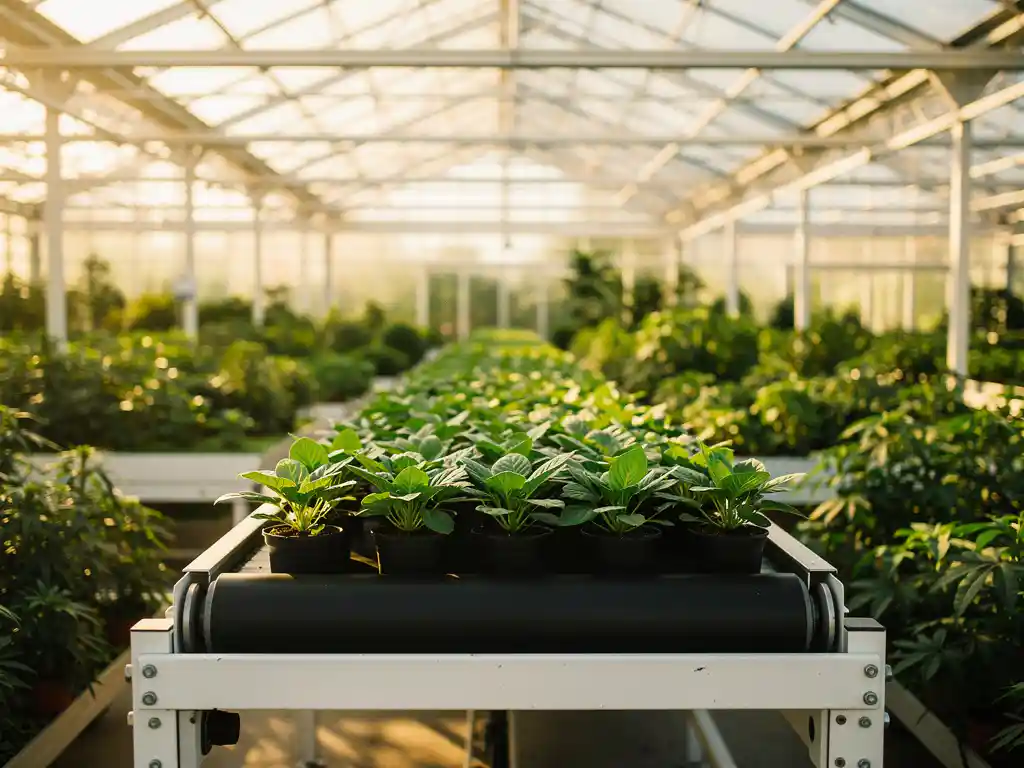
Greenhouse operations use several types of conveyor belts depending on the task. The most common are flat transport belts for moving plants or trays along a production line, buffer belts that accumulate product between workstations, roller conveyors for heavier loads, ground-level belts for soil and substrate transport, and elevator belts for moving product between different height levels.
Each type serves a specific function within the overall flow of the operation. Flat transport belts form the backbone of most production lines, connecting potting machines, sorting stations, and packing areas. Buffer belts act as a reservoir between workstations, absorbing differences in working speed and preventing bottlenecks. Roller conveyors are well suited to heavy trays or containers that need to travel longer distances with minimal friction.
Ground-level belts and elevator belts complete the picture for more complex facilities. Ground-level belts handle the movement of soil and growing substrate, while elevator belts allow products to move vertically within a building without manual lifting. We produce all of these belt types in our own facility, designed specifically for the conditions found in horticultural environments.
What’s the difference between mobile and fixed conveyor systems?
The key difference is flexibility versus permanence. Mobile conveyor systems are freestanding, repositionable units that can be moved around the greenhouse as needed. Fixed conveyor systems are installed as permanent infrastructure, integrated into the layout of a facility for continuous, high-volume transport. Mobile systems suit operations with changing layouts or seasonal workflows, while fixed systems suit high-throughput facilities with stable processes.
Mobile conveyor systems
Mobile belts are ideal for growers who need flexibility. They can be repositioned quickly, used in different areas of the greenhouse during different seasons, and scaled up or down without major investment. For smaller nurseries or businesses that are just beginning to automate, a mobile system offers a practical starting point with a lower entry cost.
Fixed conveyor systems
Fixed systems deliver consistent, high-capacity transport as part of a fully integrated production line. Once installed, they operate reliably day after day with minimal intervention. They are the right choice when your workflow is stable, your volumes are high, and you want maximum efficiency across the entire facility. Fixed systems also integrate more seamlessly with machinery like potting machines, robots, and sorting lines.
Why do standard industrial conveyors fail in horticulture environments?
Standard industrial conveyors fail in horticulture because they are not designed for the specific conditions of a greenhouse or packing facility. Persistent moisture, soil contamination, fertilizers, and the need for frequent cleaning break down components that perform perfectly well in dry factory settings. Standard belts corrode, electrical components fail, and frames weaken faster than expected when exposed to the daily reality of horticultural production.
Beyond physical durability, standard industrial suppliers rarely understand the operational logic of a greenhouse. The spacing of plants, the fragility of root systems, the height requirements of growing benches, and the workflow of a potting or packing line all create demands that a generic conveyor simply was not built to meet. The result is a system that technically moves product but creates friction everywhere it connects with the actual work being done.
This is why solutions designed from the ground up for horticulture perform so differently in practice. The materials, dimensions, surface types, and control options all reflect the real conditions of a greenhouse rather than a standard factory floor.
How can a conveyor belt integrate with other greenhouse machinery?
A conveyor belt integrates with other greenhouse machinery by serving as the connecting infrastructure between individual machines. Potting machines, transplanting robots, watering stations, weighing systems, and sorting lines all produce or receive product at specific points. A conveyor belt links these points into a single, continuous flow, eliminating the manual handoffs between stations that slow down production and introduce errors.
Integration works best when all components are designed to be compatible from the start. Conveyor height, belt width, speed control, and sensor compatibility all need to match the machinery they connect. When conveyors and machines come from a single supplier who manages the entire line, these details are resolved in the engineering phase before installation begins, rather than discovered as problems during commissioning.
Practical integration options include connecting a conveyor directly to the output of a potting machine so filled pots move automatically to a buffer or growing area, linking a transport belt to a weighing station that checks tray weight in-line, or feeding a packing line from a sorting conveyor that separates product by size or quality. Each integration point removes a manual step and increases throughput.
Should you buy or rent a conveyor belt for your nursery?
You should rent a conveyor belt if you want to test automation before committing to a full investment, if your need is seasonal or temporary, or if you are uncertain which system configuration suits your operation. You should buy if your production volumes are consistent, your workflow is established, and you are ready to integrate conveyor transport as a permanent part of your facility.
Renting is a genuinely useful option for horticulture businesses, not just a fallback. It allows you to experience the operational impact of automated transport on your specific production line before making a capital decision. You learn which belt types work best in your space, where bottlenecks actually occur, and how your team adapts to working with automated transport. That knowledge makes any subsequent purchase decision much more confident and accurate.
Buying makes the most sense when the operational case is clear. If manual transport is already costing you significant labor hours every day, a permanent system pays for itself over time through reduced wages, lower absenteeism, and higher throughput. We offer both purchase and rental options, which means you can start with a rental and transition to ownership when the timing is right for your business.
Frequently Asked Questions
How long does it typically take to install a conveyor system in an existing greenhouse?
Installation time depends on whether you are implementing a mobile or fixed system. Mobile conveyor systems can often be operational within a day or two since they require no structural modifications. Fixed systems integrated into an existing facility typically take anywhere from a few days to several weeks, depending on the complexity of the layout, the number of integration points with existing machinery, and any required electrical or structural work. The best way to get an accurate timeline is to have a supplier conduct an on-site assessment before installation begins.
What maintenance does a horticultural conveyor belt require, and how often?
A well-designed horticultural conveyor belt requires relatively straightforward maintenance: regular cleaning to remove soil, substrate, and fertilizer residue, periodic inspection of belt tension and alignment, and occasional lubrication of moving parts such as rollers and bearings. The frequency depends on usage intensity, but most operations benefit from a daily quick-clean and a more thorough weekly inspection. Choosing a conveyor built specifically for horticultural environments — with corrosion-resistant materials and easy-access components — significantly reduces the time and cost of ongoing maintenance.
How do I calculate the return on investment (ROI) for a conveyor belt in my nursery or greenhouse?
Start by quantifying your current labor costs associated with manual transport: count how many worker-hours per day are spent moving plants, trays, or substrate, and multiply that by your hourly labor rate. Then factor in indirect costs such as sick leave, injury-related absences, and staff turnover linked to physically demanding transport tasks. Compare this total against the purchase or rental cost of the conveyor system, including installation. Most horticultural businesses find that a well-matched conveyor system pays for itself within one to three growing seasons, particularly in high-volume operations.
Can a conveyor belt handle fragile or young plants without causing damage?
Yes, provided the system is designed with horticultural handling in mind. Belt surface type, speed settings, and transition points between conveyor sections all play a critical role in protecting fragile root systems, young seedlings, and delicate cuttings. Soft-surface belts, gentle inclines, and adjustable speed controls allow the system to be tuned to the sensitivity of the product being transported. This is one of the key reasons why horticulture-specific conveyor solutions outperform generic industrial alternatives — they are engineered around the fragility and variability of living plant material.
What if my greenhouse layout is irregular or has limited space — can a conveyor system still work?
Absolutely. Conveyor systems for horticulture can be configured in a wide range of lengths, widths, heights, and orientations, including curves, inclines, and elevated sections, to fit non-standard layouts. Mobile systems offer the most immediate flexibility for tight or irregular spaces, while custom-engineered fixed systems can be designed around the specific constraints of your facility. The key is to involve your supplier early in the planning process so that the conveyor layout is mapped to your actual floor plan rather than a generic template.
What is the biggest mistake growers make when investing in conveyor automation for the first time?
The most common mistake is focusing solely on the conveyor belt itself rather than thinking about the entire product flow from start to finish. A single belt that moves product faster than the surrounding workstations can handle it will create new bottlenecks rather than solve existing ones. Successful automation requires mapping the full production line first — identifying every handoff point, speed mismatch, and manual step — and then designing the conveyor system to address the flow as a whole. Starting with a rental system or a phased installation is a practical way to avoid over-investing in a configuration that does not match your actual workflow.
Is conveyor automation only worthwhile for large-scale greenhouse operations, or can smaller nurseries benefit too?
Smaller nurseries can absolutely benefit, though the right entry point looks different than it does for large facilities. For smaller operations, a single mobile conveyor belt positioned at the highest-friction point in the workflow — such as between a potting machine and a growing area — can deliver meaningful labor savings without a major capital commitment. Rental options lower the barrier further, allowing smaller businesses to experience the impact of automation before deciding whether to expand. The key question is not the size of your operation but whether manual transport is currently limiting your throughput or placing unnecessary physical demands on your team.
Related Articles
- How does automated topping improve consistency between pots?
- How do you compare manual labor productivity with machine output?
- Is renting a potting machine a smart option before buying one?
- What is the role of automation in modern horticulture?
- How do ergonomic solutions reduce sick leave in horticulture?