

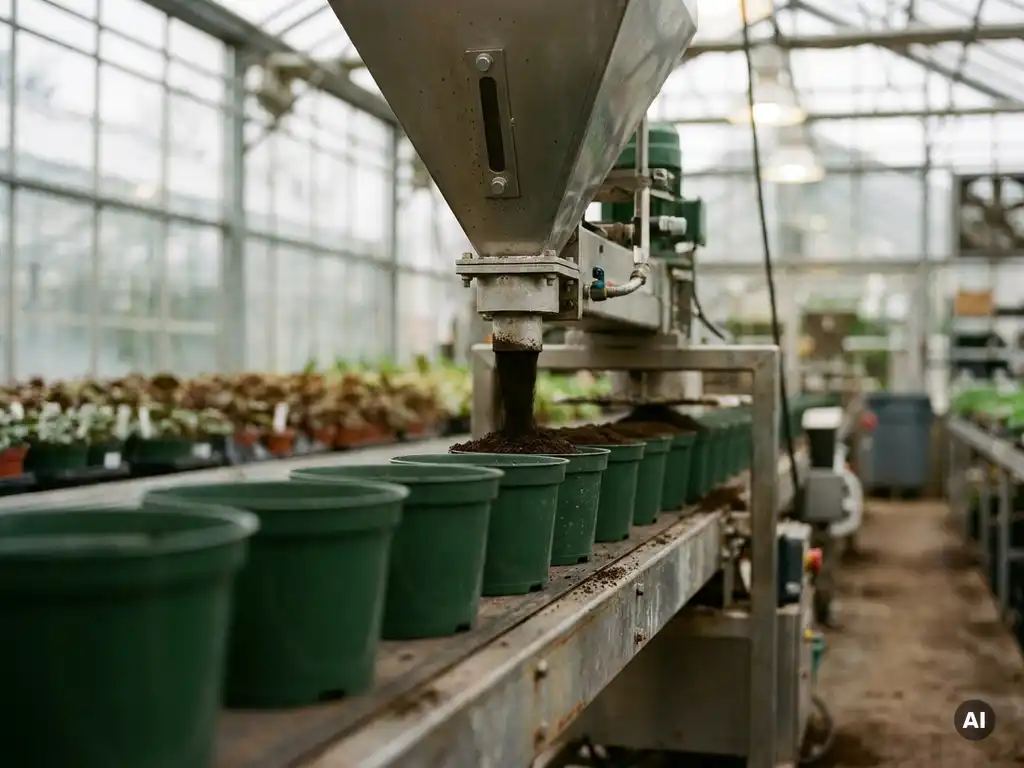
Can a topping machine apply an even layer to every pot?
Yes, a topping machine can apply an even layer of soil or substrate to every pot, provided the machine is properly calibrated for the pot size and substrate type in use. Modern topping machines use controlled dosing mechanisms that meter out a consistent volume of material regardless of pot diameter, making uniform coverage achievable at scale. The sections below unpack the key questions growers ask before investing in automated topping.
How does a topping machine distribute soil across different pot sizes?
A topping machine distributes soil by passing pots beneath a metered outlet, typically a rotating drum, belt, or auger system, that releases a controlled flow of substrate onto the surface of each pot. The discharge rate and conveyor speed are matched to the pot’s diameter and fill target, so each container receives the same volume of topping material regardless of size.
When switching between pot sizes, operators adjust the machine’s settings to account for the larger or smaller surface area. On more advanced machines, these parameters are stored as programmable presets, so changing from a 9 cm pot to a 17 cm pot takes seconds rather than a full recalibration. The conveyor speed, belt height, and substrate flow rate all work together to ensure the topping layer lands evenly across the entire pot surface rather than piling up in the centre.
Consistent distribution also depends on how the pots are presented to the machine. Pots that arrive at irregular intervals or at inconsistent heights can disrupt the dosing cycle, which is why topping machines perform best when integrated into a coordinated conveyor line rather than used as a standalone unit.
What causes uneven topping layers in automated potting?
Uneven topping layers in automated potting are most commonly caused by inconsistent substrate flow, incorrect machine settings for the pot size in use, or substrate that is too wet, too dry, or too fibrous to move freely through the dosing mechanism. Any of these factors disrupts the steady, controlled release of material that even coverage depends on.
Beyond the substrate itself, mechanical wear is a common culprit. Worn augers, clogged outlets, or a belt that has stretched over time all affect how reliably material is metered out. On older or lower-specification machines, there is also the issue of vibration and chain instability: if the conveyor shakes or the pot positioning is inconsistent, the topping layer shifts before it settles.
Operator error plays a role too. If the machine’s speed settings are not adjusted when switching to a larger pot, the outlet deposits the same volume over a longer dwell time, creating a thicker patch at the leading edge and a thinner one at the trailing edge. This is precisely why programmable presets matter: they remove the reliance on manual adjustment every time a pot size changes.
How do high-capacity topping machines maintain consistency at speed?
High-capacity topping machines maintain consistency at speed by combining precise mechanical dosing with sensor-based feedback that detects each pot as it arrives and triggers the correct release cycle. At throughputs of several thousand pots per hour, this timing has to be accurate to fractions of a second, which is why electronic controls have largely replaced purely mechanical systems on professional-grade machines.
Substrate flow is kept steady by using a continuous, driven feed mechanism rather than gravity alone. A driven belt or auger ensures the material moves at a controlled rate even when the hopper level drops, preventing the uneven flow that gravity-fed systems produce as they empty. Machines designed for high-volume production also tend to use wider outlets and broader conveyor belts to reduce the risk of bridging or blockages under sustained load.
Stability of the pot carrier is equally important at high speed. A fully guided chain or conveyor system holds each pot firmly in position as it passes under the topping outlet, preventing the lateral movement that causes off-centre deposits. This is one of the meaningful differences between entry-level and professional topping systems: at low speeds, minor instability is forgiving; at 6,000 to 8,000 pots per hour, it becomes a direct quality problem.
What’s the difference between manual topping and machine topping quality?
The core difference between manual and machine topping is consistency. A skilled worker can apply a good topping layer, but the depth, density, and coverage will vary between individuals, across a long shift, and during high-pressure seasonal peaks. A topping machine applies the same programmed volume to every pot throughout the entire production run, regardless of how many hours it has been running.
Manual topping also introduces ergonomic strain. Repeatedly scooping and spreading substrate across hundreds or thousands of pots per day is physically demanding work that leads to fatigue, and fatigue directly affects quality. As the shift progresses, coverage becomes less precise, pot-to-pot variation increases, and the risk of pots leaving the line with insufficient or uneven topping rises.
From a commercial standpoint, inconsistent topping affects plant development. Substrate depth influences moisture retention and root establishment, so pots that leave the greenhouse with varying topping depths can produce uneven crop results. For growers supplying auction markets or retail chains where presentation and uniformity matter, machine topping removes a significant source of product variability.
Can a topping machine handle different soil and substrate mixes?
Yes, most professional topping machines can handle a range of substrate mixes, but performance varies depending on the machine’s design and the physical properties of the substrate. Fine, free-flowing potting soil moves through dosing systems easily. Coarser mixes with bark, perlite, or long-fibre coir require a more robust feed mechanism to prevent bridging, blockages, or irregular flow.
Moisture content is one of the most important variables. Substrate that is too wet tends to clump and stick to the outlet, disrupting the metered flow. Very dry substrate can become dusty and flow too freely, making precise dosing harder to control. Most topping machines work best with substrate at the moisture level that would be considered ready for potting, neither freshly watered nor bone dry.
When evaluating a topping machine for a specific substrate, it is worth testing the machine with your actual mix before committing to a configuration. Machines that have been designed and tested across a wide range of growing media will give you a clearer indication of where the limits are. This is one of the reasons growers value suppliers who offer trial periods or rental options: it allows real-world testing before a capital purchase is made.
Should you buy or rent a topping machine for seasonal peaks?
For seasonal peaks, renting a topping machine is often the more practical starting point, especially for growers who have not used automated topping before or who need capacity for only a defined period each year. Renting removes the upfront capital commitment, allows you to validate the machine’s fit with your substrate and pot sizes, and avoids the cost of ownership during quieter months.
That said, buying makes more economic sense for growers who run topping operations for a significant portion of the year. The cumulative rental cost over multiple seasons typically exceeds the purchase price, and owning the machine means it is always available, fully familiar to your team, and configured exactly to your production line.
A useful middle path for growers who are uncertain is to rent first with the option to purchase. This approach lets you assess real-world output, substrate compatibility, and integration with your existing conveyor line before making a long-term investment. It also gives your team time to build confidence with the machine, reducing the learning curve if you do decide to buy.
How MartinStolze supports consistent, automated topping
We develop and produce our topping machines entirely in-house at our facility in De Lier, which means every component, from the dosing mechanism to the conveyor integration, is engineered to work as part of a complete potting line. Our topping machines are designed to pair directly with our conveyor systems, ensuring stable pot positioning and consistent throughput from the first pot to the last.
- Programmable presets for different pot sizes and substrate types, reducing changeover time
- Robust feed mechanisms suited to a wide range of growing media, including coarser bark and coir blends
- Integration with the Stolze 3030 and Stolze 3030 PRO potting machines for a fully coordinated production line
- Both purchase and rental options available, including trial periods for growers evaluating automated topping for the first time
- Installation, training, and aftercare carried out by our own technicians
If you are weighing up whether automated topping is the right step for your operation in 2026, we are happy to talk through your specific substrate, pot range, and volume requirements. Get in touch with our team to discuss the configuration that fits your production line.
Frequently Asked Questions
How do I know if my substrate is compatible with a topping machine before buying one?
The most reliable way is to request a live trial or rental period with the machine using your actual substrate mix. Pay particular attention to moisture content and fibre length, as these are the two factors most likely to cause bridging or inconsistent flow. Reputable suppliers will be able to advise based on experience with similar mixes and, ideally, demonstrate performance before you commit to a purchase.
What throughput speed should I aim for when sizing a topping machine for my operation?
Start by calculating your peak daily pot volume and working hours, then add a buffer of at least 15–20% to account for changeovers, brief stoppages, and substrate refills. A machine running comfortably below its maximum rated speed will deliver more consistent results than one operating at its limit. It is also worth considering whether your existing conveyor line can keep pace with the topping machine's capacity, as a mismatch here is a common bottleneck.
Can a topping machine be integrated into an existing potting line, or does it require a completely new setup?
In most cases, a topping machine can be integrated into an existing conveyor line, provided the conveyor speed, pot spacing, and height are compatible with the machine's requirements. The key is ensuring stable, consistent pot positioning as pots enter the topping unit. Speak to your supplier about the interface points early in the process, as minor adjustments to conveyor height or spacing are far easier to plan in advance than to retrofit after installation.
How much maintenance does a topping machine typically require, and what should I check regularly?
Routine maintenance on a topping machine centres on the dosing mechanism and conveyor components. Augers, belts, and outlet points should be inspected regularly for wear, substrate build-up, and alignment, particularly after running coarser or wetter mixes. Most issues that cause uneven topping, such as clogged outlets or a stretched belt, are preventable with consistent cleaning and scheduled checks rather than reactive repairs.
What is the typical learning curve for operators new to automated topping equipment?
For operators already familiar with potting line equipment, the learning curve is generally short, often a matter of days for core operation and a few weeks to become confident with settings adjustments and troubleshooting. The steepest part of the curve is usually understanding how substrate properties affect machine behaviour rather than the machine controls themselves. Supplier-provided training at installation makes a significant difference and is worth confirming is included before purchasing.
Is it worth investing in a topping machine if I only grow a limited number of pot sizes?
Yes, and in some ways a limited pot range makes automated topping even more straightforward, since the machine can be configured once and run with minimal changeover. The return on investment is driven more by your total annual pot volume and the consistency requirements of your end market than by the number of sizes you run. Even growers working with just two or three pot formats can see meaningful gains in throughput and crop uniformity compared to manual topping.
What should I ask a supplier when comparing topping machines from different manufacturers?
Focus your questions on four areas: substrate compatibility with your specific mix, integration with your existing conveyor setup, the availability of local technical support and spare parts, and what the changeover process looks like when switching between pot sizes. Ask for references from growers running similar volumes and substrates, and wherever possible, visit a working installation or arrange a trial before making a final decision.
Related Articles
- How much production time can an automatic topping machine save?
- How do you choose a topping machine for a high-volume nursery?
- Where should a topping machine be positioned in a production line?
- How do you avoid costly downtime during your busiest growing weeks?
- How do you reduce physical strain on greenhouse workers?