

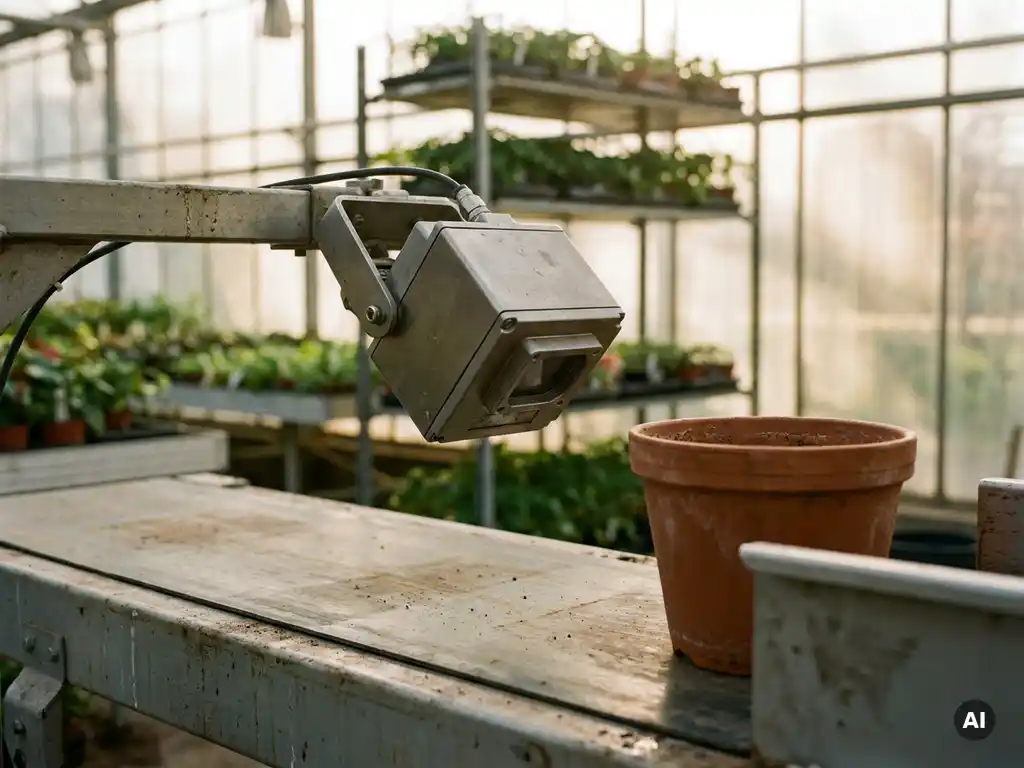
Can a topping machine automatically detect whether a pot is present?
Yes, a potting machine can automatically detect whether a pot is present before dispensing soil. This feature, known as automatic pot detection, uses sensors to confirm a pot is correctly positioned in the filling station before the soil filling cycle begins. Not every potting machine includes this capability as standard, but it is available on more advanced models.
For professional growers working at high volumes, pot detection is more than a convenience; it directly affects soil waste, output consistency, and the reliability of your potting line. The sections below cover how the technology works, what goes wrong without it, and which machines offer it.
How does automatic pot detection work on a potting machine?
Automatic pot detection uses a sensor, typically a proximity or optical sensor, positioned at the filling station of the potting machine. When a pot moves into position on the conveyor, the sensor registers its presence and signals the machine to release soil. If no pot is detected, the filling cycle is skipped entirely for that position.
The detection process happens in real time and is integrated with the machine’s control system. On more advanced machines, this logic is managed through a PLC (Programmable Logic Controller), which coordinates the sensor signal with the soil dosing mechanism and conveyor speed. This means the machine is not simply running on a fixed timer; it responds to what is actually in front of it.
The practical result is a machine that only fills when there is something to fill. This sounds simple, but it requires precise timing, especially at high throughput rates where pots are moving quickly and the window for detection is narrow.
What happens when a potting machine fills without a pot present?
When a potting machine releases soil without a pot in position, the soil falls directly onto the conveyor belt or the floor beneath the filling station. This leads to immediate soil waste, but the consequences go further than that. Accumulated loose soil on the conveyor can interfere with pot positioning for subsequent cycles, increasing the risk of misaligned fills.
Without pot detection, operators must either slow the machine down to reduce the risk of missed fills or accept a level of waste and occasional inconsistency as part of the process. Neither option is ideal when you are working against a deadline, such as preparing stock for auction.
Over a full working day, the volume of wasted soil from missed fills adds up noticeably. Beyond the material cost, cleaning loose soil from conveyor components takes time and can accelerate wear on moving parts. In short, running without pot detection increases both operational cost and maintenance frequency.
Which potting machines have built-in pot detection?
Automatic pot detection is a feature found on higher-specification potting machines rather than entry-level models. Among our machines, the Stolze 3030 PRO is equipped with automatic soil detection as a standard feature. This ensures that soil is only dispensed when a pot is correctly positioned, delivering a consistent and accurate fill every cycle.
The Stolze 3030 PRO also combines pot detection with a fully guided chain for improved stability, a touchscreen interface for programming different pot sizes and fill depths, and quieter operation with reduced maintenance requirements. These features work together to support reliable output at capacities of up to 8,000 pots per hour.
The standard Stolze 3030 is a robust and capable machine for professional growers, but it does not include automatic pot detection as a built-in feature. For growers who work with high volumes, variable pot flow, or mixes that require precise dosing, the PRO version is the more appropriate choice.
Does automatic pot detection affect potting speed?
Automatic pot detection does not reduce potting speed. In practice, it often supports higher effective throughput because the machine skips empty positions cleanly rather than dispensing soil that then needs to be cleaned up or that disrupts subsequent pots on the line.
The sensor and control system operate fast enough to keep pace with high-speed conveyor movement. At up to 8,000 pots per hour, the detection cycle must complete within milliseconds, and modern PLC-based systems handle this without creating a bottleneck.
What pot detection does change is the quality of output at speed. Without it, pushing a machine faster increases the likelihood of missed fills or soil waste. With it, you can run at full capacity with confidence that each pot receives the correct amount of soil. Speed and consistency are no longer in tension with each other.
Can pot detection be added to an existing potting machine?
Whether pot detection can be retrofitted to an existing potting machine depends on the machine’s control architecture. Machines with a PLC-based control system may be able to accommodate sensor integration, but this requires engineering assessment of the existing wiring, sensor compatibility, and software logic. It is not a universal plug-and-play upgrade.
For older machines or models without a programmable control system, retrofitting pot detection is often technically complex and may not be cost-effective compared to upgrading to a machine that includes it as standard. The sensor alone is not the limiting factor; it is the integration with the dosing mechanism and conveyor control that determines whether the upgrade is viable.
If you are running an older potting machine and considering whether to upgrade or retrofit, it is worth evaluating the total cost of continued operation alongside the investment in a newer model. Factors such as soil waste, downtime, maintenance frequency, and output consistency all contribute to that calculation.
How the Stolze 3030 PRO helps with automatic pot detection
The Stolze 3030 PRO is our answer for growers who need reliable, high-volume potting without the waste and inconsistency that comes from running without pot detection. Here is what the machine brings to your potting line:
- Automatic soil detection as standard, ensuring soil is only dispensed when a pot is present
- PLC control with touchscreen for easy programming of pot sizes, fill depths, soil feed, and rotation speeds
- Fully guided chain for greater stability and consistent pot positioning at high speeds
- Quieter operation and lower maintenance compared to standard models
- Capacity up to 8,000 pots per hour, suitable for the most demanding production environments
- Seamless integration with conveyor systems and complete potting lines
Both purchase and rental options are available, including a trial period so you can evaluate the machine in your own production environment before committing. Want to find out whether the Stolze 3030 PRO is the right fit for your operation? Get in touch with us and we will help you find the configuration that matches your crop, your soil mix, and your throughput requirements.
Frequently Asked Questions
What types of sensors are most reliable for pot detection on a potting machine?
Proximity sensors and optical (photoelectric) sensors are the most commonly used types for pot detection. Optical sensors tend to perform well across a wide range of pot colours and materials, while proximity sensors are valued for their durability in dusty or moist greenhouse environments. The best choice depends on your specific production conditions, and a machine manufacturer can advise which sensor type is integrated into their system and why.
Can automatic pot detection handle irregularly spaced pots or gaps in the conveyor flow?
Yes, this is precisely where pot detection adds the most value. When pots are fed manually or arrive from a de-stacker with occasional gaps, a machine with pot detection simply skips the empty positions without interrupting the cycle. Without this feature, irregular spacing would either require the operator to slow the line or result in soil being dispensed into empty positions, causing waste and potential conveyor buildup.
How do I know if my current potting setup is losing significant soil from missed fills?
A straightforward way to assess this is to monitor soil accumulation on your conveyor belt and floor around the filling station over a single shift. If you are regularly cleaning loose soil from the conveyor or notice inconsistent fill levels in finished pots, missed fills are likely occurring. Tracking your soil consumption against your pot output over a week can also reveal discrepancies that point to waste from undetected empty positions.
Is the Stolze 3030 PRO suitable for all pot sizes, or are there limitations?
The Stolze 3030 PRO is designed to handle a range of pot sizes, and the PLC touchscreen interface allows operators to programme different pot dimensions, fill depths, and soil feed settings for each product run. Switching between pot sizes is managed through the control system rather than manual mechanical adjustment, which reduces changeover time. For very small or unusually shaped containers, it is worth discussing your specific requirements with us directly to confirm compatibility.
What is the typical maintenance routine for the pot detection sensor on a potting machine?
Pot detection sensors generally require minimal maintenance, but regular cleaning is important in a potting environment where dust, soil particles, and moisture can accumulate on sensor lenses or housings. A brief inspection and wipe-down at the start or end of each shift is usually sufficient to keep the sensor functioning accurately. It is also good practice to periodically verify sensor alignment, particularly after moving or servicing the machine, as even slight displacement can affect detection reliability at high conveyor speeds.
Can the Stolze 3030 PRO be integrated into an existing potting line, or does it require a completely new setup?
The Stolze 3030 PRO is built for integration with conveyor systems and complete potting lines, meaning it can in many cases be incorporated into an existing production layout rather than requiring a full rebuild. The key factors are conveyor height compatibility, line speed synchronisation, and available space around the filling station. Our team can assess your current setup and advise on what, if any, modifications would be needed to connect the machine effectively.
Is renting the Stolze 3030 PRO a practical option for seasonal growers with peak demand periods?
Rental is a well-suited option for growers whose potting volumes are concentrated in specific seasons, such as spring bedding plant production or pre-auction preparation. Rather than committing to a full purchase for equipment that may sit idle for months, rental allows you to bring in a high-specification machine precisely when throughput demands justify it. The trial period option also means you can evaluate actual performance in your own environment before deciding whether ownership makes long-term sense for your operation.
Related Articles
- How do sensors help control an automatic topping machine?
- Where should a topping machine be positioned in a production line?
- How much spare pots-per-hour capacity should a nursery plan for?
- How can you increase average pots per hour without replacing your potting machine?
- What causes bottlenecks in greenhouse production lines?