
Can a topping machine be added to an existing potting line?
Yes, a topping machine can be added to an existing potting line in most cases. Whether your line is fully automated or partially manual, a topping machine can be integrated as a standalone unit that fits between your potting machine and the outfeed conveyor. The key factor is whether your current conveyor system can accommodate the machine’s footprint and pot flow. The sections below walk through everything you need to consider before making that decision.
What does a topping machine actually do in a potting line?
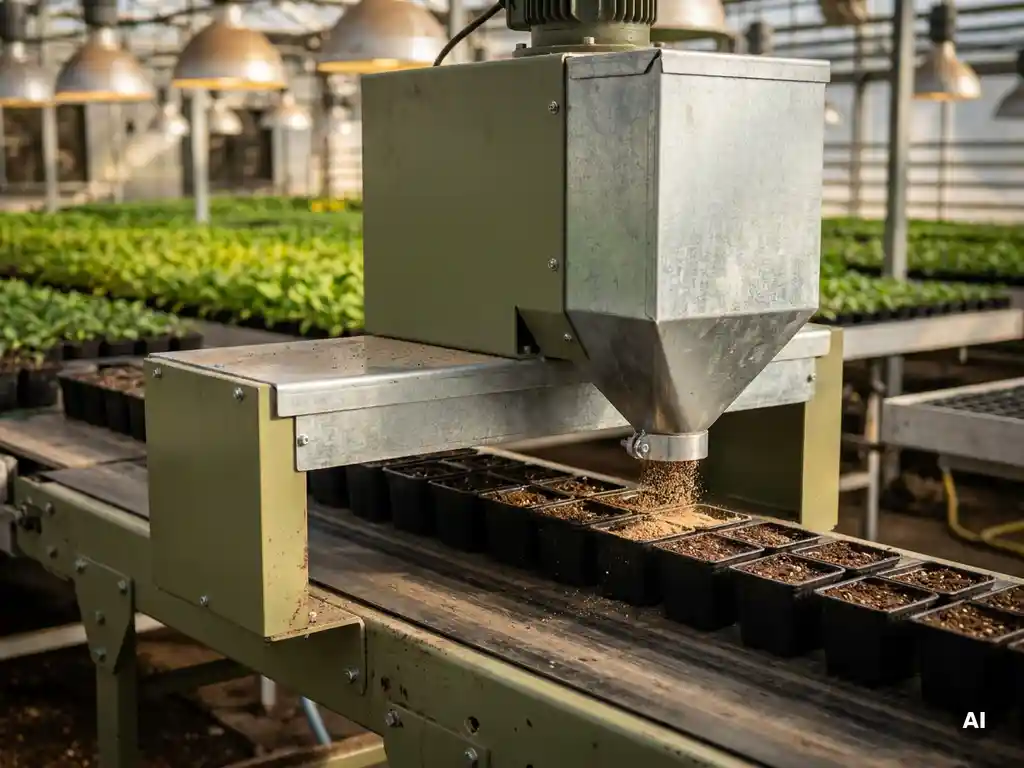
A topping machine adds a layer of covering soil or substrate on top of a freshly filled pot after the main potting process. In a potting line, it sits downstream from the potting machine and applies a precise, consistent top layer before pots move on to the next stage. This finishing step improves moisture retention, gives pots a uniform appearance, and reduces the need for manual correction.
In practical terms, the topping machine doses a controlled amount of material onto each pot as it passes along the conveyor. The volume and distribution can typically be adjusted to suit different pot sizes and substrate types. For growers producing ornamental plants or potted crops at high volume, this consistency is not just cosmetic. It directly affects how evenly plants develop and how professional the end product looks when it reaches the auction or retail buyer.
Topping machines are particularly common in operations where a specific top layer material differs from the main growing substrate. Bark, perlite, and decorative gravel are common examples. Without automation, applying these materials evenly across thousands of pots per hour is simply not feasible with manual labour.
What types of potting lines can a topping machine be added to?
A topping machine can be added to both fully automated and semi-automated potting lines, as well as to lines where pots are transported manually between stations. The main requirement is that pots pass the machine at a consistent height and spacing. As long as those conditions can be met, the type of potting machine or conveyor brand you already use is rarely a barrier.
Fully automated lines with a continuous conveyor flow are the most straightforward to extend. The topping machine slots into the line at the appropriate point, and pot flow continues uninterrupted. Semi-automated lines, where operators place pots onto a belt manually, can also accommodate a topping machine, though throughput must be realistic. Running a topping machine at 8,000 pots per hour only makes sense if the upstream potting process can match that output.
Lines that use roller conveyors, flat belt conveyors, or chain conveyors are all compatible with standard topping machine configurations. If your existing line uses a non-standard pot carrier or tray system, that is worth discussing with a technical specialist before purchasing, since pot stability during the topping process is essential for consistent results.
How does a topping machine connect to an existing conveyor system?
A topping machine connects to an existing conveyor system by aligning its infeed and outfeed with the belt or roller sections on either side of it. In most installations, the machine is placed directly in line with the existing conveyor, and short bridging sections are used to close any gaps. The machine’s working height must match the conveyor height, which is usually adjustable within a standard range.
Electrically, the topping machine typically operates independently with its own control panel, but it can also be linked to the line’s central PLC so that it starts and stops in sync with the rest of the system. This integration avoids situations where pots pile up at the topping station because the machine is running while the upstream potting machine has paused.
The substrate hopper sits above the machine and feeds material down by gravity or auger. For heavier or coarser materials, an auger-fed system provides more consistent dosing. The hopper capacity determines how often it needs to be refilled, which is a practical consideration for uninterrupted high-volume runs. Connecting the hopper to an automated soil supply system is possible on larger lines and eliminates manual refilling entirely.
For growers already working with conveyor systems, the integration process is generally straightforward since standard belt widths and working heights are designed to be compatible across modular potting line components.
What can go wrong when adding a topping machine mid-line?
The most common problems when adding a topping machine to an existing line are height mismatches, pot instability during topping, and flow rate imbalances. If the topping machine’s working surface does not align precisely with the incoming conveyor, pots can tip or jam at the transition point. Even a small height difference of a few millimetres can cause consistent disruption at high throughput speeds.
Flow rate imbalance is a subtler but equally disruptive issue. If the topping machine doses more slowly than the upstream potting machine produces, a backlog builds quickly. Conversely, if pots arrive irregularly, the dosing mechanism may apply too much or too little material per pot. Getting the line speeds calibrated correctly before full production is essential.
Substrate type can also cause unexpected problems. Wet, sticky, or very fine materials can clog dosing mechanisms that were designed for dry, free-flowing substrates. If your topping material is unusual in texture or moisture content, this should be tested before committing to a configuration. A machine that performs well with dry bark may struggle with wet coco coir unless it is specifically set up for it.
Finally, adding a machine mid-line increases the total footprint of your operation. Growers sometimes underestimate the space required for the hopper, any soil return systems, and safe operator access around the machine. Measuring the available space carefully before installation avoids costly rearrangements later.
Should you buy or rent a topping machine for an existing line?
Whether to buy or rent a topping machine for an existing line depends on how central topping is to your year-round production process. If you top pots across multiple product lines throughout the season, buying is almost always the better long-term investment. If you only need topping capacity during a specific seasonal peak, renting gives you the output without the capital commitment.
Renting is also a sensible first step if you have never run a topping machine before and want to validate that it genuinely improves your line’s output and product quality before purchasing. A trial period removes the risk of discovering that the machine does not suit your substrate or pot range after the purchase is finalised.
For growers already running a potting machine from a single supplier, adding a topping machine from the same source simplifies integration, maintenance, and technical support. Machines designed to work together share compatible working heights, control logic, and service intervals, which reduces the operational overhead of managing multiple vendor relationships.
How MartinStolze helps you integrate a topping machine
We design and build our topping machines to work seamlessly within complete potting line configurations, including lines that were not originally built around our equipment. Here is what we offer for growers looking to add topping capacity to an existing setup:
- Technical assessment: We review your existing line layout, conveyor heights, and pot flow to identify the right integration approach before any equipment is ordered.
- Compatible conveyor components: Our topping machines are designed to connect directly with standard conveyor systems, and we supply bridging sections where needed.
- Flexible substrate handling: Our machines handle a wide range of topping materials, from dry bark to heavier decorative substrates, with dosing systems matched to your material type.
- Buy or rent options: Both purchase and rental are available, including trial periods for growers who want to test the machine in their own production environment before committing.
- Installation and training: Our own technicians handle installation and provide hands-on training at our facility in De Lier or on-site at your location.
If you are considering adding a topping machine to your existing potting line, get in touch with us and we will help you find the right configuration for your operation.
Frequently Asked Questions
How much space do I need to add a topping machine to my existing potting line?
The space required depends on the specific model, but you should account for the machine body itself, the hopper above it, any soil return or collection systems beneath it, and safe operator access on all sides. In practical terms, most topping machines add between 1 and 2 metres to the total length of your line. Before installation, measure not just the floor footprint but also the overhead clearance, since hoppers can add significant height to the overall setup.
Can a topping machine handle multiple different topping materials without reconfiguring the whole machine?
Many topping machines can handle a range of materials, but switching between very different substrates — such as dry bark and wet coco coir — may require adjusting the dosing mechanism or cleaning out the hopper between runs. Machines with auger-fed dosing systems tend to be more adaptable to varied materials than gravity-fed models. If you regularly switch between multiple topping materials, it is worth discussing this with your supplier upfront so the dosing system is configured to handle your full range from day one.
What throughput speeds are realistic when running a topping machine on a semi-automated line?
Throughput on a semi-automated line is ultimately limited by the slowest step in your process, which is typically the manual potting or pot-placement stage. A topping machine rated for 8,000 pots per hour will only deliver that output if the upstream process can match it. For most semi-automated operations, realistic throughput sits between 1,500 and 4,000 pots per hour, and calibrating your line speed expectations to that reality before installation will save you frustration during commissioning.
Do I need to upgrade my existing conveyor to support a topping machine, or will my current setup work as-is?
In many cases, your existing conveyor will work without modification, provided the working height falls within the topping machine’s adjustable range and the belt width is compatible. The most common upgrades needed are short bridging sections to close gaps at the infeed and outfeed transition points. If your conveyor uses a non-standard pot carrier or tray system, that is the scenario most likely to require additional engineering, so it is worth getting a technical assessment before purchasing.
How do I know if the topping machine is applying a consistent dose to every pot?
Most topping machines allow you to verify dosing consistency by weighing a sample of topped pots and comparing the added substrate weight across the batch. Visual inspection of the top layer distribution is a quick first check, but weight-based sampling gives you a more reliable baseline during initial calibration. If you notice inconsistency, the most common causes are irregular pot spacing on the conveyor, a partially blocked dosing mechanism, or a mismatch between conveyor speed and dosing rate — all of which can be corrected through adjustment rather than replacement.
What maintenance does a topping machine require, and how does that affect production planning?
Routine maintenance for a topping machine typically includes cleaning the hopper and dosing mechanism at the end of each production run, inspecting the auger or dosing wheel for wear, and periodically checking belt or roller alignment at the infeed and outfeed. The frequency of deeper maintenance depends on how abrasive your topping material is — coarser substrates like gravel or bark cause more wear than fine, soft materials. Building a short daily cleaning window into your production schedule is the most effective way to prevent substrate buildup from causing dosing inconsistencies or unplanned downtime.
Is it possible to automate hopper refilling so the topping machine can run uninterrupted during high-volume production?
Yes, connecting the topping machine’s hopper to an automated soil or substrate supply system is a practical option for high-volume operations where manual refilling would create bottlenecks. This typically involves a conveyor or pneumatic feed line that keeps the hopper topped up throughout the production run. It is worth planning this during the integration phase rather than retrofitting it later, as the supply line routing and hopper inlet position are much easier to configure before the machine is installed in the line.