

Can a topping machine keep up with a high-speed potting machine?
Yes, a topping machine can keep up with a high-speed potting machine, but only when both are properly matched in capacity. A well-configured topping machine running at the same output rate as your potting machine ensures a smooth, uninterrupted line. When there is a mismatch, bottlenecks form quickly and your entire potting operation slows down. The sections below unpack exactly how that matching works and what to do when it does not.
What does a topping machine actually do in a potting line?
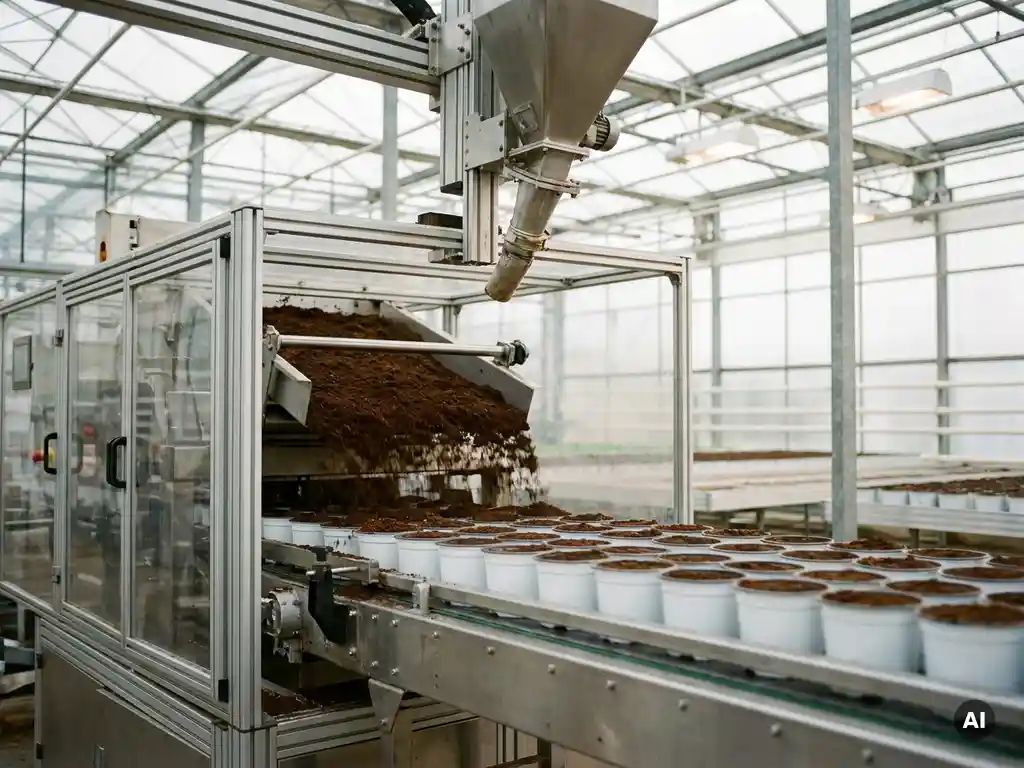
A topping machine adds a layer of cover material, typically a different substrate, bark, or decorative gravel, on top of a freshly filled pot. In a potting line, it sits downstream from the potting machine and works on pots as they move along the conveyor. Its job is to complete the pot presentation before it reaches sorting, labelling, or dispatch.
Beyond aesthetics, topping serves practical functions. A cover layer suppresses weeds, reduces moisture evaporation, and gives the end product a cleaner, more retail-ready appearance. In professional sierteelt and pot plant operations, a consistent top layer is part of the product standard, not an optional extra. That means the topping machine must run reliably and at the right speed every single shift.
How fast can a topping machine run compared to a potting machine?
Modern topping machines are designed to match the output of high-capacity potting machines, which can run at up to 8,000 pots per hour in professional configurations. In practice, the maximum speed of a topping machine depends on the pot size, the topping material, and how evenly that material flows. Most commercial toppers are rated to handle volumes in the same range as mid-to-high-capacity potters.
The key variable is material behaviour. Fine substrates flow predictably and allow higher speeds, while coarser materials like bark chips can bridge or clump, reducing throughput. If your topping material is inconsistent in texture or moisture content, the machine will not reach its rated speed reliably. Choosing a topping machine with adjustable dosing and a robust feeding mechanism gives you the flexibility to handle different materials without sacrificing pace.
What happens when a topper can’t match potting machine speed?
When a topping machine runs slower than the potting machine feeding it, pots begin to queue up on the conveyor. If there is no buffer in the line, the potting machine must slow down or stop entirely to prevent pots from piling up or falling. This directly cuts your effective output and turns a high-speed investment into a constrained one.
Beyond lost output, the mismatch creates pressure on operators. Someone has to manage the backup, redirect pots, or manually remove them from the line. During peak season, when every hour counts, this kind of disruption is costly. Inconsistent topping also becomes more likely when the machine is pushed beyond its comfortable operating speed, leading to uneven cover layers and rejected pots at quality control.
How do you match topping machine capacity to your potting output?
Start with your potting machine’s actual working speed, not its theoretical maximum. Most operations run at 70 to 85 percent of rated capacity due to changeovers, material refills, and minor interruptions. Your topping machine should comfortably handle that real-world number, not just the peak figure on the spec sheet.
Then factor in your pot sizes and topping material. Larger pots need more topping material per cycle, which reduces throughput if the dosing system cannot keep up. Run a realistic trial with your actual substrate before committing to a configuration. If your line runs multiple pot sizes across the week, look for a topping machine with programmable dosing settings so you can switch quickly without recalibrating from scratch each time. A well-matched conveyor system between the two machines also plays a role, giving you the buffer space to absorb small speed variations without creating a jam.
Can one integrated line handle both potting and topping automatically?
Yes, a fully integrated potting line can handle both potting and topping automatically without manual intervention between the two steps. When the potting machine, conveyor, and topping machine are configured as a single system, pots move seamlessly from filling to topping to output. The result is a consistent, high-throughput line that requires fewer operators and produces a uniform end product.
Integration also means the machines can communicate. If the potting machine slows for a refill, the conveyor and topper adjust accordingly rather than running dry or overloading. This kind of line-level coordination reduces waste, prevents jams, and makes the whole operation easier to manage. For growers running high volumes during seasonal peaks, an integrated approach is far more reliable than running two separate machines with a manual handoff in between.
When should you rent instead of buy a topping machine?
Renting a topping machine makes sense when your topping volume is seasonal, when you are trialling a new line configuration, or when you want to test a specific machine before committing to a purchase. It is also a practical option if you are scaling up temporarily for a large order and do not want to carry the capital cost of a machine that will sit idle for months.
Renting lets you match machine capacity to actual demand without overinvesting. If you find that topping adds consistent value to your product and the machine runs at full capacity through most of the year, that is a clear signal that buying is the better long-term decision. Starting with a rental period removes the guesswork and gives you real operational data before you commit.
How MartinStolze helps you build a complete potting and topping line
We design and produce potting lines that bring potting machines, conveyors, and topping machines together as a single, coordinated system. Every component is built and tested in our own facility in De Lier, which means we control the quality and compatibility of the entire line, not just individual machines.
- Our Stolze 3030 and Stolze 3030 PRO potting machines run at up to 8,000 pots per hour and are designed to integrate directly with topping machines and sorting lines
- We match topping machine capacity to your actual potting output, taking pot size, substrate, and working speed into account
- Our conveyor systems create the buffer space needed to keep the line running smoothly even when one stage briefly slows
- Both buying and renting are available, including a trial period, so you can validate the configuration before making a long-term commitment
- Our own technicians handle installation, training, and ongoing support
Whether you are building a new line from scratch or upgrading an existing setup, we are happy to think through the right configuration with you. Get in touch with our team and we will help you find a solution that fits your volume, your substrate, and your season.
Frequently Asked Questions
What maintenance does a topping machine need to keep up with a high-speed potting line?
Regular cleaning of the dosing mechanism and feeding system is essential, especially when working with moist or fibrous materials like bark that can compact and clog. Check and calibrate the dosing settings at the start of each shift, and inspect conveyor belts and sensors weekly for wear. A well-maintained topping machine will consistently hit its rated speed, while a neglected one will gradually fall behind the potting machine and create bottlenecks during your busiest periods.
Can a topping machine handle multiple types of topping material, or do I need a separate machine for each substrate?
Most commercial topping machines can handle a range of materials, but performance varies depending on the particle size, density, and moisture content of each substrate. Machines with adjustable dosing systems and interchangeable feeding components give you the most flexibility across materials like fine substrate, bark chips, or decorative gravel. If you regularly switch between very different materials, look for a model with programmable presets so you can change over quickly without losing production time.
How much space do I need in my greenhouse or nursery to add a topping machine to an existing potting line?
The footprint depends on the size of the topping machine itself, the hopper or bulk storage feeding it, and the buffer conveyor between the potting machine and the topper. As a practical starting point, plan for at least one to two metres of additional conveyor length between the potting machine and the topper to create a workable buffer zone. Before purchasing or renting, share your floor plan with your supplier so they can recommend the right configuration for your available space.
What are the most common mistakes growers make when integrating a topping machine into their potting line?
The most frequent mistake is sizing the topping machine to the potting machine’s theoretical maximum speed rather than its real working speed, which is typically 70–85% of the rated figure. Another common error is not accounting for how topping material behaviour changes with moisture content, leading to unexpected slowdowns mid-shift. Finally, skipping a proper trial run with the actual substrate before the busy season means problems only surface when the pressure is highest and there is no time to resolve them.
Is it possible to add a topping machine to an older or existing potting line, or does it require a completely new setup?
In many cases, a topping machine can be integrated into an existing potting line, provided the conveyor speed and pot spacing are compatible with the topper’s dosing cycle. The key is ensuring the conveyor between the two machines can be adjusted or extended to create enough buffer space. A supplier with experience in full-line integration can assess your current setup and advise whether modifications to the existing conveyor are sufficient or whether a new section is needed.
How do I know if the topping layer quality is consistent enough for retail standards?
A consistent topping layer should have uniform depth across the pot surface with no bare patches or excessive overfill, which is typically checked visually during the first production run and then periodically throughout the shift. If you are seeing uneven coverage, the most common causes are irregular material flow, incorrect dosing settings, or pot spacing that is too tight for the machine’s timing. Running a sample batch and measuring topping depth across multiple pots gives you a reliable baseline before scaling up to full production speed.
At what production volume does it make financial sense to invest in a dedicated topping machine rather than doing it manually?
Manual topping becomes a significant bottleneck and cost factor once you are consistently producing more than a few hundred pots per hour, as labour costs and inconsistency both scale quickly at higher volumes. For operations running seasonal peaks above 1,000 to 2,000 pots per hour, a dedicated topping machine typically pays for itself within a single busy season through labour savings and reduced quality rejections. Starting with a rental period is a practical way to calculate the exact return on investment for your specific volume and product mix before committing to a purchase.