

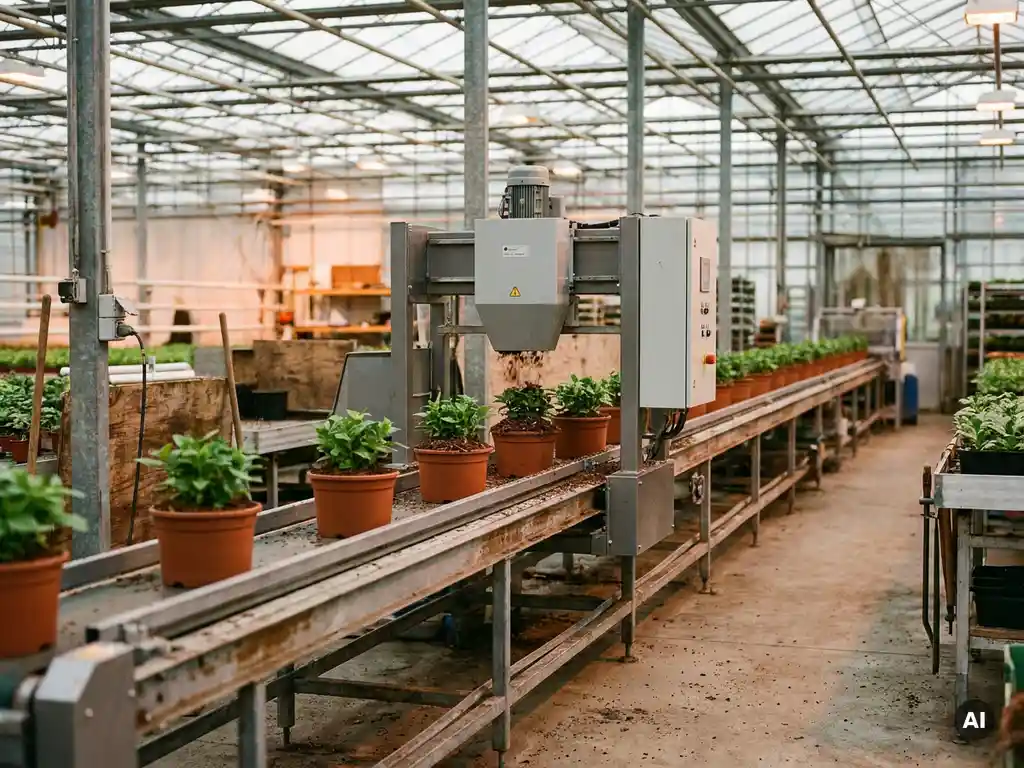
Can a topping machine work with an existing conveyor system?
Yes, a potting machine can work with an existing conveyor system in most cases. The key factor is whether the conveyor’s speed, height, and pot-flow direction can be aligned with the potting machine’s output. Most modern potting machines are designed with integration in mind, making it possible to connect them to a wide range of existing conveyor setups with the right adjustments.
Whether you are running a simple single-line setup or a more complex multi-row system, the compatibility between a potting machine and your conveyor largely comes down to mechanical alignment, speed synchronization, and pot handling. The questions below walk through the most important practical considerations.
What types of conveyor systems are compatible with a potting machine?
Most standard conveyor types used in horticultural production are compatible with a potting machine, including flat belt conveyors, roller conveyors, and chain conveyors. The most important requirements are that the conveyor can handle the weight and size of filled pots, maintain a consistent flow speed, and position pots correctly as they leave the potting machine’s output.
Flat belt conveyors are the most common match for potting machines because they provide a stable, even surface for freshly filled pots that may not yet be fully settled. Roller conveyors work well further down the line, once pots are stable and can roll without tipping. Chain conveyors are often used in heavier-duty or higher-volume operations.
The conveyor’s width and height are also critical. If the existing line was built around a different machine or a different pot size, you may need an adapter section or a height-adjustable connection bridge to ensure a smooth handoff from the potting machine to the conveyor. In many cases, this is a straightforward modification rather than a full system overhaul.
How does a potting machine connect to an existing conveyor line?
A potting machine connects to an existing conveyor line through a physical output section that feeds filled pots directly onto the conveyor belt or rollers. This connection point typically requires height alignment, directional matching, and sometimes a short bridging conveyor to close any gap between the machine’s output and the start of the existing line.
In practice, the connection involves three elements:
- Height alignment: The potting machine’s output height must match or smoothly transition to the conveyor’s receiving height. Adjustable legs or a ramp section can resolve small differences.
- Directional flow: Pots need to exit the potting machine in the same direction the conveyor runs. If the existing line runs at an angle or in the opposite direction, a turntable or curved section may be needed.
- Gap management: Any gap between the machine and the conveyor risks pots tipping or jamming. A short bridging conveyor or an extended output table is often the simplest fix.
For more complex lines, the potting machine may also need to be electrically linked to the conveyor’s control system so that both run at a coordinated speed. This is especially relevant in fully automated setups where the line must respond to stoppages or slowdowns automatically.
What happens when potting machine speed doesn’t match conveyor speed?
When a potting machine runs faster than the conveyor it feeds, pots begin to back up at the connection point, which causes jams, tipping, and potential damage to freshly filled pots. When the conveyor runs faster than the potting machine, gaps appear in the flow, reducing overall efficiency and creating uneven spacing on the line.
Speed mismatches are one of the most common integration challenges, and they can usually be resolved in one of two ways. The first is manual speed adjustment: most conveyor systems and potting machines have variable speed controls that allow operators to tune both sides until they run in sync. The second is electronic synchronization, where both machines are connected to a shared control system that automatically keeps their speeds matched.
In high-volume operations, even small speed differences compound quickly. A mismatch of just a few pots per minute can result in significant downtime or quality loss over a full production day. This is why it is worth investing time in proper calibration during installation rather than adjusting on the fly during a busy production run.
Can a potting machine be added to a line without stopping production?
In most cases, adding a potting machine to an existing line does require a planned production stop, at least for the physical installation and connection. However, the downtime can be minimized significantly with good preparation, and in some setups with modular conveyor systems, sections of the line can be modified while other parts continue running.
The installation itself typically involves positioning the machine, making the physical connection to the conveyor, running electrical connections, and calibrating speed and flow. For straightforward integrations, this can be completed within a day. More complex setups, particularly those requiring control system integration or custom bridging sections, may take longer.
Planning the installation during a natural production break, such as between seasons or during a scheduled maintenance window, is the most practical approach. If timing is critical, it is worth discussing a phased installation with your supplier so that the most disruptive steps happen outside peak hours.
What’s the difference between a standalone and a fully integrated potting machine setup?
A standalone potting machine operates independently, with operators manually placing empty pots and removing filled ones. A fully integrated setup connects the potting machine to upstream and downstream conveyor systems, automating the flow of pots through the entire production line with minimal manual handling.
The practical difference is significant:
- Standalone setup: Lower upfront cost, easier to install, and flexible enough to move around the facility. Best suited for smaller operations or growers who pot in batches rather than continuous runs.
- Fully integrated setup: Higher throughput, fewer operators required, and consistent output quality. Best suited for larger operations running high volumes continuously, where labor savings justify the investment in conveyor infrastructure.
Between these two extremes, there is also a semi-integrated option where the potting machine connects to one conveyor section, such as an output line that carries filled pots to a work table or sorting area, without automating the entire flow. This is a common middle step for growers who are expanding their automation gradually.
Who should assess whether a potting machine fits an existing line?
The assessment should involve both the person responsible for daily production operations and a technical specialist from the potting machine supplier. The production manager or head grower understands the practical flow of the existing line, while the supplier’s technical team can evaluate compatibility, identify integration challenges, and recommend the right connection approach.
Before any site visit or assessment, it helps to have the following information ready:
- The make and model of your existing conveyor system
- The conveyor’s speed range and belt or roller dimensions
- The pot sizes and types you work with
- Your target output in pots per hour
- The available floor space around the intended installation point
A good supplier will want to see the line in person before making recommendations, rather than giving a generic answer based on machine specifications alone. Every production environment has its own layout quirks and workflow patterns that affect how integration should be approached.
How MartinStolze helps you integrate a potting machine into your existing line
We understand that every growing operation is different, which is why we approach every integration project individually. Our team assesses your existing setup, identifies any compatibility challenges, and recommends the right configuration for your specific line and production goals.
- Complete in-house production: Our potting machines, including the Stolze 3030 and Stolze 3030 PRO, are designed and built by us, which means we know exactly how they connect to different conveyor types.
- Seamless line integration: Our machines work directly with our own conveyor systems, and we have extensive experience connecting them to third-party conveyor lines as well.
- Speed synchronization and control: The Stolze 3030 PRO features advanced PLC control and touchscreen programming, making it straightforward to calibrate output speed to match your existing conveyor flow.
- Buy or rent: Not sure yet whether integration will work for your operation? Our rental option lets you trial a machine in your own facility before committing to a purchase.
- Full installation support: Our own technicians handle installation and commissioning, so you are not left to figure out the connection yourself.
Curious whether your existing conveyor system is compatible with one of our potting machines? Get in touch with our team and we will assess your situation and advise you on the best approach.
Frequently Asked Questions
How do I know if my existing conveyor is strong enough to handle the output of a potting machine?
Check your conveyor's load rating against the combined weight of your filled pots at maximum throughput. A standard potting machine can output hundreds of pots per hour, so the conveyor must handle not just individual pot weight but the cumulative load of pots in motion across the belt. If your conveyor's specifications are unclear, your potting machine supplier can help you calculate the required capacity based on your pot size, substrate weight, and target output rate.
What if my existing conveyor runs in the opposite direction to the potting machine's output?
A directional mismatch is a common integration challenge but rarely a dealbreaker. The most practical solutions are installing a turntable at the connection point, adding a curved conveyor section, or repositioning the potting machine relative to the line if floor space allows. Your supplier should evaluate the available layout during a site visit and recommend the least disruptive option for your specific setup.
Can I integrate a potting machine with a conveyor system from a different manufacturer?
Yes, cross-manufacturer integration is standard practice in horticultural production. Most potting machines are designed to connect to third-party conveyor systems, provided that height, speed, and directional requirements are met. The main consideration is whether the control systems can communicate if you want full electronic synchronization — this may require an additional interface or a small amount of custom wiring, which an experienced supplier technician can handle during installation.
What are the most common mistakes growers make when integrating a potting machine into an existing line?
The most frequent mistakes are underestimating the importance of speed calibration, skipping the site assessment, and trying to rush installation during peak production. Speed mismatches that seem minor during a test run can cause significant downtime at full volume. Taking the time to calibrate both machines carefully during a quiet period — and having your supplier's technician present for commissioning — prevents the majority of integration problems before they start.
Is it possible to expand a semi-integrated setup into a fully automated line later?
Absolutely, and many growers take exactly this phased approach. Starting with a semi-integrated setup — where the potting machine connects to just one conveyor section — allows you to learn how the machine fits into your workflow before investing in full upstream and downstream automation. Most modern potting machines are built with this scalability in mind, so the same machine can be reconfigured or extended as your operation grows.
How long does it typically take to calibrate speed synchronization between a potting machine and an existing conveyor?
For straightforward setups with manual speed controls on both machines, calibration can usually be completed within a few hours during the commissioning phase. Fully electronic synchronization via a shared PLC or control system may take longer depending on the complexity of the existing line's control architecture. Either way, this step should always be done before the first full production run — not adjusted reactively once the line is under pressure.
What should I do if pots are tipping or jamming at the connection point between the potting machine and the conveyor?
Tipping and jamming at the handoff point are almost always caused by one of three issues: a height difference between the machine output and the conveyor, a gap that pots must bridge unsupported, or a speed mismatch causing pots to bunch up. Start by checking height alignment and closing any gap with a bridging section or extended output table, then fine-tune the speed of both machines until the flow is smooth. If the problem persists, contact your supplier's technical team — this is a well-understood integration issue with reliable solutions.
Related Articles
- Why can two nurseries using the same potting machine achieve different output?
- How do you compare two potting machines with different hourly capacities?
- What is the difference between maximum and practical pots-per-hour capacity?
- Can fewer operators maintain the same pots-per-hour output with automation?
- Why do standard industrial conveyor belts fail in greenhouses?