

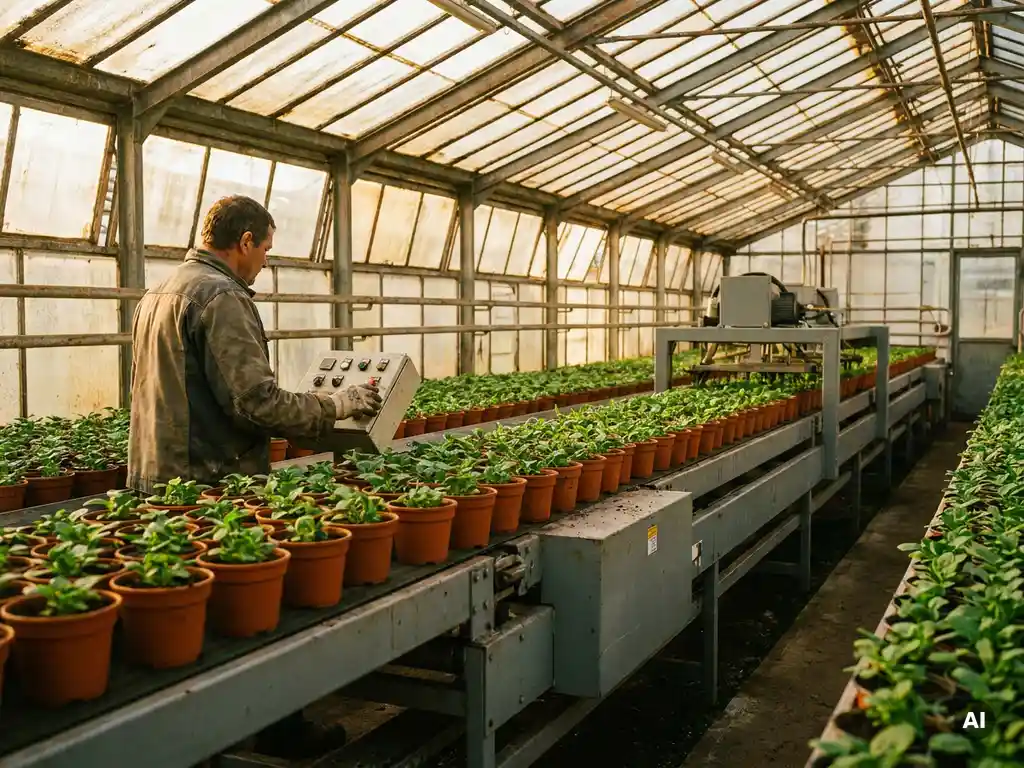
Can fewer operators maintain the same pots-per-hour output with automation?
Yes, fewer operators can absolutely maintain the same pots-per-hour output with the right automation in place. A modern potting machine handles the most labor-intensive steps automatically, which means one or two people can oversee a line that previously required four or more. The sections below unpack exactly how that works in practice.
How much labor does manual potting actually require?
Manual potting typically requires three to six operators per line, depending on pot size, mix type, and target output. Each person fills, tamps, and positions pots by hand, which limits throughput to a few hundred pots per hour per worker at best. Over a full shift, physical fatigue compounds the bottleneck and drives output down further as the day progresses.
The labor demand is not just about headcount. Manual potting places a heavy ergonomic burden on workers: repetitive bending, lifting trays, and handling soil mix for hours at a stretch leads to fatigue-related errors and, over time, higher absenteeism. During seasonal peaks, when large volumes need to move fast, finding and coordinating enough reliable workers becomes a logistical challenge on top of the operational one. The cost per pot, once you account for wages, training, and inconsistency, adds up quickly.
How does a potting machine maintain output with fewer operators?
A potting machine maintains output with fewer operators by automating the three most time-consuming steps: soil filling, compaction, and pot positioning. These steps run continuously at a fixed, consistent pace regardless of worker fatigue or skill level. One operator feeding empty pots and one monitoring the line can replace a team that previously handled each of those tasks manually.
The key mechanism is the machine’s ability to decouple production speed from human physical capacity. Instead of output depending on how fast a person can fill and tamp a pot, the machine sets the rhythm and operators simply support it. Soil is drawn from a hopper, metered into each pot at a calibrated depth, and the filled pots move along the line automatically. The operator’s role shifts from doing the work to overseeing it.
Integration with conveyor systems extends this further. When a potting machine connects to an automated transport line, filled pots move away from the machine without manual handling, eliminating another labor point entirely.
What is the realistic pots-per-hour difference between manual and automated potting?
Manual potting by an experienced worker typically yields 200 to 400 pots per hour. An automated potting machine can reach up to 8,000 pots per hour. The difference is not marginal. Even at moderate machine settings, automated output is several times higher than what a full manual team can achieve.
The practical throughput you achieve depends on factors like pot size, soil mix consistency, and how well the line is configured. Smaller pots run faster; heavier or coarser mixes may require adjustments. That said, even a conservatively configured machine running at half its maximum capacity outperforms a manual team of four or five workers. For growers operating at commercial scale, this gap determines whether seasonal demand can be met at all.
Which potting tasks still need a human operator?
Even with full automation, a human operator remains essential for three core responsibilities: loading raw materials (soil, empty pots, or trays), monitoring machine performance and catching faults early, and handling any plant-specific adjustments when switching between pot sizes or growing programs.
These are oversight and setup tasks rather than repetitive physical labor. An operator watching a potting line is not filling pots by hand. They are making sure the hopper stays fed, the pots are aligned correctly on the infeed, and the machine settings match the current run. When something goes wrong, a trained operator catches it before it becomes a larger problem. This shift from doing to supervising is precisely what makes automation labor-efficient rather than labor-eliminating.
What features help a potting machine run with minimal supervision?
The features that most reduce the need for constant supervision are automatic soil detection, programmable run settings, and a clear control interface. These allow the machine to self-regulate during a run and allow operators to set parameters in advance rather than adjusting them manually throughout the shift.
- Automatic soil detection ensures each pot receives a consistent fill without an operator manually checking depth or density. The machine compensates for variations in soil mix automatically.
- Touchscreen controls with saved programs mean that switching between pot sizes or drilling depths is a matter of selecting a preset, not reconfiguring the machine from scratch.
- Fully guided chain systems reduce mechanical variation and improve pot positioning stability, which lowers the frequency of jams or misfeeds that would otherwise require operator intervention.
- Quieter, lower-maintenance design reduces the time operators spend on routine upkeep during production hours.
Together, these features allow a single operator to monitor a running line confidently rather than standing over it at every step.
Should a grower buy or rent a potting machine first?
For growers who are investing in a potting machine for the first time, renting is a practical way to validate the decision before committing to a purchase. Renting lets you run the machine in your own facility, with your own soil mix and pot sizes, before you have skin in the game on a capital purchase. If the machine fits your process, the path to buying is straightforward.
Buying makes more sense when you already have experience with the machine model, have predictable year-round volume, or are integrating the machine into a larger automated line. The total cost of ownership over several seasons generally favors ownership for high-volume operations.
The right answer depends on your current scale, how variable your seasonal demand is, and how confident you are in the configuration you need. A trial period removes most of that uncertainty.
How MartinStolze helps you achieve more output with fewer operators
We design and build our potting machines entirely in-house, which means every component is engineered to work together reliably under real production conditions. Our flagship models, the Stolze 3030 and the Stolze 3030 PRO, are built for exactly the scenario this article describes: consistent, high-volume output with minimal operator involvement.
- Capacity up to 8,000 pots per hour, suitable for pots from 7 to 30 cm
- PLC control with an intuitive touchscreen for easy program switching
- Automatic soil detection on the 3030 PRO for consistent fill depth without manual adjustment
- Seamless integration with conveyor and sorting lines for a fully connected production flow
- Both purchase and rental options available, including a trial period for first-time buyers
- Installation, training, and ongoing support from our own technicians
If you are weighing up whether automation makes sense for your operation, or you want to know which configuration fits your specific soil mix and pot range, get in touch with us and we will walk you through it.
Frequently Asked Questions
How long does it typically take to set up a potting machine before a production run?
Most modern potting machines, including the Stolze 3030 series, are designed for quick changeovers. If you are switching between pot sizes or soil programs, selecting a saved preset on the touchscreen takes only a few minutes. A full initial setup from cold start to running production is typically achievable within 15 to 30 minutes once operators are trained on the machine.
What happens to output if the soil mix changes mid-season?
Changes in soil mix — such as a coarser texture, higher peat content, or different moisture levels — can affect fill consistency and machine speed. Machines with automatic soil detection, like the Stolze 3030 PRO, compensate for these variations automatically, maintaining consistent fill depth without manual recalibration. For machines without this feature, an operator will need to adjust the metering settings when switching to a significantly different mix.
Can a potting machine handle both small seedling pots and larger container sizes on the same line?
Yes, most commercial potting machines are designed to handle a range of pot sizes, and the Stolze 3030 models accommodate pots from 7 to 30 cm. Switching between sizes is handled through saved programs on the control panel rather than mechanical reconfiguration, which keeps changeover time short. For operations running highly varied pot assortments in a single day, this flexibility is one of the most practical advantages of a programmable machine.
What are the most common mistakes growers make when first transitioning from manual to automated potting?
The most common mistake is underestimating the importance of consistent soil mix preparation before it reaches the machine. Automated potting lines perform best when the input material — soil moisture, mix ratio, and particle size — is kept stable, something that often requires more discipline than manual potting does. A second common issue is understaffing the infeed and outfeed points during the first weeks, before operators have fully adjusted to the machine's pace and rhythm.
How much floor space does a potting machine and its conveyor integration typically require?
A standalone potting machine has a relatively compact footprint, but the total space requirement grows significantly once you factor in the hopper, infeed conveyor, outfeed conveyor, and any downstream sorting or spacing equipment. As a practical starting point, plan for a clear working area of at least 6 to 10 metres in length for a basic integrated line, with additional width for operator access on both sides. Your equipment supplier should be able to provide a layout drawing based on your specific facility dimensions before installation.
Is operator training difficult, and how long does it take before someone can run the line independently?
Most operators reach a level of confident independent operation within one to three days of hands-on training, particularly when the machine features an intuitive touchscreen interface with saved programs. The learning curve is steeper for troubleshooting mechanical faults than for day-to-day operation, which is why supplier-provided training that covers both normal operation and common fault responses is worth prioritising. MartinStolze includes installation and training support from their own technicians as part of the setup process.
At what production volume does investing in a potting machine start to make financial sense?
The break-even point varies depending on your labour costs, machine model, and whether you buy or rent, but most commercial growers find that automation becomes clearly cost-effective when they are running more than 50,000 to 100,000 pots per season. Below that volume, renting rather than buying is often the more financially sound approach, as it lets you capture the efficiency benefits without committing to the full capital cost. For high-volume operations running year-round, the cost per pot with an automated line is typically a fraction of what manual production costs once wages, inconsistency losses, and absenteeism are factored in.