

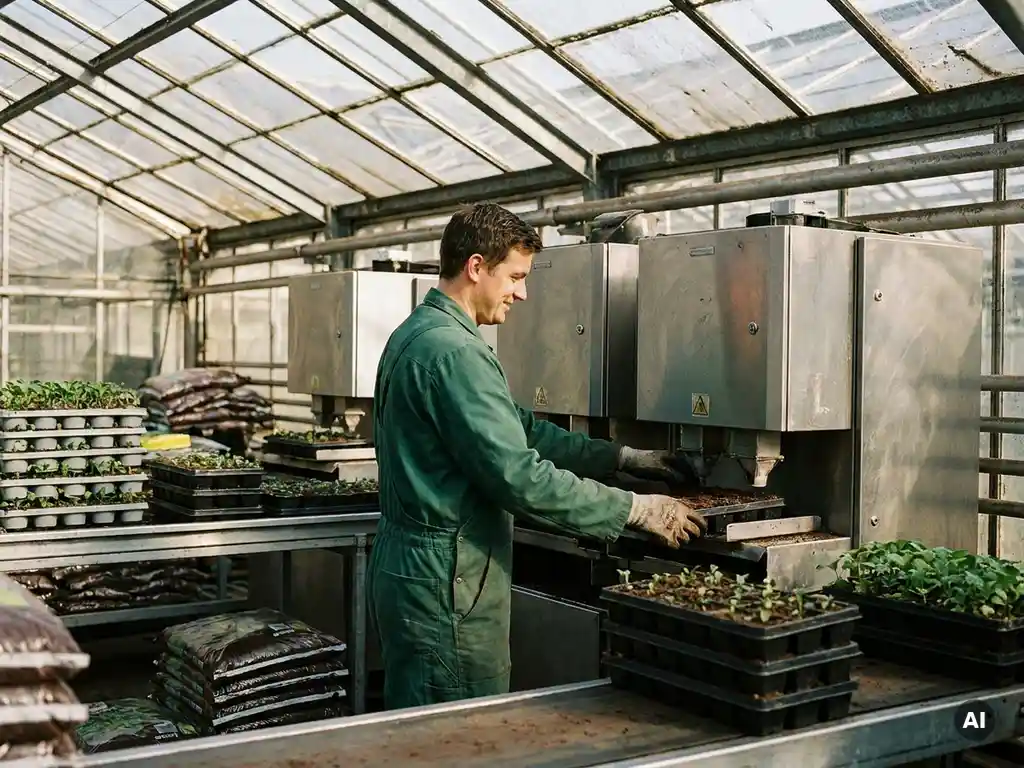
Can one operator manage both a potting machine and topping machine?
Yes, one operator can realistically manage both a potting machine and a topping machine at the same time, provided the line is well designed and the machines are properly configured. In most professional potting lines, this single-operator setup is not only possible but standard practice. The sections below walk through exactly how it works and what conditions need to be in place.
What does a topping machine actually do in a potting line?
A topping machine applies a layer of cover material, typically a different soil mix, bark, or gravel, on top of the freshly filled pot after the potting machine has done its work. It is the finishing step in the potting process, ensuring the top of the pot looks clean, suppresses weeds, or meets specific crop requirements. Without it, this layer would need to be applied by hand.
In a potting line, the topping machine is positioned directly downstream from the potting machine. Pots travel along the conveyor from the potting machine, pass under the topping unit, receive their cover layer, and then continue along the line to the next station, whether that is a watering station, a sorting table, or a trolley loader. The topping machine operates continuously and in sync with the speed of the rest of the line, so it does not create a bottleneck when set up correctly.
Because the topping machine runs automatically once configured, it does not require constant manual attention. The operator sets the material volume, the distribution width, and the conveyor speed, and the machine handles the rest. This is precisely what makes it compatible with single-operator management.
Can one person realistically run both machines at the same time?
Yes, one person can run both machines simultaneously in a well-configured line. The key is that both the potting machine and the topping machine are automated systems, not manual tools. Once the operator has set the parameters and started the line, both machines run in parallel without requiring constant intervention. The operator’s role shifts from active operation to monitoring and refilling.
In practice, the operator’s main tasks during a running shift are refilling the soil hopper on the potting machine, refilling the cover material on the topping machine, placing empty pots or trays at the infeed, and removing or redirecting filled pots at the outfeed. These tasks are spread across the length of the line, and because both machines run continuously, the operator can move between stations in a predictable rhythm.
The realistic workload depends on the volume and speed of production. At lower throughput rates, one operator has comfortable time between tasks. At higher speeds, closer to the upper capacity range of the potting machine, the pace becomes tighter and the margin for error shrinks. This is where machine features and line layout become decisive factors.
What machine features make single-operator use possible?
The features that enable single-operator use are those that reduce the need for constant manual adjustment and minimize unplanned stops. Automatic soil detection, touchscreen programming, and stable material feeding are the three most important capabilities to look for when evaluating whether a potting line can run with one person.
Automatic soil detection ensures the potting machine fills each pot to the correct level without the operator needing to check every pot individually. If the sensor detects an underfill or overfill, it adjusts automatically rather than producing a run of defective pots. This removes one of the most common reasons an operator would need to stop and intervene mid-shift.
Touchscreen controls with programmable presets allow the operator to switch between pot sizes or soil mixes quickly and reliably. Instead of manually recalibrating the machine by trial and error, the operator selects a saved profile and the machine adjusts itself. This is especially valuable when the same line handles multiple pot sizes across a single day.
On the topping machine side, a consistent and clog-resistant feeding mechanism is essential. If the cover material bridges or clumps in the hopper, the operator must stop to clear it, which disrupts the entire line. Machines designed with wider hopper openings or agitator systems handle coarser or wetter materials far more reliably, reducing the number of unplanned interventions per shift.
How does line layout affect whether one operator is enough?
Line layout is often the deciding factor in whether single-operator management is practical. Even with excellent machines, a poorly designed layout forces the operator to cover too much ground, creates blind spots, or places refill points in awkward positions that eat into productive time.
The most operator-friendly layouts are compact and linear, with the potting machine and topping machine positioned close together so the operator can observe both from a central point. Infeed and outfeed stations should be within easy reach without requiring the operator to leave the line unattended for extended periods.
The positioning of the soil and topping material hoppers also matters. If both hoppers are on the same side of the line and at a comfortable working height, the operator can refill both without crossing the line or bending awkwardly. Ergonomic placement reduces fatigue over a long shift and keeps the operator alert to what the machines are doing.
Buffer capacity within the line, for example a small accumulation conveyor between the potting machine and the topping machine, gives the operator a few extra seconds to complete a task without the line jamming. Even a short buffer of two or three pot lengths can make the difference between a manageable pace and a stressful one.
When does a potting line need a second operator?
A second operator becomes necessary when the output speed exceeds what one person can physically keep up with, when the product or process introduces complexity that requires constant attention at multiple points simultaneously, or when the physical layout of the line makes it impossible for one person to cover all stations safely.
Specific situations that typically require a second person include:
- Very high throughput rates where the outfeed pots accumulate faster than one person can handle
- Manual pot placement at the infeed when no automatic tray filler or pot feeding system is in use
- Complex grading or quality checks that must happen immediately after the topping station
- Working with difficult soil mixes that require frequent hopper clearing or manual intervention
- Lines with multiple branches or parallel tracks where one operator cannot maintain sight lines across all active stations
It is also worth considering the length of the shift. A single operator managing a busy line can sustain that pace for a few hours, but fatigue accumulates. For full-day production runs at high volume, a second operator is not just a convenience, it is a practical safeguard against errors and downtime.
How MartinStolze helps you design an efficient single-operator potting line
We design and build potting lines specifically around the reality of how growers work, including how many people are actually available on the floor during a shift. Our conveyor systems are engineered to integrate seamlessly with both the potting machine and the topping machine, with buffer capacity and ergonomic station placement built into the line design from the start. The result is a line that one operator can genuinely manage, not just in theory but across a full working day.
When we configure a line for you, we take into account:
- Your target output volume and pot size range
- The type of soil and topping material you use
- The number of operators available per shift
- Your floor space and any layout constraints
- Whether you want to buy or rent, including a trial period before committing
If you are weighing up whether a single-operator setup is realistic for your situation, or if you want to see how a potting line with a topping machine actually runs in practice, get in touch with us. We are happy to walk you through the options and, if useful, arrange a demonstration at our facility in De Lier.
Frequently Asked Questions
What is a realistic throughput rate for a single-operator potting line with a topping machine?
A comfortable single-operator throughput typically falls in the range of 500 to 1,500 pots per hour, depending on pot size, soil type, and line configuration. At these speeds, one operator has enough time to manage infeed, refilling, and outfeed without the pace becoming unmanageable. Beyond that range, the margin for error shrinks significantly and a second operator is usually worth considering, especially for full-day production runs.
How often does the topping machine hopper need to be refilled, and how disruptive is it?
Refill frequency depends on the hopper capacity of your topping machine and the volume of cover material being applied per pot. On most professional machines, a full hopper load lasts anywhere from 20 to 45 minutes at standard production speeds. Because the refill can typically be done while the line continues running, it rarely causes a full stop — the key is positioning the topping material supply close enough to the machine that the operator can refill quickly without leaving other stations unattended.
Can a single-operator potting line handle multiple pot sizes in the same shift?
Yes, provided the potting machine and topping machine both support programmable presets for different pot profiles. With touchscreen controls and saved configurations, switching between pot sizes is a matter of selecting the correct profile and making minor physical adjustments to guides or formers, which typically takes just a few minutes. Without programmable presets, each changeover requires manual recalibration, which adds time and increases the risk of a poorly configured run — a significant burden for a single operator managing the full line.
What types of topping materials can a topping machine handle, and are some harder to work with than others?
Most topping machines are designed to handle a range of materials including bark, gravel, perlite, coarse compost, and decorative mulch. Finer or wetter materials tend to flow more predictably, while coarser or fibrous materials like bark chips can bridge or clump in the hopper if the feeding mechanism is not designed for them. If your operation regularly uses coarser or moisture-heavy topping materials, look specifically for machines with agitator systems or wider hopper openings, as these significantly reduce the number of manual interventions needed per shift.
What is the most common mistake growers make when setting up a single-operator potting line?
The most common mistake is underestimating the importance of line layout relative to machine quality. Growers often invest in capable machines but then arrange them in a way that forces the operator to cover excessive distances, cross the line repeatedly, or work with hoppers at inconvenient heights. Even a well-specified potting and topping machine combination will create operator fatigue and downtime if the physical setup is not ergonomically thought through. Getting the layout right before installation — ideally with input from the line supplier — saves significant rework later.
Is it possible to trial a potting line with a topping machine before committing to a purchase?
Yes, this is something MartinStolze offers directly. You can arrange a demonstration at their facility in De Lier to see a configured potting line with a topping machine running under realistic conditions before making a decision. For growers who want to validate the setup in their own environment first, rental options with a trial period are also available, allowing you to assess single-operator feasibility with your own soil types, pot sizes, and production volumes before committing to a full purchase.
How do I know if my current floor space is sufficient for a potting line that includes a topping machine?
The minimum floor space required depends on the length of the conveyor run, the positioning of infeed and outfeed stations, and how much buffer capacity is built into the line. A compact, linear layout with integrated buffer conveyors can fit into surprisingly modest spaces, but you need to account for operator movement around the line as well — not just the machine footprint itself. The best approach is to share your floor plan dimensions and layout constraints with your line supplier early in the process so the configuration can be designed around your actual space rather than adjusted after the fact.