

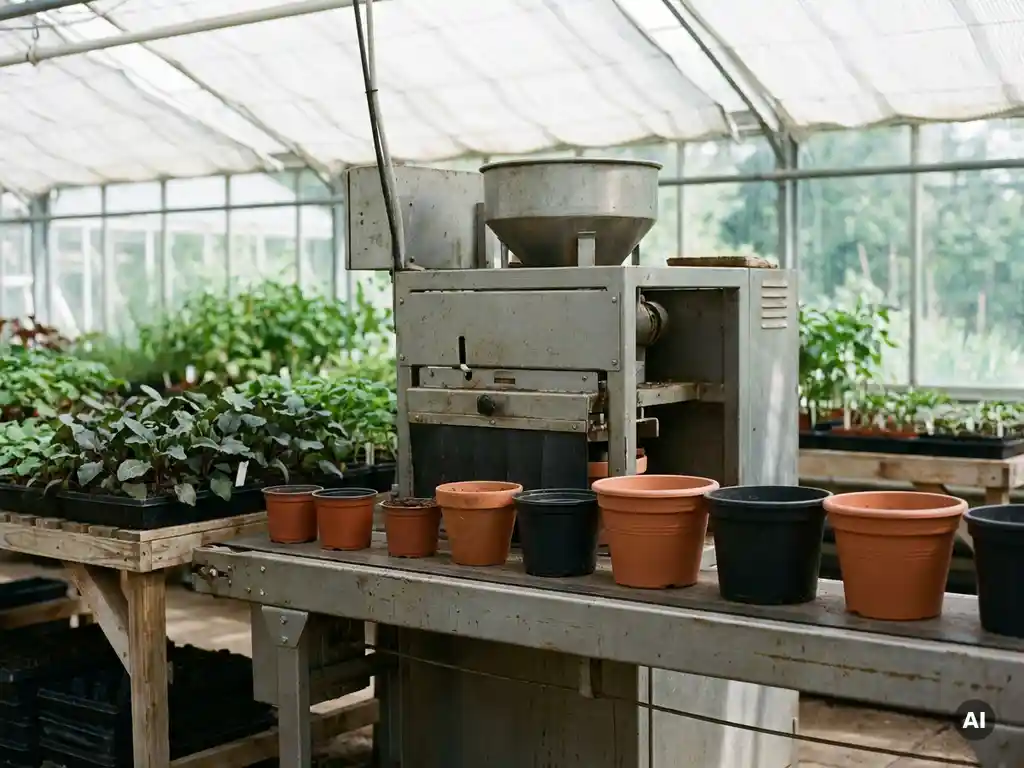
Can one topping machine handle multiple pot diameters?
Yes, a single potting machine can handle multiple pot diameters. Most professional potting machines are designed to work across a range of pot sizes without requiring a full machine swap. The key factor is how quickly and reliably the machine can switch between sizes, and whether that process disrupts your production flow.
For growers working with a varied assortment, flexibility across pot diameters is not a nice-to-have; it is a core requirement. The sections below break down exactly how pot size switching works, what range to expect, and when a more advanced model makes the difference.
How do potting machines switch between different pot sizes?
Potting machines switch between pot sizes by adjusting the conveyor guides, the filling depth, and the soil dosing settings to match the dimensions of the new pot. On manual models, this means physically repositioning guides and recalibrating fill depth by hand. On touchscreen-equipped machines, operators select a pre-programmed profile for each pot size, and the machine adjusts automatically.
The speed of this switchover depends heavily on the machine’s control system. A basic machine may require several minutes of manual adjustment and test runs before production can resume. A more advanced model with programmable profiles lets you store settings for each pot diameter and switch between them in seconds, simply by selecting the right menu on the touchscreen.
The practical implication for growers with a varied assortment is significant. If you are running multiple pot sizes across a single working day, a machine that requires lengthy manual recalibration between batches adds up to real lost time. Pre-programmable settings eliminate that friction and keep the line moving.
What pot diameter range can a single potting machine handle?
A single professional potting machine can typically handle pot diameters ranging from approximately 7 cm to 30 cm. This covers the vast majority of pot sizes used in ornamental plant cultivation and pot plant production, from small plug pots to larger container sizes.
This range makes a well-specified machine genuinely versatile for most nursery operations. Growers producing a broad assortment of pot plants, from compact 9 cm pots for seasonal flowering plants to 25 cm or 30 cm pots for larger specimens, can run all of these on a single machine without investing in separate equipment for each size category.
The critical point is that the machine must be capable of consistent soil filling across this full range. A wide diameter range on paper means little if the machine struggles to fill smaller pots accurately or cannot handle the volume of soil required for larger ones. Soil dosing precision across the full range is what separates a genuinely flexible machine from one that performs well only in the middle of its stated range.
Does switching pot sizes affect filling speed or consistency?
Switching pot sizes can affect both filling speed and consistency if the machine is not properly set up for the new diameter. When settings are dialled in correctly, a well-designed potting machine maintains its rated capacity and filling accuracy across the full pot size range. The risk of inconsistency comes primarily during the transition, not during steady-state production.
On machines without programmable profiles, operators must manually recalibrate fill depth and soil dosing each time the pot size changes. During this adjustment phase, the first pots off the line may be underfilled or overfilled until the settings are correct. This is a real quality risk, particularly in ornamental plant production where consistent pot density directly affects root development and presentation at auction.
Automatic soil detection addresses this risk directly. Rather than relying on a fixed fill setting, the machine senses the actual soil level in each pot and adjusts in real time. This means that even as pot sizes change, or as soil mix density varies across a batch, every pot receives a consistent, accurate fill. For growers for whom presentation quality is non-negotiable, this level of consistency is a meaningful operational advantage.
What’s the difference between a standard potting machine and a PRO model for multi-size use?
The key difference for multi-size use is automation and programmability. A standard potting machine handles multiple pot diameters through manual adjustment of guides and fill depth settings. A PRO model adds touchscreen-based profile storage, automatic soil detection, and a fully guided chain system, making size changes faster, more accurate, and less dependent on operator skill.
In practical terms, this distinction matters most for operations that switch between pot sizes frequently or that run high volumes where any inconsistency has downstream consequences. Consider the specific advantages of a PRO model in a multi-size context:
- Pre-programmed size profiles: Settings for pot diameter, boring depth, soil feed rate, and rotation speed are stored per pot size and recalled instantly via the touchscreen, eliminating manual recalibration between batches.
- Automatic soil detection: The machine reads the actual fill level in each pot and compensates in real time, maintaining consistent pot density regardless of pot size or variations in soil mix.
- Fully guided chain system: Provides greater stability during transport along the line, which is particularly important when running smaller pots that are more prone to tipping or misalignment.
- Quieter operation and lower maintenance: Reduced mechanical wear means less downtime, which is especially valuable during peak seasons when the machine is switching between sizes multiple times per day.
For growers with a single dominant pot size, a standard model may be entirely sufficient. For operations with a varied assortment and frequent size changes, the PRO model’s programmability and automatic detection translate directly into less waste, less downtime, and more reliable output.
When should you use separate machines for different pot sizes?
Separate machines make sense when pot sizes are so different in volume, weight, or handling requirements that a single machine cannot serve both efficiently, or when production volumes are high enough that switching between sizes on one machine creates a bottleneck. In most standard nursery operations, however, a single well-specified machine covers the full range.
The scenarios where a second machine becomes worth considering include:
- Extreme size differences: If you regularly run very small pots (7 to 9 cm) and very large containers (25 to 30 cm) in high volumes on the same day, the setup differences between these extremes may slow production enough to justify dedicated lines.
- Simultaneous production lines: If your operation runs multiple parallel potting lines at the same time, each line will need its own machine regardless of pot size overlap.
- Specialist soil mixes per size: Some growers use fundamentally different soil mixes for different pot sizes or plant types. If these mixes require different hopper configurations, running them on a single machine may create cleaning and contamination challenges between batches.
- Volume that exceeds a single machine’s capacity: At very high throughput, the capacity ceiling of a single machine (up to 8,000 pots per hour) may become the constraint, making a second machine a capacity decision rather than a flexibility one.
For the majority of growers producing a mixed assortment within the 7 to 30 cm range, a single programmable machine handles the full scope of daily production without compromise.
How MartinStolze helps with multi-size potting
We design our potting machines specifically for growers who need real flexibility across pot diameters, without sacrificing speed or consistency. Our range addresses the full spectrum of multi-size production requirements:
- Wide diameter range as standard: Both the Stolze 3030 and the Stolze 3030 PRO are built to handle pots from 7 to 30 cm, covering the full assortment of most ornamental and pot plant operations.
- Touchscreen with programmable profiles: Store settings for each pot size, boring depth, soil feed, and rotation speed, and switch between them instantly at the start of each batch.
- Automatic soil detection (PRO model): Guarantees consistent fill quality across all pot sizes, even as soil mix density varies across the day.
- Seamless line integration: Our potting machines connect directly with our conveyor systems and topping machines, so your full production line works as one coordinated system regardless of the pot size running.
- Try before you commit: Both buying and renting are available, including trial periods, so you can verify the machine performs across your specific pot sizes and soil mixes before making a final decision.
If you are unsure whether a single machine covers your full assortment, or whether the standard or PRO model is the right fit for your operation, we are happy to think through it with you. Contact us and we will help you find the configuration that fits your production process.
Frequently Asked Questions
How do I know if my current soil mix will work consistently across all pot sizes on the same machine?
The best way to verify this is to run a test batch with your actual soil mixes across the smallest and largest pot sizes you use. Pay close attention to fill consistency at both extremes, since soil mixes with high peat content or coarse amendments can behave differently at low and high dosing volumes. If your operation uses multiple soil mixes, machines with automatic soil detection are particularly valuable because they compensate in real time for density variations, regardless of which mix is loaded.
Can I retrofit my existing potting machine with programmable profiles, or do I need to upgrade to a PRO model?
In most cases, programmable profile functionality is tied to the machine’s control system and cannot be retrofitted onto a basic manual model after purchase. If multi-size flexibility is a growing priority for your operation, upgrading to a PRO model is typically the more cost-effective long-term path rather than attempting to modify existing hardware. It is worth contacting your machine supplier directly to confirm what, if any, software or hardware upgrades are available for your specific model.
How many pot size profiles can typically be stored on a touchscreen potting machine?
Most professional touchscreen potting machines can store a significant number of pre-programmed profiles, often enough to cover every pot diameter in a standard nursery assortment without needing to delete or overwrite existing settings. In practice, this means you can set up profiles for each pot size once during initial commissioning and simply recall them at the start of each batch. Check the specifications of your specific model, as storage capacity can vary between manufacturers and machine generations.
What's the biggest mistake growers make when switching between pot sizes mid-production?
The most common mistake is skipping test pots after a size change and going straight into full production, which risks an entire batch being underfilled or overfilled before the issue is caught. Even on machines with programmable profiles, running two or three test pots after each switchover is good practice, especially if soil mix density has changed since the profile was last used. Building this short verification step into your standard operating procedure protects both product quality and material costs.
Does running smaller pots at high speed increase the risk of tipping or misalignment on the conveyor?
Yes, smaller and lighter pots are more susceptible to tipping or shifting on the conveyor, particularly at higher throughput speeds. This is one of the practical reasons why a fully guided chain system, as found on PRO models, makes a meaningful difference when running smaller pot sizes in volume. If you are using a standard conveyor setup, reducing line speed slightly when running your smallest pot sizes is a simple way to reduce misalignment without affecting overall daily output significantly.
Is renting a potting machine a practical way to test multi-size performance before buying?
Renting is an excellent way to validate real-world performance across your specific pot sizes, soil mixes, and production volumes before committing to a purchase. It allows you to run the machine under your actual working conditions, with your team, across a full production day, which gives you far more reliable data than a showroom demonstration. Some suppliers, including MartinStolze, offer rental and trial arrangements specifically for this purpose, so it is worth asking about this option early in your decision process.
How often should conveyor guides and fill depth settings be rechecked after switching pot sizes?
After an initial size switch and verification run, settings should remain stable throughout a production batch unless soil mix density changes significantly or mechanical wear causes drift in guide positioning. It is good practice to do a quick visual check on pot fill levels at regular intervals during long runs, particularly when operating near the edges of the machine’s diameter range. Scheduling a more thorough calibration check as part of routine weekly or monthly maintenance keeps settings accurate over time and prevents gradual inconsistencies from going unnoticed.