

Does automated topping reduce the amount of manual finishing required?
Yes, automated potting does reduce the amount of manual finishing required, often significantly. When a potting machine fills each pot consistently and to the correct depth, operators spend far less time correcting uneven soil levels, removing excess substrate, or pressing down loose fills by hand. The reduction depends on how advanced the machine is and how well it suits your specific soil mix and pot size.
Below, we work through the most common questions growers ask about potting automation and finishing work, from why manual finishing builds up in the first place to which tasks a topping machine and automated line can eliminate entirely.
How much manual finishing does potting typically require?
In a fully manual or semi-automated operation, finishing work can account for a substantial share of total labour time on the potting line. Workers routinely level soil surfaces, remove overflow, firm up loose substrate, and correct pots that were underfilled or overfilled before they move down the line. On high-volume days, this work compounds quickly and creates bottlenecks.
The exact volume of finishing work depends on several factors: the consistency of your soil mix, the speed at which pots move through the line, and how well calibrated your filling equipment is. Fibrous or chunky substrates are particularly prone to uneven distribution, which means more hands are needed at the end of the line to bring pots up to standard before they reach the tray or conveyor.
What does an automated potting machine actually do to the soil fill?
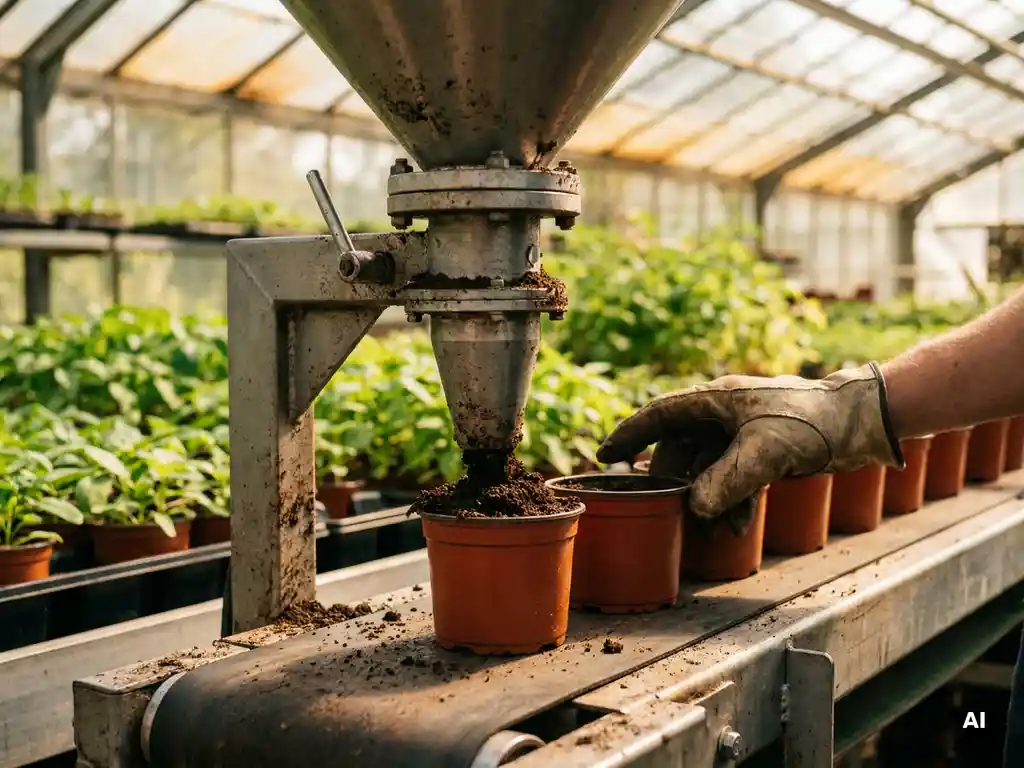
An automated potting machine measures and delivers a controlled volume of substrate into each pot in a single, repeatable action. Rather than relying on an operator to judge fill depth by eye or feel, the machine uses a fixed or programmable bore depth to determine how much soil enters each pot. This produces a consistent fill level across every cycle.
More advanced machines go further. The Stolze 3030 PRO, for example, uses automatic soil detection to sense the substrate level in real time and adjust accordingly. This means that even when the soil mix varies slightly in density or moisture content, the machine compensates to maintain a uniform fill. The result is less variation between pots and less need for human correction afterwards.
Why does inconsistent pot filling lead to more finishing work?
Inconsistent filling creates a cascading problem on the potting line. When one pot is overfilled and the next is underfilled, every pot that falls outside the acceptable range requires manual intervention before it can move forward. At scale, this means a portion of your workforce is permanently assigned to correction rather than production.
There is also a quality dimension. Inconsistent potting density affects how roots establish in the substrate. Pots that are too loosely filled dry out faster and may cause plants to lean or fall, which leads to further handling downstream. Pots that are compacted too firmly restrict root development. Both outcomes require additional attention that a well-calibrated automated system avoids from the start.
Which finishing tasks can automation eliminate entirely?
A well-configured automated potting line can eliminate several finishing tasks that would otherwise require dedicated labour. These include:
- Manual levelling of the soil surface – consistent bore depth means the fill arrives at the correct level without adjustment
- Removing substrate overflow – precise dosing prevents excess soil from spilling over pot edges
- Correcting underfilled pots – automatic soil detection catches and compensates for shortfalls before the pot leaves the machine
- Hand-firming loose substrate – controlled compaction during filling removes the need to press down the mix by hand
- Sorting and rejecting non-standard pots mid-line – when fill consistency is high, fewer pots need to be pulled from the line for rework
The degree to which each task is eliminated depends on the machine’s calibration, the suitability of the machine for your specific substrate, and whether the full line, including transport conveyors, is integrated to maintain a steady, controlled flow.
What finishing steps still remain after automated potting?
Even with a high-quality automated potting machine, some finishing steps remain. These are typically minor and require far less labour than in a manual setup, but they are worth planning for:
- Visual quality checks – a trained eye at the end of the line catches any pots that fall outside tolerance, particularly when changing pot sizes or soil mixes
- Topping with decorative substrate – if your product requires a layer of white peat, bark, or another topping material, this step is handled separately by a dedicated topping machine rather than the potting machine itself
- Plant placement and orientation – in lines where cuttings or young plants are inserted after potting, this step often remains manual or requires a separate transplanting system
- Tray loading and spacing – depending on your line configuration, placing potted plants into trays or onto growing gutters may still involve human handling
The key point is that automation shifts the nature of finishing work. Instead of correcting errors, remaining tasks become predictable, lower-intensity steps that can be planned and staffed accordingly.
When does upgrading to a more advanced potting machine reduce finishing further?
Upgrading to a more advanced potting machine reduces finishing work most noticeably when your current machine struggles with your soil mix, runs at speeds that create inconsistency, or lacks programmable settings for different pot sizes. If your team is regularly correcting pots after they leave the machine, that is a reliable indicator that the machine is not matched to your operation.
The difference between an entry-level machine and a model with automatic soil detection and programmable bore settings is most visible at high volumes and during peak season. When the line is running at full speed and every minute counts, a machine that self-corrects for substrate variation keeps the line moving without requiring extra hands to manage quality at the end.
Growers who run multiple pot sizes in a single day also benefit significantly from machines with programmable menus, since switching between configurations without reprogramming by hand reduces setup errors and the inconsistent fills that follow during the transition.
How MartinStolze helps reduce manual finishing on your potting line
We design and build our potting machines entirely in-house, which means every component is engineered to work together as a system rather than a collection of separate parts. For growers looking to reduce manual finishing, our range offers a direct solution:
- Consistent fill depth via programmable bore settings for each pot size and substrate type
- Automatic soil detection on the Stolze 3030 PRO, which compensates for density variation in real time
- Full line integration with our own transport conveyors and topping machines, so pots move through the system at a controlled pace without the bottlenecks that create finishing backlogs
- In-house support from our own engineers, who configure and install the machine to suit your specific mix and production volume
- Hire options with a trial period, so you can validate the reduction in finishing work before committing to a purchase
If you want to understand exactly how much finishing labour your current setup could save, we are happy to look at your specific situation. Contact us and we will work through the options with you.
Frequently Asked Questions
How long does it typically take to see a reduction in finishing labour after installing an automated potting machine?
Most growers notice a significant reduction in finishing labour within the first few production runs, once the machine has been properly calibrated to their specific substrate and pot sizes. The initial setup period, where your MartinStolze engineer fine-tunes bore depth and compaction settings, is the most important phase. After that, the consistency gains are immediate and repeatable from day one of full operation.
Can an automated potting machine handle different substrate types, such as peat-free or fibrous mixes, without increasing finishing work?
Yes, but the machine's suitability for your specific substrate is critical. Peat-free and fibrous mixes behave differently from standard potting soils, often requiring adjusted bore depths and compaction settings to achieve a consistent fill. Machines with automatic soil detection, like the Stolze 3030 PRO, handle substrate variation more reliably because they sense and compensate for density changes in real time rather than relying on fixed settings alone.
What is the difference between a potting machine and a topping machine, and do I need both?
A potting machine fills pots with your primary growing substrate to the correct depth and density, while a topping machine applies a separate decorative or functional layer, such as white peat, bark, or gravel, on top of the filled pot. Whether you need both depends entirely on your end product. If your plants are sold with a decorative top layer, a topping machine handles that step separately and far more consistently than doing it by hand.
How do I know if my current potting machine is the root cause of my finishing bottleneck, rather than something else on the line?
A simple way to diagnose this is to track where pots are being pulled from the line for correction and why. If the majority of interventions happen immediately after the potting machine, the machine's fill consistency is the likely cause. If corrections cluster further down the line, the issue may lie with conveyor speed, tray loading, or substrate preparation upstream. Mapping your correction points gives you a clear picture before investing in new equipment.
Is it worth automating a potting line if I only run small volumes or seasonal production?
Automation can still deliver value at lower volumes, particularly if your finishing labour is disproportionately high relative to your output. Hire options with a trial period, like those offered by MartinStolze, allow you to test the impact on your specific operation without committing to a full purchase. For seasonal growers, the ability to return or scale equipment after peak season makes automation more accessible than a permanent capital investment.
What should I prepare or check before integrating a new potting machine into an existing line?
Before integration, assess whether your existing conveyors can maintain a consistent pot flow at the speed the new machine operates, since mismatched line speeds are a common cause of post-installation finishing problems. You should also have your substrate mix characterised in terms of density and moisture range, so the machine can be calibrated accurately from the start. Finally, confirm that your pot sizes and tray configurations are compatible with the machine's settings to avoid setup errors during the transition.
Can automation help reduce plant losses caused by inconsistent potting, not just labour costs?
Absolutely, and for many growers this is where the return on investment becomes most visible. Inconsistent fill density directly affects root establishment, moisture retention, and plant stability, all of which influence crop losses and the additional handling required to correct leaning or stressed plants later in the growing cycle. A well-calibrated automated line produces uniform conditions for every plant from day one, which reduces downstream losses and the labour associated with managing them.
Related Articles
- How do you prevent wasting substrate when topping thousands of pots?
- How do sensors help control an automatic topping machine?
- How do you calculate how long it will take to pot 10,000 plants?
- What does a fully automated potting line actually look like?
- How does poor internal transport affect greenhouse output?