
Does running pots in multiple rows increase hourly production?
Yes, running pots in multiple rows does increase hourly production on a potting machine, but the relationship is not purely linear. Doubling your rows does not automatically double your output. The real gain depends on how well your entire line keeps pace with the machine’s filling speed. Below, we unpack exactly how multi-row potting works, where the limits are, and how to get the most pots per hour from your setup.
How does running pots in multiple rows actually work?
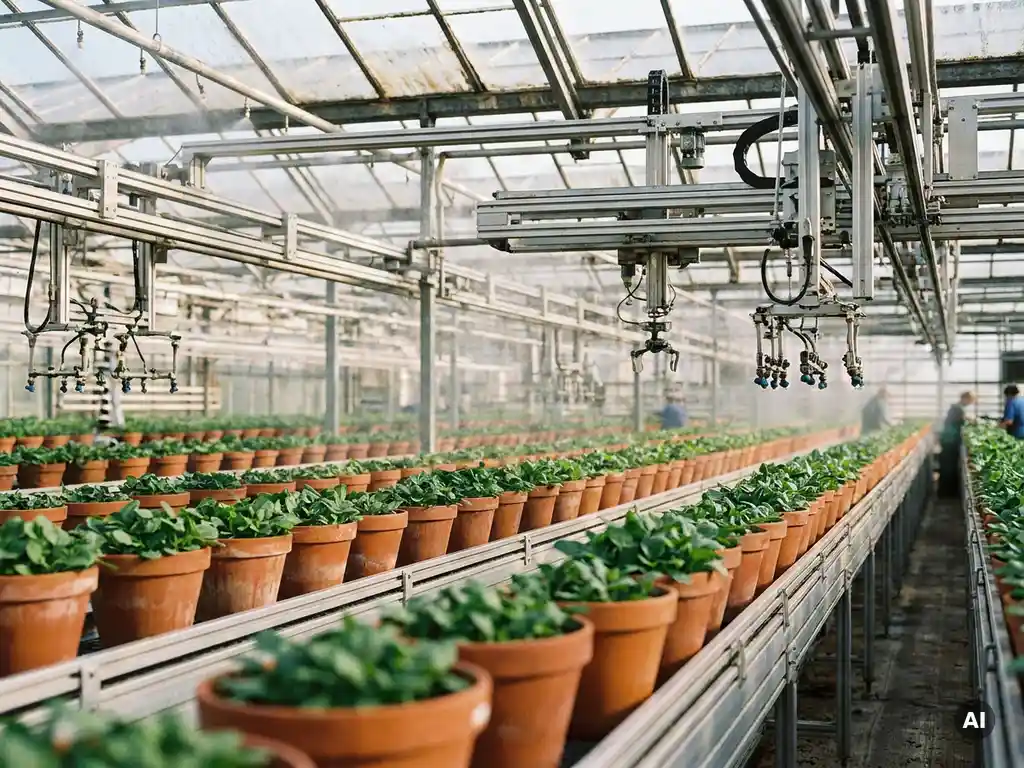
A potting machine fills pots by moving them along a chain or conveyor past a soil-filling and boring mechanism. In single-row mode, one pot at a time passes through the filling station. In dual-row or alternating mode, two pots are filled simultaneously per cycle, effectively doubling the number of pots processed per unit of time at the same chain speed. Some machines also offer an alternating pattern, where pots are offset to allow tighter spacing and a more continuous flow.
The key mechanism is that the machine’s chain speed and boring depth remain constant regardless of row count. What changes is how many pots sit across the width of the conveyor at any given moment. This means the hourly output per row is essentially the same as in single-row operation, so adding a second row is the most direct way to increase total pots per hour without increasing chain speed or mechanical stress on the machine.
For this to work smoothly, the infeed of empty pots and the outfeed of filled pots must be able to handle the wider flow. A single-row conveyor feeding a dual-row machine becomes the bottleneck immediately, which is why multi-row production almost always requires a matching transport and conveyor system on both sides of the potting machine.
Do more rows always mean more pots per hour?
Not always. More rows increase the theoretical capacity of the potting machine itself, but total pots per hour is determined by the slowest point in your entire production line, not just the machine. If your soil supply, pot infeed, or downstream conveyor cannot match the pace of a dual-row setup, the extra row adds no real throughput.
In practice, growers who switch from single- to dual-row operation without upgrading their surrounding line often see only a partial improvement. The machine fills pots faster, but filled pots back up, or empty pots run out before the machine can use its full capacity. The result is more downtime, not more output.
That said, when the full line is properly configured, adding a second row can come very close to doubling your pots per hour. The closer your supporting equipment is to being in balance with the machine, the more of that theoretical gain you actually capture.
What factors limit hourly output beyond row count?
Several factors cap your real-world potting machine pots per hour, regardless of how many rows you run.
- Soil supply consistency: If your soil mix is uneven, too wet, or contains clumps, the filling mechanism slows down or stops to clear blockages. Machines with automatic soil detection handle this better by adjusting in real time.
- Pot infeed speed: Empty pots need to arrive at the machine at the same rate they are being filled. Manual placement or a slow infeed conveyor creates gaps in the chain and reduces effective output.
- Chain speed and boring depth: Running the chain faster increases throughput but can reduce fill accuracy if the machine is not calibrated for it. Boring too deep also slows the cycle.
- Operator involvement: Any step that requires a person to intervene, reposition, or correct a pot introduces variability and limits sustainable hourly output.
- Downstream handling: Filled pots need somewhere to go. A congested outfeed causes the machine to pause, directly cutting into your pots per hour figure.
Addressing these factors is often more impactful than simply adding a row. A well-tuned single-row line can outperform a poorly supported dual-row setup.
How do the Stolze 3030 and 3030 PRO compare on multi-row production?
Both the Stolze 3030 and the Stolze 3030 PRO support single-row, dual-row, and alternating configurations, with a maximum capacity of up to 8,000 pots per hour. The difference between the two models is not the row capability itself, but how reliably and consistently each machine sustains that capacity during a full production shift.
The Stolze 3030 is a robust, straightforward machine with PLC control and a touchscreen interface. It handles pots from 7 to 30 cm and performs well across a wide range of soil mixes and pot sizes. For many growers, it is the right machine for the job.
The Stolze 3030 PRO takes multi-row production a step further with automatic soil detection, which continuously monitors and adjusts the fill level per pot. This matters most in dual-row operation, where inconsistency tends to compound. The PRO also runs more quietly, requires less maintenance, and uses a fully guided chain that keeps pot positioning stable at higher speeds. For operations running long shifts or dealing with variable soil conditions, the PRO’s automation reduces the human intervention that typically limits sustained pots per hour.
When does adding a row stop improving your output?
Adding a row stops improving your output when the rest of your production line cannot absorb the additional volume. This is the point of diminishing returns in multi-row potting, and it is determined entirely by your weakest link, not by the machine itself.
Practically speaking, most growers reach this point when one of the following is true: the soil supply cannot fill two rows consistently, the pot infeed requires manual loading that cannot keep pace, or the outfeed conveyor is sized for single-row flow. At that point, running a second row creates more interruptions than it solves, and your real pots per hour may actually drop compared to a smooth single-row operation.
The right time to add a row is when your current single-row output is already running at its ceiling and the rest of your line has headroom to handle more volume. If you are unsure where your actual bottleneck is, a line audit before investing in a wider configuration will save time and money.
How we help you maximize pots per hour
At MartinStolze, we do not just supply a potting machine and leave you to figure out the rest. We design and build complete potting lines where every component is matched to your specific output target, pot size range, and soil mix.
- Both the Stolze 3030 and the Stolze 3030 PRO are available in single, dual, and alternating row configurations
- We integrate the machine with transport conveyors, topping machines, tray fillers, and sorting lines built in our own production facility
- Our own technicians handle installation, calibration, and training at your location
- Buying and renting are both possible, including a trial period so you can validate output before committing
- We guide you through the right configuration for your soil mix, pot sizes, and production volume from the very first conversation
If you want to know exactly how many pots per hour your operation can realistically achieve and which setup gets you there, get in touch with our team and we will work it out with you.
Frequently Asked Questions
How do I know if my current production line is ready for dual-row potting?
The best indicator is whether your single-row setup is already running at full capacity without bottlenecks. Check whether your soil supply, pot infeed conveyor, and outfeed handling can each sustain roughly double their current volume. If any of these components already struggles to keep up in single-row mode, upgrading them should come before — or alongside — switching to dual-row operation.
What is the most common mistake growers make when switching to multi-row potting?
The most common mistake is upgrading the potting machine itself without upgrading the surrounding line. Growers often assume that a dual-row machine will automatically double output, but if the pot infeed, soil supply, or outfeed conveyor remains sized for single-row production, the new capacity goes unused. Always treat the switch to multi-row as a full line upgrade, not just a machine setting change.
Can I run different pot sizes simultaneously in dual-row mode?
Generally, no. In dual-row mode, both rows are filled in the same pass, which means the boring depth, fill volume, and pot spacing are set for one pot size at a time. Mixing pot sizes across rows would result in inconsistent fill levels and misaligned boring. If you regularly switch between pot sizes, look for a machine with quick-change calibration settings so you can reconfigure the line efficiently between runs.
How does soil moisture and mix consistency affect pots per hour in multi-row setups?
Soil quality has a disproportionate impact in multi-row operation because any inconsistency — clumps, excessive moisture, or uneven texture — affects two pots per cycle instead of one. This can lead to fill errors, blockages, or machine pauses that compound quickly over a full shift. Using a well-prepared, consistent soil mix and a machine with automatic soil detection, like the Stolze 3030 PRO, significantly reduces this risk and helps sustain peak output throughout the day.
What chain speed should I run for optimal pots per hour without sacrificing fill accuracy?
The optimal chain speed depends on your specific pot size, soil mix, and machine configuration — there is no single universal setting. As a rule, increasing chain speed beyond the machine's calibrated range reduces the time each pot spends under the filling mechanism, which can lead to underfilling or uneven boring. Start at the manufacturer's recommended speed for your pot size, validate fill accuracy across both rows, and only increase speed incrementally while monitoring output quality.
Is renting a potting machine a practical way to test multi-row production before buying?
Yes, and it is often the smartest first step for growers who are unsure whether dual-row production will deliver the throughput gains they need. A rental or trial period lets you run the machine under your actual soil conditions, pot sizes, and production schedule before making a capital investment. MartinStolze offers both buying and renting options, including a trial period specifically so you can validate real-world output before committing.
How long does it typically take to install and calibrate a new multi-row potting line?
Installation and calibration timelines vary depending on the complexity of your line and the number of integrated components, but most setups are operational within one to a few days when handled by experienced technicians. Having your soil mix, pot sizes, and target output defined in advance speeds up the calibration process significantly. MartinStolze's own technicians handle installation, calibration, and on-site training, which reduces downtime and ensures the line is dialled in correctly from the start.
Related Articles
- How accurate are automatic topping machines at high speeds?
- Is pots per hour the best metric for comparing potting machines?
- How does higher hourly capacity help meet tight delivery deadlines?
- How do you train staff to operate a new potting machine quickly?
- How do you choose between a mobile and fixed conveyor system?