

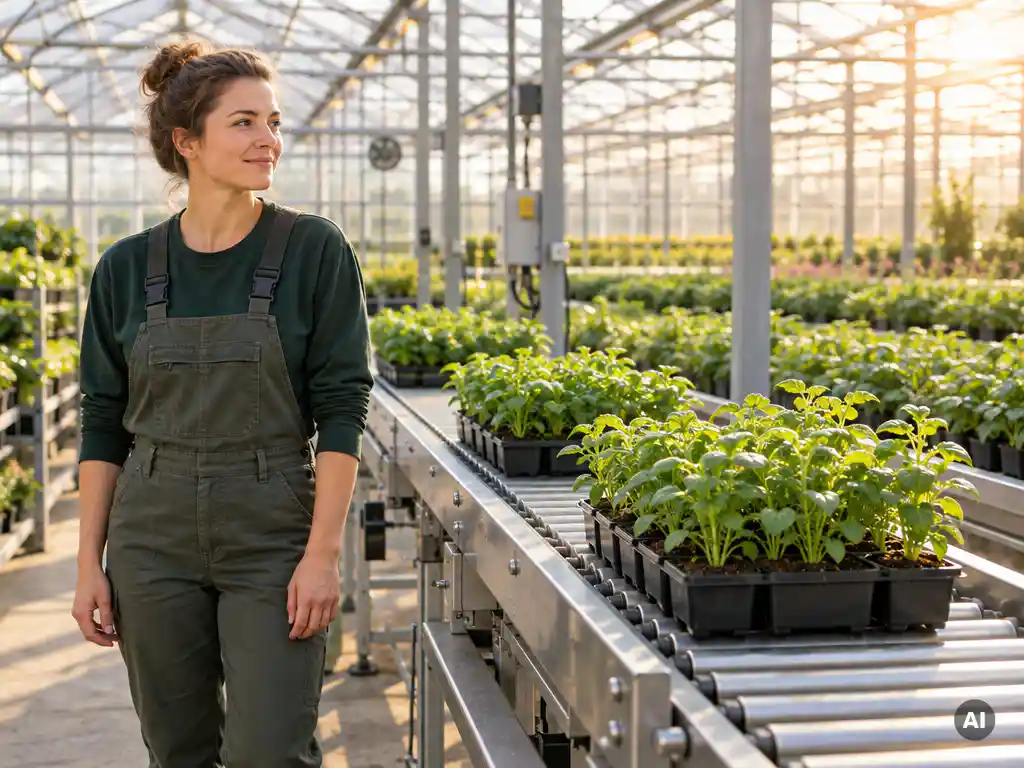
Easy greenhouse efficiency wins for nurseries with heavy manual lifting
If your team spends the day lifting pots, trays and crates, you already know where the hours go. Greenhouse efficiency rarely depends on one big breakthrough. More often, it comes from a handful of small changes that take the heavy, repetitive work off people’s hands. For nurseries struggling to fill vacancies and keep up with rising wage costs, those changes can make the difference between a stressful season and a smooth one.
The good news is that you do not need to rebuild your whole operation to see results. Simple internal transport upgrades can lift productivity, protect your staff’s backs and make your output more predictable. Here is where to look first.
Where Manual Lifting Quietly Drains Your Margins
Manual lifting costs more than most growers realize, because the expense hides in slow hours, sick days and constant recruitment rather than in a single line on the balance sheet.
Think about a typical day in a potted plant nursery. People carry trays from the potting line to the buffer area, move crates to the dispatch zone and shuffle plants between greenhouse sections. Each of these movements looks small, yet repeated hundreds of times they add up to a large share of your total labor hours, none of which add value to the plant itself.
Then there is the human side. Heavy, repetitive work leads to strain injuries, higher absenteeism and staff who leave for easier jobs. Replacing them means more vacancies, more training and often more expensive temporary workers during peak weeks. Reducing lifting is therefore both a cost issue and a retention issue.
A useful first step is simply to walk your site and count the touches. How many times is one plant picked up between potting and the truck? Every touch you remove is a direct saving, and it shows exactly where improving greenhouse efficiency will pay off fastest.
Quick Wins With Mobile Conveyor Belts
Mobile conveyor belts are the easiest way to cut manual carrying, because they work immediately, need no building changes and can be moved to wherever the work is.
A flexible belt lets you connect two workstations without anyone walking back and forth with a trolley. Plants travel at a steady pace, people stay at their stations, and the flow of the whole line becomes calmer. Because the belt is mobile, you can set it up in the potting area one week and use it in the packing zone the next.
This low threshold makes mobile belts a smart starting point for nurseries that are unsure where to begin. You can test the effect in one corner of the operation, see the time saved and decide on the next step with real experience instead of guesswork. At MartinStolze, we offer a wide range of conveyor belts that can be combined with work tables, scales and lighting, so a simple belt can grow into a complete workstation over time.
Seasonal peaks are another good reason to start here. If you only need extra capacity for a few busy weeks, renting a mobile belt lets you try the benefits before you commit to a purchase.
Buffer Tables and Potting Machines That Save Hands
Buffer tables and potting machines save hands by taking over the two most repetitive jobs in a nursery: temporarily holding product and filling pots.
A buffer table smooths out the uneven rhythm between production steps. When the potting line runs faster than packing, plants have nowhere to go, and people start stacking and carrying them by hand. A buffer absorbs that difference, so nobody has to wait and nothing has to be lifted just to keep the line moving.
Why potting machines change the picture
Potting by hand is slow, tiring and hard to staff. A potting machine handles the filling and placing at a steady speed, so one operator can achieve what used to take a whole group. The work also becomes more consistent, which helps quality as well as speed.
Combining machines into one flow
The real gain appears when these machines connect. A potting machine feeding a conveyor, which leads to a buffer table, creates a continuous line where plants barely need to be touched. This is how growers reduce a large team to a fraction of its former size while keeping the same output.
Automating Watering and Soil Handling Rounds
Automating watering and soil handling frees up the time spent on daily rounds, which are among the most physically demanding and least visible tasks in a greenhouse.
Watering by hand means walking long distances with hoses, while moving soil means shovelling, carrying and refilling. Both jobs are necessary, but neither needs to be done manually. A watering station can give plants a consistent amount of water as they pass through, which reduces waste and makes the result more reliable than a hurried round with a hose.
Soil transport deserves the same attention. Soil conveyor belts bring potting mix straight to where it is needed, removing the heavy lifting of bags and wheelbarrows. It is a quieter improvement than a new potting machine, yet it takes away some of the hardest physical work on the site.
When watering and soil handling are built into the same flow as your belts and buffers, the whole nursery starts to behave like one connected system rather than a series of separate manual tasks.
A Step-by-Step Path From Mobile to Fixed Systems
The most reliable route to automation is gradual: start with mobile equipment, learn from daily use, and move to fixed systems once the benefits are clear.
A practical sequence looks like this:
- Map your internal transport and identify the most labor-intensive handovers.
- Rent or install a mobile conveyor belt at the biggest bottleneck.
- Add buffer tables, work tables or weighing stations where flow still stalls.
- Introduce a potting machine or watering station once the line is stable.
- Convert proven setups into fixed, integrated systems.
This approach keeps risk low and lets your team grow comfortable with the changes. Because each step builds on the last, you are never locked into a large investment before you have seen it work. Some growers following this path have reduced a team of 26 people to 6 for the same output, which shows how far a step-by-step plan can take you.
If you are curious where your nursery could save the most hours, we are happy to think it through with you. Get in touch through our contact page and we will look at your situation together, from the first mobile belt to a complete line, with installation handled by us from start to finish.
Frequently Asked Questions
How do I know which part of my nursery to automate first?
Start by walking your site and counting how many times a single plant is touched between potting and dispatch. The handovers with the most manual lifting, walking back and forth with trolleys, or waiting time are your best candidates. A mobile conveyor belt at the biggest bottleneck is usually the lowest-risk way to test the effect before investing further.
How can I measure whether a mobile conveyor belt is actually saving me time?
Record a baseline before you install anything: how many people work on that step, how many trays or pots they handle per hour, and how much walking or carrying is involved. Repeat the same measurement one or two weeks after the belt is in use. Compare labor hours per 1,000 plants, and also ask staff whether the work feels less tiring, since reduced strain shows up in absenteeism over time.
Is renting equipment really worth it for seasonal peaks?
Yes, if you only need extra capacity for a few busy weeks, renting lets you add a mobile belt or work table without a long-term commitment. It also works as a trial run: if the equipment clearly improves your flow, you have solid evidence to justify a purchase. Plan the rental before the peak starts so your team has time to get used to the new setup.
What if my greenhouse layout is tight or irregular?
Mobile belts are designed for exactly this situation because they need no building changes and can be repositioned as needed. Measure your walkways and workstation spacing first, and keep enough room for people and trolleys to pass safely. If space remains a challenge, an equipment supplier can suggest a layout that combines belts, buffer tables and work tables in a compact configuration.
How do I get my staff on board with new equipment?
Involve the people who do the work in choosing where to start, since they know which tasks are the most tiring and where delays occur. Introduce one change at a time, give everyone a short hands-on introduction, and highlight how the equipment reduces lifting rather than replaces people. When employees notice less strain at the end of the day, acceptance usually follows quickly.
What are common mistakes when automating internal transport?
The most frequent mistake is buying a large, fixed system before understanding your real bottlenecks. Another is automating one step, such as potting, without adding a buffer or conveyor, which simply moves the pile-up to the next station. Work step by step, check that the whole flow keeps pace, and only then convert proven setups into fixed systems.
Can I combine different pieces of equipment into one workstation?
Yes, conveyor belts can be combined with work tables, scales, lighting, buffer tables and potting machines to build a complete workstation or line. Begin with a simple belt and add components where flow still stalls. Choosing equipment that fits together from the start makes it easier to expand without redoing your setup.