

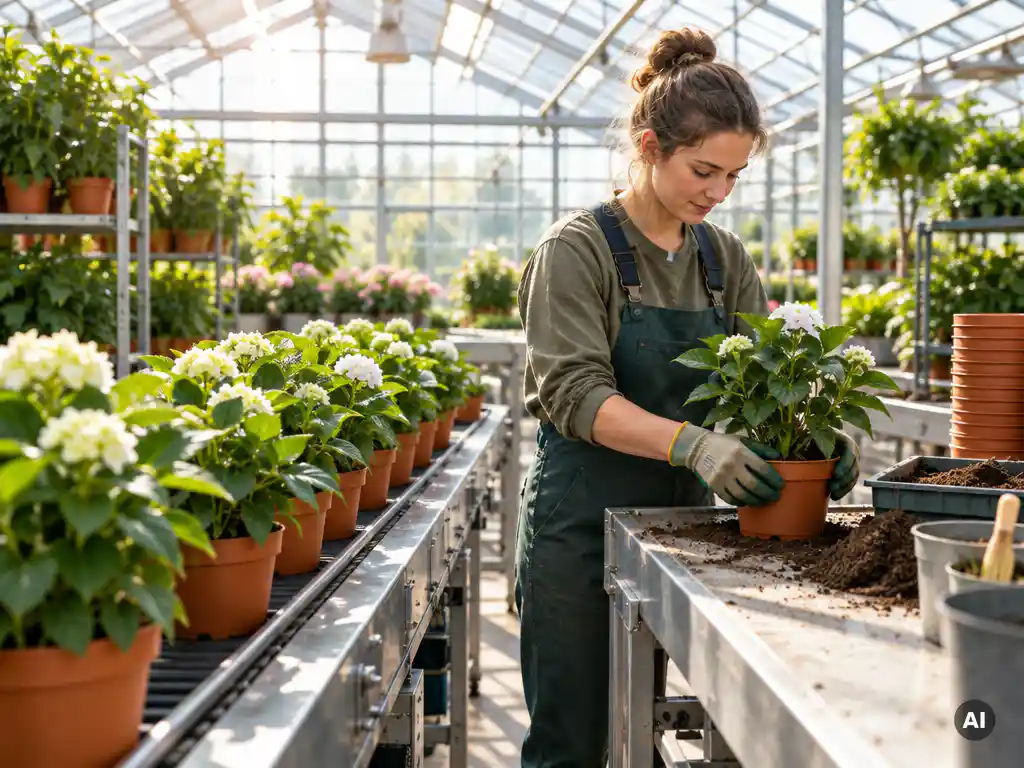
Essential greenhouse efficiency upgrades for ornamental growers in 2026
Where Labor Hours Disappear in Ornamental Production
Most labor hours in an ornamental nursery vanish into handling, not growing. Moving pots, trays and trolleys from one station to the next consumes far more time than many growers realize, simply because it is spread across dozens of small tasks and many people.
A simple exercise helps: follow a single batch of plants from potting to shipping and note every time someone lifts, pushes, carries or waits. Typical findings include double handling at buffer points, employees walking empty-handed back to a starting position, and peaks where a bottleneck at one station leaves three other people standing idle.
Physically heavy work adds a second cost on top of the hours themselves. Repetitive lifting leads to absenteeism and turnover, and replacing a trained colleague in a tight labor market is expensive. Mapping these hotspots first makes every later upgrade decision easier, because you know which movement to remove rather than guessing.
Automating Internal Transport With Conveyors and Buffer Tables
Automating internal transport means letting machines carry the plants while people focus on tasks that need judgment, such as quality checks, sorting and finishing. Conveyors and buffer tables are the backbone of that shift, and they are usually the most effective starting point for improving greenhouse efficiency.
Conveyors that keep the flow moving
A conveyor replaces the constant pushing and carrying between stations. Plants travel at a steady pace, workstations stay supplied, and nobody has to leave their position to fetch the next batch. Because the belts can be combined with work tables, scales and lighting, one line can handle picking, checking and weighing in a single pass. Our range of transport conveyors is built in our own workshop in De Lier for exactly this kind of flexible, combinable setup.
Buffer tables that smooth out the peaks
Production is never perfectly even. A buffer table collects plants between two process steps so that a short stop at one station does not halt the entire line. The result is a calmer rhythm, fewer idle minutes and less pressure on the team during busy periods.
Together, these two building blocks cut the handling that used to require many hands. Growers who automate their transport in a structured way have reported dramatic reductions, with some going from 26 to 6 FTE for the same output.
Smart Potting and Watering Upgrades Worth Considering
Potting and watering are the next logical targets once transport flows well, because both are repetitive, time-bound and easy to standardize. Automating them delivers consistency as well as savings.
A potting machine fills and places pots at a steady speed, replacing a task that is physically demanding and prone to variation when done by hand. Connected to a conveyor, it feeds directly into the rest of the line with no extra carrying. Soil transport belts support this by bringing substrate where it is needed without wheelbarrows or manual shoveling.
Watering stations bring a similar benefit. Instead of walking the greenhouse with hoses, plants pass through a station that gives each pot the right amount of water. This saves hours, reduces waste and supports more even crop quality, which matters when buyers expect uniform trays. Because these machines are designed to work together, each addition strengthens the whole line rather than creating another isolated island of automation.
Starting Small With Mobile and Rental Solutions
The lowest-risk way to begin is with a mobile conveyor or a rental machine, which lets a grower see real results on the real shop floor before committing to a fixed installation. Many nurseries begin by renting equipment during a peak period and then build up step by step.
This approach answers the most common hesitation: not knowing whether a system will actually fit the way a nursery works. A mobile belt can be moved between greenhouses, tested on different crops and adjusted as the team learns what helps most. If it proves its value, the next step might be a second belt, a buffer table or a fixed line integrated with potting and watering.
Growing in stages also spreads the investment and keeps the business flexible. Teams get used to automation gradually, which usually leads to better acceptance on the work floor than a sudden, large-scale change.
Planning Your 2026 Upgrade Roadmap and Budget
A good roadmap starts with the biggest labor drain and works outward, with each phase paying for part of the next. Rather than aiming for a fully automated nursery in one go, sequence the upgrades by impact and ease of implementation.
- Measure first. Track handling hours per process step to find the real bottleneck.
- Start with transport. A conveyor or mobile belt usually offers the quickest visible saving.
- Add buffering. Place buffer tables where stops and peaks cause delays.
- Automate potting and watering. Link these machines to the existing line.
- Review and expand. Compare hours saved against the plan and decide on the next phase.
For budgeting, weigh the cost of equipment against the cost of agency staff, absenteeism and unfilled vacancies, not just against the current payroll. Choosing a partner who delivers hardware, software and installation from one source also reduces coordination work and surprises along the way. If you are unsure where to begin, our team is happy to think through your layout with you, and you can get in touch for advice on the first step that makes sense for your nursery.
The growers who come out ahead in 2026 will not necessarily be those who spend the most. They will be the ones who pick the right first step, learn from it, and keep building from there.
Frequently Asked Questions
How do I measure handling hours in my nursery if I have never tracked them before?
Start with a simple two-day observation of one product batch, from potting to shipping. Use a clipboard or a spreadsheet to log each step, the number of people involved, and how long they spend lifting, pushing, carrying or waiting. Even a rough baseline is enough to reveal the biggest bottleneck, and you can refine it later with timestamps or simple time-tracking apps.
What if my greenhouse layout is too tight or irregular for a conveyor system?
Tight or irregular layouts are common in ornamental nurseries, and they are exactly where modular, combinable belts help. Sketch your floor plan with dimensions, door widths and walking routes, then ask a supplier to review it before you buy anything. A mobile conveyor is also a good way to test whether a line fits your space without making a permanent change.
How can I get my team on board with automation and avoid resistance?
Involve employees early by asking which tasks they find the heaviest or most repetitive, and let them test a mobile belt or rented machine first. Make it clear that automation takes over the physical handling so people can focus on quality checks, sorting and finishing. Introducing changes in stages also gives the team time to adapt and share practical feedback.
How do I calculate whether an investment in conveyors or potting machines will pay back?
Compare the total annual cost of the current process, including wages, agency staff, absenteeism and overtime, against the cost of the equipment plus maintenance and energy. Estimate the hours saved per week based on your handling measurements, and multiply by your fully loaded hourly labor cost. Include softer gains such as more consistent quality and lower turnover, but base the core decision on the hard numbers.
What are the most common mistakes growers make when starting to automate?
The most frequent mistakes are automating a step that is not actually the bottleneck, buying isolated machines that do not connect to each other, and trying to change the whole nursery at once. Avoid these by measuring first, choosing equipment that can be combined into one line, and expanding in phases. Also plan for buffer capacity, since one stalled station can otherwise stop everything downstream.
Is renting equipment a realistic option during peak season?
Yes, renting is a practical way to cover seasonal peaks without a long-term commitment. Book early, since demand for rental machines rises sharply in busy periods, and agree in advance on delivery, setup and support. If the rental clearly saves hours, use the results as evidence for a fixed installation in your next budget round.
What should I ask a supplier before choosing an automation partner?
Ask whether they can deliver hardware, software and installation from one source, how quickly they can provide service and spare parts, and whether the equipment can be extended later. Request references from nurseries growing similar crops, and ask for a layout proposal based on your own greenhouse. A partner willing to think through your workflow before quoting is usually a good sign.