

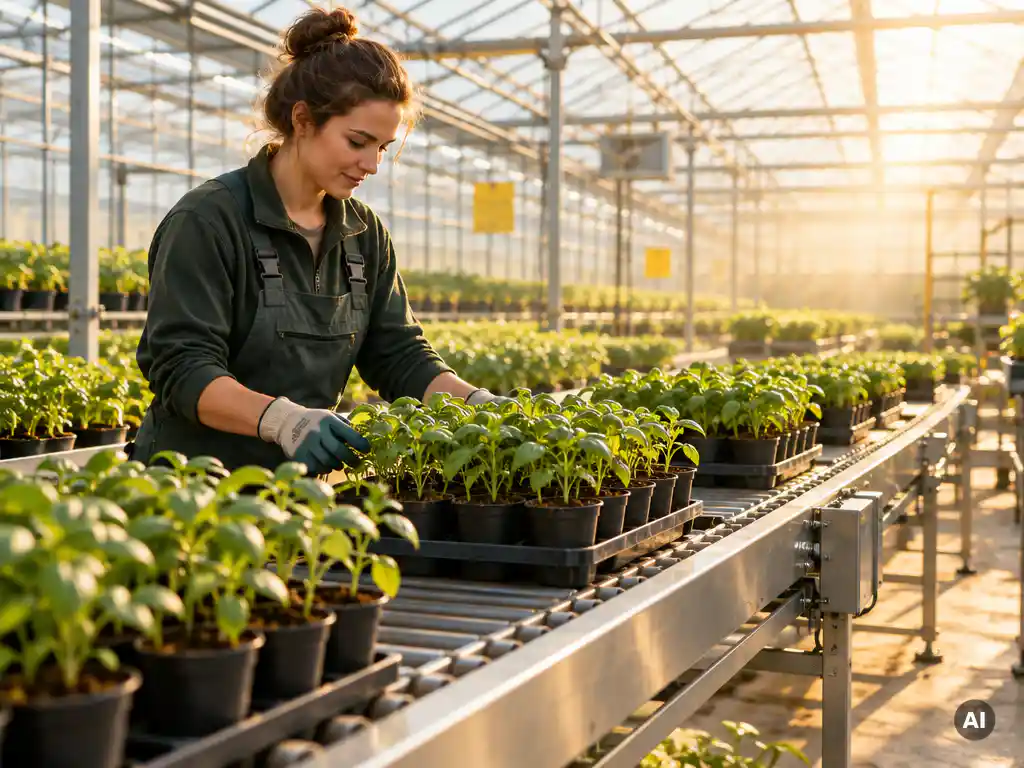
Greenhouse efficiency and conveyor belts: what every grower should know
Walk through almost any nursery during a busy week and you will notice the same thing: people carrying, pushing and stacking plants far more than they are actually growing or packing them. That movement is where greenhouse efficiency is won or lost. Moving trays, pots and crates by hand is slow, tiring and expensive, especially now that good people are harder to find every year.
Conveyor belts are one of the most practical ways to improve greenhouse efficiency without rebuilding your whole operation. This guide looks at where labor hours go missing, how conveyors fix it, and how to start in a way that fits a family-run nursery in 2026.
Where Greenhouse Labor Hours Quietly Disappear
Most labor hours disappear in internal transport: the repetitive moving, lifting and waiting that happens between the real production steps. Because it is spread across the whole day and across many people, it rarely shows up as a single line on a cost sheet.
Think about a typical potting or packing process. Someone carries plants to the potting station, someone else removes finished trays, and a third person walks plants to the dispatch area. None of these actions adds value to the plant, yet together they can swallow a large share of your payroll.
Seasonal peaks make it worse. When volume jumps, growers often cover the gap with temp workers who need training, make more mistakes and cost more per hour. Heavy lifting adds another hidden cost, because physically demanding work leads to sick leave and higher turnover. Each lost employee takes experience out the door.
The good news is that these losses are fixable. Once you see transport as a process rather than a necessary evil, it becomes the obvious place to start.
How Conveyor Belts Raise Greenhouse Efficiency
A conveyor belt raises efficiency by moving plants automatically between workstations, so people stay at their stations and the product comes to them. The result is fewer steps walked, fewer loads lifted and a steadier flow of work.
Less walking, more working
When plants travel on a belt, employees no longer spend part of every hour carrying trays. A worker at a sorting or packing table can focus on the task itself, which raises output per person. The pace also becomes more consistent, because the line sets a rhythm instead of relying on who happens to be free to fetch the next batch.
Better ergonomics, steadier teams
Lifting and bending are among the main reasons nursery work wears people out. Belts at a comfortable working height take most of that strain away, which helps reduce absenteeism and makes the job more attractive to new hires. In a tight labor market, that matters as much as the raw time saved.
Modular lines that combine
Conveyors become even more useful when you combine them with other equipment. Belts can be linked with buffer tables, work tables, scales and lighting, so a simple transport line grows into a complete processing line. Our range of conveyor belts is built exactly for this kind of combination, so you can expand step by step as your needs change.
The effect on staffing can be dramatic. Growers who automate their internal transport consistently find that the same output needs far fewer people, and some of our customers have gone from 26 to 6 FTE for the same production volume.
Choosing Between Mobile and Fixed Systems
The choice comes down to flexibility versus permanence: mobile belts suit changing layouts and seasonal peaks, while fixed systems suit stable, high-volume processes that run all year.
A mobile conveyor can be moved to wherever it is needed. It works well for a nursery that is still learning where automation pays off most, or one that handles different crops through the year. Setup is quick, the investment is smaller, and the belt can be redeployed if your process changes.
A fixed system is built into the flow of your greenhouse or packing hall. It takes more planning and a larger investment, but it becomes the backbone of production, linking potting, watering, buffering and dispatch into one connected line. For high volumes and repeating routines, this is where the biggest long-term savings sit.
Many growers do not have to choose one or the other. A common path is to start mobile, prove the benefit in daily practice, and then grow toward a fixed setup. Renting equipment during a busy period is a low-risk way to experience the difference before committing capital.
Smart Starting Points for Your Nursery
The smartest place to start is the busiest bottleneck: the one spot where people carry the most, wait the most or work the hardest. Fixing that single point usually delivers the quickest and most visible return.
Begin by watching a normal working day and noting where plants are moved by hand. Count how many people are involved and how often the same route is walked. Potting, sorting, watering and loading for dispatch are frequent candidates, and they often reveal one clear priority.
Then think in stages. Put one mobile belt at that bottleneck during a peak period and measure what changes in hours, output and the mood on the floor. Once the benefit is clear, extend the line to the next step in the process rather than automating everything at once.
It also helps to talk through the layout with someone who knows greenhouse logistics. If you would like a second opinion on where your own hours disappear, you are welcome to get in touch with our team, and we will think along with you about a sensible first step.
Common Automation Mistakes Growers Can Avoid
The most common mistakes are automating too much at once, ignoring the full process and mixing too many suppliers. All three are avoidable with a bit of planning.
Going all in on day one is tempting, especially when labor shortages feel urgent. But a large system built on untested assumptions can lock in a layout that does not fit how your team really works. A stepwise approach lets you learn first and invest second.
Another pitfall is automating a single machine without looking at what comes before and after it. A fast potting line that feeds into a slow, manual dispatch area simply moves the bottleneck down the line. Thinking about the whole flow keeps the improvement real.
Finally, coordinating hardware, software and installation across several suppliers creates friction, delays and finger-pointing when something does not work. Choosing a partner who delivers everything from one source keeps the project simple and the line reliable. Growers who avoid these traps tend to see steady gains in greenhouse efficiency year after year, and they build a team that spends its time growing plants instead of carrying them.
Frequently Asked Questions
How do I calculate whether a conveyor belt will pay for itself in my nursery?
Start by measuring how many people and how many hours go into manual transport on one specific route over a typical week and a peak week. Multiply those hours by your fully loaded hourly labor cost (including temp worker training and error rates), then compare that to the cost of the belt, including installation and maintenance. Also factor in softer gains such as lower absenteeism and less turnover, since these often tip the business case in favor of automation.
How do I get started if I have never used automation in my greenhouse before?
Begin with a single mobile conveyor at your biggest bottleneck, such as potting, sorting or loading for dispatch. Run it during a busy period, track hours, output and employee feedback, and use those numbers to decide on the next step. Renting a belt for a peak season is a low-risk way to test the concept before you commit capital.
How do I get my team on board with new conveyor equipment?
Involve your employees from the start by asking where they walk, lift and wait the most, since they know the real bottlenecks better than anyone. Emphasize that the belt takes over the heavy, repetitive work so they can focus on tasks that actually need skill and attention. A short pilot with a few team members, followed by their feedback, usually builds acceptance faster than a top-down rollout.
What should I consider when planning the layout for a conveyor line?
Map the full route of your plants from potting to dispatch and note available floor space, walking paths, doorways and any height restrictions. Plan work surfaces at a comfortable ergonomic height and leave room for buffer tables so the line doesn’t stall when one station is temporarily slower. Choosing a modular system makes it easier to adjust the layout later as your crops or volumes change.
What if a conveyor just moves the bottleneck to another part of my process?
This is a common issue when only one step is automated. Look at the entire flow before and after the belt, and add buffer tables or extend the line to the next manual step if it becomes the new constraint. Measuring throughput at each station for a week or two after installation will quickly show where the next bottleneck is.
Can conveyor belts handle different pot sizes, trays and crops?
In most cases yes, especially with modular belts that can be combined with different work tables, guides and accessories. Make sure you share the range of pot sizes, tray types and weights you use with your supplier so the belt width, speed and surface are matched to your products. Mobile belts are particularly handy if your crop mix changes through the season.
How much maintenance does a greenhouse conveyor belt need?
Maintenance is generally modest: keep the belt clean from soil, water and plant debris, check for wear on the belt surface and rollers, and make sure the drive and safety features work properly. Greenhouse environments are humid and dusty, so a simple weekly cleaning and inspection routine goes a long way. Working with a single supplier for hardware, installation and service also makes it easier to get quick help if something goes wrong.