

Greenhouse efficiency and fewer errors: what automated lines change on the floor
Where Manual Handling Quietly Costs Growers Money
Manual handling costs money through wasted walking time, physical strain, inconsistent pace, and avoidable mistakes, none of which appear as a single line item on the balance sheet.
Think about how many times a pot or tray is picked up, carried, set down, and picked up again before it reaches its destination. Each of those moments takes seconds, but across hundreds of hectares of production or thousands of trays a day, those seconds become full working days. Add the physical load, and the picture gets worse: heavy lifting and repetitive movement drive absenteeism and turnover, which then forces growers to hire and train again.
Seasonal peaks make things harder still. When workloads spike, many growers bring in temporary staff who need time to learn the process, and the pace of the line often suffers. The hidden cost is not just wages. It is the inconsistency that comes with a workforce that changes from week to week.
What Changes on the Floor With Automated Lines
On the floor, automated lines replace carrying and walking with a steady, predictable flow, so people spend their time on tasks that actually need human judgment.
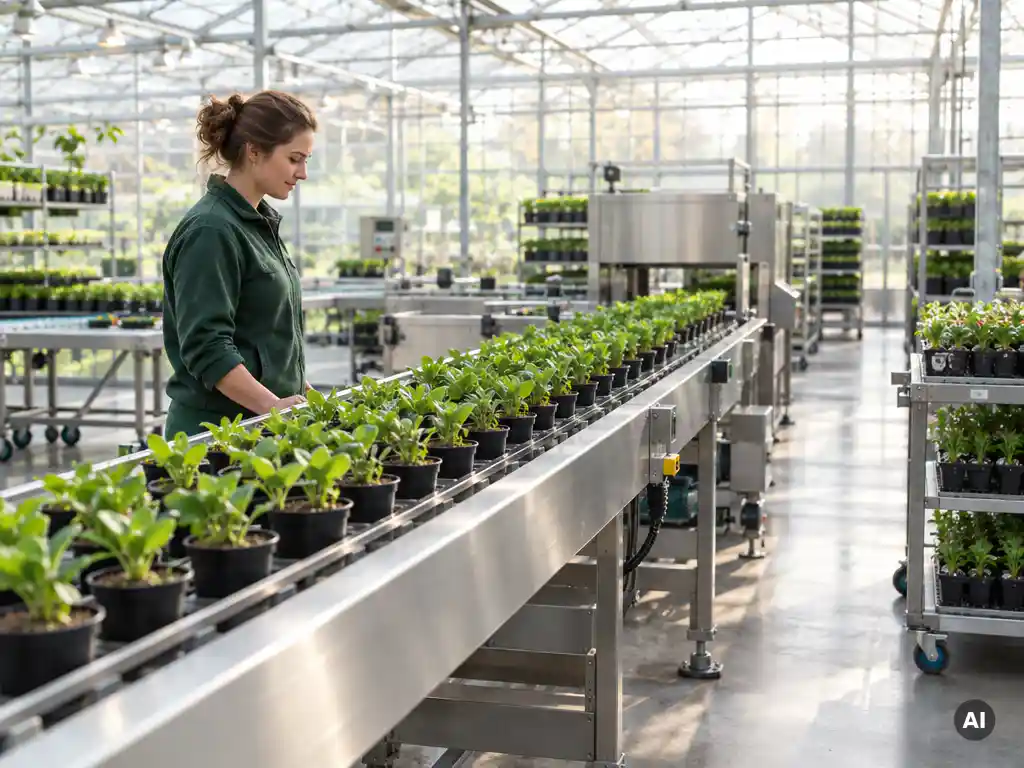
A conveyor moves plants from one workstation to the next at a controlled pace. Buffer tables absorb the difference between stations that work at different speeds, so one slow step no longer stalls everything behind it. Potting machines, watering stations, and roller tracks can be linked into one line, with work tables, scales, and lighting added where employees need to inspect or sort.
The change is visible in how people move. Instead of crossing the greenhouse with a trolley, employees stand at a fixed, ergonomic position and the product comes to them. The work becomes lighter, calmer, and easier to train for, which matters when finding experienced staff is a struggle. Our range of conveyor belts is built for exactly this kind of flexible, combinable setup.
How Consistent Flow Reduces Handling Errors
A consistent flow reduces errors because fewer manual touches mean fewer chances to damage plants, mix up batches, or skip a step.
Many handling mistakes are really fatigue and timing problems. A tired employee at the end of a long shift stacks trays carelessly, or a rushed team sends the wrong batch to the wrong lane. When the route is fixed and the pace is steady, the process itself guides the work. Plants travel the same path every time, which makes it easier to spot something out of place.
Fewer drops and knocks also mean less crop damage and less waste. Because each station receives a regular supply of product, quality checks can happen at a calm rhythm rather than in bursts. Over time, that stability improves both the end quality and the confidence of the team running the line.
Labor Savings in Numbers: From 26 to 6 FTE
Automation can cut labor needs dramatically: some of our customers went from 26 to 6 FTE while keeping the same output.
That result comes from removing the steps that only existed to move product around. When transport, buffering, and routine handling run automatically, the same volume needs far fewer hands. The remaining team members take on supervision, quality control, and finer plant care, which are tasks that are more rewarding and harder to automate.
Results like this depend on the layout, crop, and volume of each business, so no single figure applies everywhere. Still, the direction is consistent: less dependence on scarce labor, lower exposure to rising wage costs, and steadier margins. For a family business competing with more automated rivals, that shift can decide whether growth stays affordable.
Starting Small: A Step-by-Step Automation Path
The easiest way to begin is with a mobile conveyor, then expand toward fixed systems as the benefits become clear.
Many growers hesitate because full automation sounds like a big, risky investment. A phased approach removes much of that risk. Start by renting equipment during a peak period, watch how the line changes daily work, and build from there. Over time, a single mobile belt can grow into a connected line that forms the core of the production process.
Because we supply hardware, software, and installation from one source, there is no need to coordinate between several suppliers as the system grows. If you are weighing where to begin in your own greenhouse, get in touch with our team and we will gladly help you think through the first practical step. Greenhouse efficiency in 2026 is less about working harder and more about letting the right machines carry the load.
Frequently Asked Questions
How do I know which part of my greenhouse process to automate first?
Start by observing where your team spends the most time carrying, walking, or waiting. Track one or two busy days and note which handling steps repeat most often, such as moving trays from potting to the growing area. The step with the highest number of repetitive touches is usually the best candidate for a first conveyor or buffer table.
What if my greenhouse layout is irregular or space is limited?
Modular, combinable equipment is designed for exactly this situation. Mobile conveyors can be repositioned as needed, and buffer tables and roller tracks can be arranged around existing walkways and workstations. Measure your available width and turning space beforehand, and share a simple sketch with your supplier so the line can be planned around your constraints.
How can I test automation without a large upfront investment?
Renting a mobile conveyor during a seasonal peak is a low-risk way to try it out. Use it for a few weeks, compare output per person and handling errors with your previous routine, and then decide whether to expand. This gives you real data from your own crop and workflow instead of relying on estimates.
Will automation mean I have to lay off staff?
Not necessarily. In most cases the goal is to reduce dependence on hard-to-find temporary labor and shift existing employees toward supervision, quality control, and plant care. Many growers use automation to handle growth or seasonal peaks without hiring more people, rather than to replace their core team.
How do I train my team to work with a new automated line?
Introduce the line gradually, starting with one workstation and a small group of employees who can then coach others. Because the product comes to a fixed, ergonomic position, the tasks are usually simpler to learn than manual handling. Clear instructions on safety, emergency stops, and basic troubleshooting should be part of the first session.
What are common mistakes when introducing automated internal transport?
The most common mistakes are automating one station without considering the stations before and after it, and skipping buffer capacity so one slow step still stalls the line. Another is failing to involve the people who work on the floor in the planning. Map the full flow first, add buffers where speeds differ, and ask your team where the biggest bottlenecks are.
How do I measure whether automation is paying off?
Set a baseline before you start: trays or pots handled per hour, labor hours per batch, damage or waste percentage, and mislabeling incidents. Measure the same figures a few weeks after installation and again after a full season. Comparing these numbers against the investment or rental cost shows clearly where the savings come from.