

Greenhouse efficiency basics for nursery owners new to automation
Where Nurseries Lose Hours Without Noticing
Most lost time in a nursery hides in repetitive handling, not in the big jobs. Carrying trays between stations, waiting for the next batch to arrive and walking empty-handed back to the start all add up across a full working day.
These losses are easy to miss because they feel like normal work. A grower sees people busy from morning to evening and assumes the time is well spent. Yet when you watch one task from start to finish, you often find that a large share of the effort goes into moving product rather than treating or sorting it.
Seasonal peaks make this worse. When orders surge, extra temporary staff need training, and every extra pair of hands adds coordination work. Physically heavy tasks also drive absence and turnover, which quietly pushes up the cost of every hour that actually gets worked.
Mapping Your Internal Transport Flow First
Before buying any equipment, draw the route a plant takes from arrival to dispatch and mark every point where someone has to lift, carry or wait. This simple map shows where automation will help most and where it would only add cost.
A practical way to do this is to follow a single batch for a full day. Note how many times it is handled, how far it travels, and how many people touch it. Count the idle moments too, such as a potting line that stops because trays are not delivered in time.
Once you have the route on paper, look for three things:
- Bottlenecks: stations where product piles up or the line waits.
- Long manual stretches: distances that people cover on foot with heavy loads.
- Repeated handling: places where the same item is lifted more than once.
These points tell you which machine to consider first. They also give you a baseline, so you can measure the real effect of any change later.
Core Machines That Save the Most Labour
The machines that save the most labour are usually the ones that remove repetitive carrying and connect separate steps into one smooth line. For most nurseries, that means conveyors, buffer tables, potting machines and watering stations.
Transport and buffering
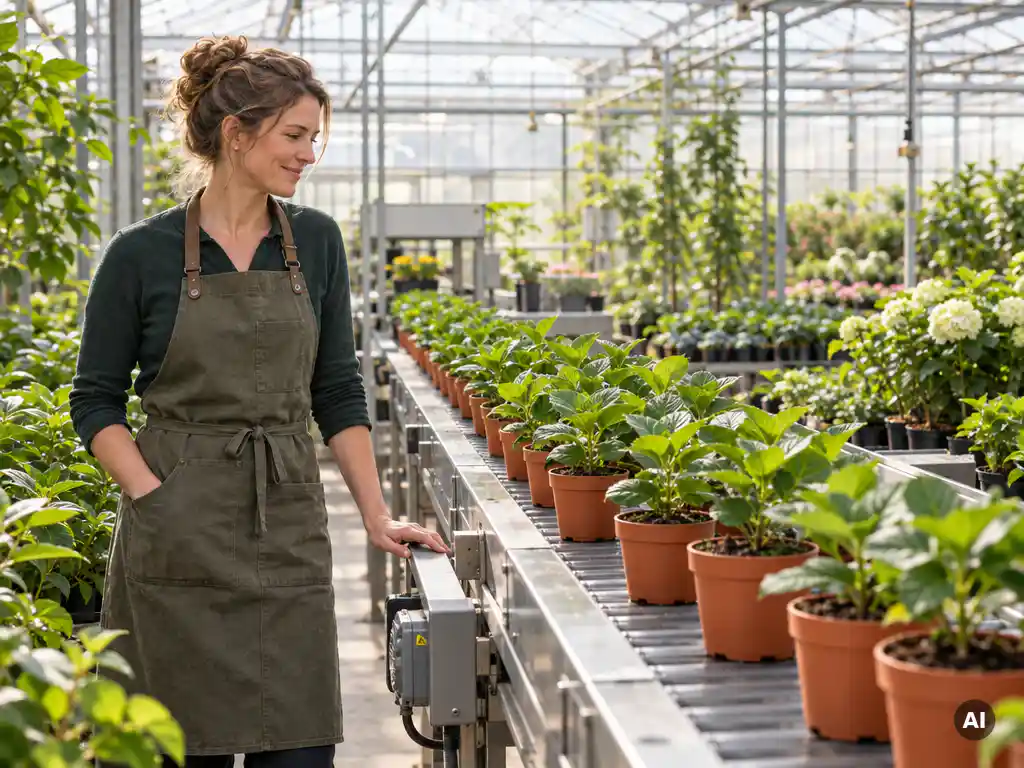
Conveyors take over the walking and lifting that fill so much of the day. They can be combined with work tables, scales and lighting, so a transport line doubles as a workstation. Our conveyor belts are built in our own workshop in De Lier and are designed to be combined, so a line can grow as your needs do.
Buffer tables smooth out the differences in speed between steps. Instead of one station waiting on another, product collects on the table and flows on at an even pace. That alone can make a line feel calmer and more predictable.
Potting and watering
Potting machines handle one of the most repetitive and physically demanding jobs in a nursery. Watering stations take care of a task that is often done by hand, and they do it consistently every time. Together with soil transport belts, these machines let a small team handle volumes that once required many more people.
The effect can be large. Some of our customers have gone from 26 to 6 FTE for the same output, which shows how much of the workload was really about moving and handling product.
Starting Small With Mobile Conveyors and Rental
The lowest-risk way to begin is with a mobile conveyor, ideally rented during a busy period. This lets you see the effect on your own site before committing to a fixed installation.
A mobile belt can be placed where your map showed the biggest bottleneck. Within a season you will know how much time it saves, how your team responds and where the next step should be. Renting also keeps the financial commitment low while you learn what works for your crop and layout.
From there, growth can be gradual. Many nurseries move from one mobile belt to several, then to fixed systems that form the backbone of the production line. Because the machines are made to work together, earlier investments are not wasted as the setup expands.
Common Automation Mistakes and How to Avoid Them
The most common mistake is automating a single task without looking at the whole flow. A fast machine in front of a slow station simply moves the bottleneck down the line and delivers little real gain.
Other pitfalls come up again and again:
- Buying before mapping: equipment chosen without a clear picture of the flow often ends up in the wrong place.
- Going too big, too fast: a full system installed in one step leaves little room to learn and adjust.
- Ignoring the team: people who understand why a change is made adapt faster and spot problems early.
- Juggling many suppliers: separate vendors for hardware, software and installation can make coordination harder than the automation itself.
Avoiding these traps mostly comes down to patience and good advice. Start with your flow map, test with a mobile solution, and expand only when the numbers support it. If you would like a second pair of eyes on your layout, get in touch with us and we will think it through with you, from the first conveyor to a complete line.
Greenhouse efficiency is built step by step, and the nurseries that do it well treat automation as a series of small, measured moves rather than one big leap.
Frequently Asked Questions
How do I measure whether automation is actually paying off after I install my first conveyor?
Use the baseline from your flow map: record handling times, number of touches per batch, idle minutes on the potting line and labour hours per day before the change. Repeat the same measurements after a few weeks of regular use and compare them. Even a simple spreadsheet tracking trays handled per labour hour will show whether the machine is saving time or just moving the bottleneck.
How long should I trial a rented mobile conveyor before deciding on a fixed installation?
Aim for at least one full busy period or a few weeks of normal production, so you see the machine under real workloads and not only on quiet days. Track time saved, how your team uses it and where product still piles up. If the data shows a clear gain and a new bottleneck appears further down the line, that is a good sign it’s time to plan the next step.
What should I do if my team is hesitant about new machines?
Involve them early by sharing your flow map and explaining which heavy or repetitive tasks you want to remove, not whose jobs are at risk. Let the people who do the work help decide where the mobile conveyor goes and ask for their feedback during the trial. Teams that see less lifting and walking in practice usually become the strongest supporters of the next step.
What if my greenhouse layout is cramped or irregular? Can conveyors still work?
Yes. Mobile and modular conveyors can be placed, combined and repositioned to fit narrow aisles or uneven layouts, and they can be built to custom dimensions. Start by marking the available width, turning points and obstacles on your flow map, then share it with a supplier who can design a line around those limits.
How do I handle seasonal peaks without over-investing in permanent equipment?
Cover the peak with rented mobile conveyors while keeping your permanent setup sized for your average workload. This lets you absorb surges without hiring and training many temporary workers or buying capacity that sits idle for most of the year. If you rent the same equipment every season, that is a good signal to buy it.
How do I avoid creating a new bottleneck after automating one step?
Check the capacity of the stations before and after the machine you plan to add, and make sure they can keep pace with it. Buffer tables are a simple way to absorb speed differences between steps. After installation, watch the line for a few days to see where product starts to pile up or the line waits, and adjust that point next.
Which step should I automate first if I can only afford one change this year?
Pick the spot on your flow map where people carry heavy loads over the longest distance or where a station regularly waits for deliveries. For most nurseries, this is a conveyor or mobile belt that links two existing steps. It is usually the cheapest change with the most visible time saving, and it provides data to guide your next investment.