

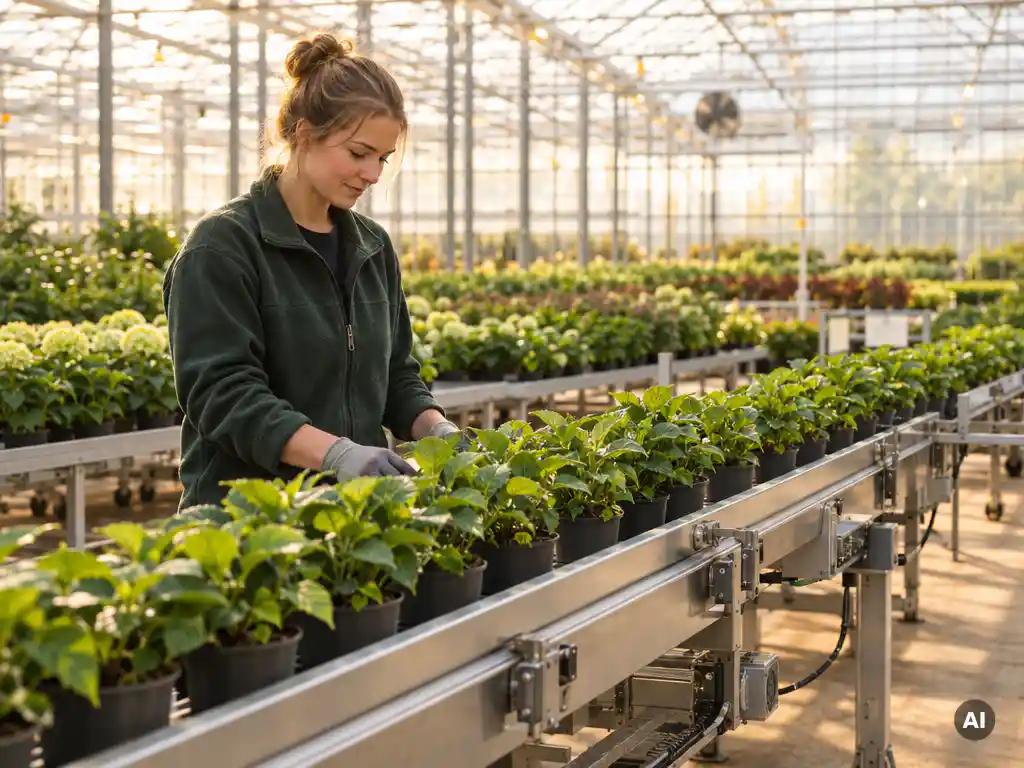
Greenhouse efficiency explained for growers facing a labor shortage
Finding enough skilled people for a greenhouse has become one of the toughest parts of running a nursery. Vacancies stay open for months, seasonal peaks call for expensive temporary workers, and wages keep climbing. For many growers, greenhouse efficiency is no longer a nice-to-have. It is the only realistic way to protect margins when the labor pool keeps shrinking.
The good news is that improving efficiency does not have to mean rebuilding your whole operation. Often it starts with understanding where hours are actually lost and tackling the biggest drain first. Here is how to look at your greenhouse with fresh eyes.
Where Labor Hours Disappear in Your Greenhouse
Most lost labor hours hide in repetitive handling tasks: carrying, lifting, moving trays, and walking back and forth between work areas. These tasks rarely feel like a problem on any given day, but across a full season they add up to a huge share of your payroll.
Think about a typical day. Someone loads plants onto a cart, pushes it across the greenhouse, unloads it at a workstation, and then returns for the next batch. None of that movement adds value to the plant. It simply fills hours that could go toward potting, inspecting, or packing.
Physical strain makes the issue worse. Heavy, repetitive work leads to sick leave and high turnover, which means you constantly retrain new people. Tracking how much of your team’s time goes to pure transport is a surprisingly revealing first step toward better greenhouse efficiency.
Internal Transport as the Biggest Efficiency Lever
Automating internal transport is usually the most effective way to cut labor costs in a greenhouse, because moving products is both the most common and the least skilled task. When plants travel on their own, people can focus on work that truly needs human hands and judgment.
Internal transport also connects every other process. Potting, watering, sorting, and packing all depend on a steady flow of material. If that flow is manual, it becomes the bottleneck that limits your entire output, no matter how fast individual workstations are.
Once transport is automated, the benefits compound. Fewer people walk around with carts, workstations receive a constant supply, and the ergonomic load drops significantly. That is why growers who automate here often see bigger gains than those who start with a single machine elsewhere in the process.
Automation Tools That Replace Manual Handling
A handful of proven tools can take over most manual handling in a greenhouse. The key is choosing combinations that fit your layout and crop rather than buying machines in isolation.
Conveyors, Buffer Tables, and Roller Systems
Conveyor belts are the backbone of automated transport. They move trays and pots from one station to the next without a single cart. We build a wide range of transport conveyors in our own workshop in De Lier, so they can be tailored to the width, length, and load your operation requires.
Buffer tables add flexibility by collecting products between process steps, which keeps workstations running even when one stage briefly slows down. Roller conveyors handle heavier loads and smooth the flow toward packing and shipping.
Potting, Watering, and Soil Handling
Potting machines take over one of the most labor-intensive jobs in pot plant production. Watering stations replace the walking and hose work that eats up hours every day, and soil conveyors deliver growing media where it is needed without wheelbarrows or shovels.
Because these machines can be combined, you can add work tables, scales, or lighting to the same line. The result is a coherent production flow instead of a patchwork of separate solutions.
Starting Small With Mobile Conveyors and Rentals
The easiest way to begin automating is with a mobile conveyor, ideally one you can try before committing to a larger investment. A mobile belt can be positioned where the pressure is highest and moved again as your needs change.
Renting is a particularly practical route during peak periods. You bring in equipment for a busy season, see exactly how it changes your workflow, and then decide what to do next. There is no big upfront risk, and your team gets used to working with automation gradually.
Many growers who start this way later grow into fixed systems, adding one component at a time as the benefits become clear. This step-by-step path keeps investments manageable and builds confidence along the way.
Real Results: From 26 to 6 FTE
Automation can reduce staffing needs dramatically. One of our customers went from 26 FTE to just 6 FTE for the same output after automating internal transport. That is not a marginal improvement. It changes the economics of the entire business.
What makes such a result possible is the combination of tools rather than any single machine. When transport, potting, watering, and packing all connect, the savings stack up. Fewer people are needed to handle the same volume, errors drop, and the work that remains is lighter and more rewarding.
Results will differ by nursery, depending on crop, layout, and starting point. Still, the example shows what is possible when automation is approached as a complete flow instead of a set of isolated fixes.
Planning an Automation Roadmap That Lasts
A lasting automation plan starts with mapping your current process, picking the biggest bottleneck, and building outward in logical steps. Rushing to buy equipment without a plan often leads to machines that do not work well together.
A practical roadmap might look like this:
- Measure where labor hours go, especially on transport and handling tasks.
- Start with a mobile conveyor or rental to prove the concept on your own site.
- Expand into fixed systems where the flow is most stable and the savings are clearest.
- Add potting, watering, and soil handling to complete the line.
- Review the setup each season and adjust as your crop mix or volume changes.
Choosing a partner who delivers hardware, software, and installation from one source keeps the process simple and avoids compatibility headaches. If you are wondering where to begin in your own greenhouse, we are happy to think it through with you. Just get in touch and we will look at your situation together.
Frequently Asked Questions
How do I measure where labor hours are actually being lost in my greenhouse?
Start by shadowing a few workers for a full day and logging how much time goes to carrying, pushing carts, and walking between stations versus value-adding tasks like potting or inspecting. You can use a simple spreadsheet or a time-tracking app and repeat the exercise during peak and off-peak weeks. Group the results into categories such as transport, handling, and production so the biggest drain becomes obvious.
What should I look at before choosing a conveyor system for my nursery?
Consider the weight and size of your trays or pots, the distance between workstations, the available floor space, and how your layout may change in the coming years. Also check that the conveyor can be customized in width and length and that it can be combined with other machines such as potting lines or buffer tables. Sharing your layout and crop details with a supplier early on helps avoid costly adjustments later.
Is it realistic for a small or mid-sized nursery to automate, or is this only for large growers?
Yes, automation can be scaled to nearly any size of operation. Starting with a single mobile conveyor or a rental during peak season keeps the investment low and lets you see the impact on your own site. Smaller growers often add one component at a time, expanding into fixed systems only once the savings are proven.
What are the most common mistakes growers make when starting to automate?
The most frequent mistakes are buying machines in isolation without considering the whole production flow, automating a step that is not the real bottleneck, and mixing equipment from different suppliers that does not integrate well. To avoid this, map your process first, tackle the biggest bottleneck, and plan how each new piece will connect to the next. Working with a partner who supplies hardware, software, and installation can also prevent compatibility problems.
How can I get my team on board with automation?
Involve employees early by explaining that automation is meant to remove heavy, repetitive tasks, not to make people redundant. Let them test a mobile conveyor or rental unit and give feedback on positioning and workflow. Offer short training sessions and highlight the ergonomic benefits, since lighter work often reduces sick leave and improves job satisfaction.
What should I do if my crop mix or volume changes after I have automated?
Build flexibility into your setup from the start by using mobile conveyors, buffer tables, and modular components that can be repositioned or extended. Review your line at the end of each season to check whether the layout still matches your crops and volumes. Because machines in a modular system can be combined, you can usually adapt the flow rather than replace it.
How quickly can I expect to see a return on an automation investment?
Payback depends on your crop, layout, labor costs, and how much manual transport you currently have, so it varies from nursery to nursery. A practical way to estimate it is to calculate the hours saved on transport and handling, multiply by your fully loaded hourly labor cost, and compare that to the cost of the equipment. Starting with a rental or mobile conveyor lets you gather real figures from your own operation before committing to a larger investment.