
Greenhouse efficiency for potted plant growers: a complete practical guide
Every potted plant grower knows the feeling: the order book is full, the plants are ready, and there simply are not enough hands to move them. Greenhouse efficiency rarely fails because of the crop itself. It fails in the hours spent carrying trays, shifting pots, and waiting for the next person to become available.
The good news is that most of that lost time can be recovered without rebuilding the entire nursery. A clear look at where the hours go, combined with a phased approach to automation, can make a real difference to your margins. Here is how we see it after more than 30 years in the horticulture sector.
Where Labor Hours Disappear in Potted Plant Nurseries
In most potted plant nurseries, the biggest share of lost labor hours sits in internal transport: moving plants between potting, growing areas, watering, and packing. These tasks add little value to the plant, yet they occupy a large part of the workforce.
The pattern is easy to recognize. Staff walk back and forth with trolleys, lift trays by hand, and wait at bottlenecks where one workstation is faster than the next. Seasonal peaks make it worse, because temporary workers need training time and often work at a different pace from your core team.
Physical strain is a hidden cost as well. Repetitive lifting leads to absenteeism and turnover, which then creates new vacancies that stay open for months. Mapping a single day of plant movement, from the potting line to the dispatch area, often reveals more wasted effort than expected.
Automating Internal Transport for Faster Throughput
Automating internal transport raises throughput by keeping plants moving continuously, so people can focus on skilled tasks instead of carrying. A well-designed line removes waiting time, reduces handling damage, and lets fewer people achieve the same or higher output.
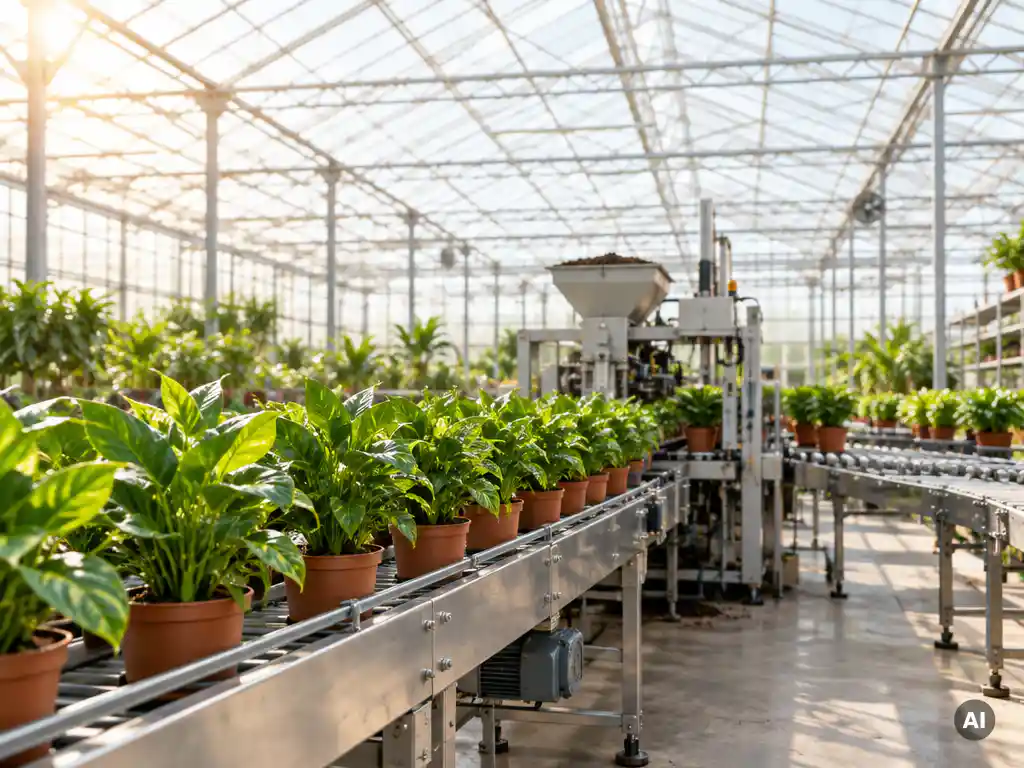
The building blocks are straightforward. Conveyor belts carry plants between stations, buffer tables smooth out differences in speed, roller conveyors handle trays, and potting machines and watering stations take over repetitive handling. Because these elements can be combined, you can add work tables, scales, or lighting right where the process needs them.
Ergonomics matter just as much as speed. When plants arrive at a comfortable working height, employees tire less and make fewer mistakes. That supports greenhouse efficiency in a way that goes beyond pure output numbers, because a stable, healthy team is easier to retain.
A Step-by-Step Automation Path That Limits Risk
The safest way to automate is to start small with mobile conveyors, learn from daily use, and expand toward fixed systems once the benefits are proven. This keeps the initial investment low and lets your team get comfortable with new routines.
A typical path looks like this:
- Rent or buy a mobile conveyor for a single bottleneck, such as potting or packing.
- Measure the effect on hours, output, and strain over a full peak period.
- Add buffer tables and roller conveyors to connect separate workstations.
- Move toward fixed, integrated lines that form the backbone of your production flow.
Renting equipment during a busy season is a low-threshold way to experience the difference before committing. Many growers begin exactly this way and then build step by step. Since we supply hardware, software, and installation ourselves, there is no need to coordinate between several suppliers along the way.
Real Results: From 26 to 6 FTE
Automating the full internal transport chain can reduce staffing needs dramatically. One of our customers went from 26 to 6 FTE for the same output, which shows what is possible when transport, handling, and watering are connected into one flow.
That outcome did not come from a single machine. It came from looking at the entire process, removing manual steps one by one, and making sure each part of the line matched the pace of the next. Fewer people were needed, errors dropped, and the remaining team worked on tasks that genuinely required their skills.
Results will differ by nursery, depending on crop, layout, and volume. Still, the principle holds: the more manual transport you eliminate, the less exposed you are to labor shortages, rising wage costs, and expensive temporary staffing.
Common Greenhouse Automation Mistakes to Avoid
The most common mistake is automating one step in isolation and creating a new bottleneck right next to it. Faster potting means little if the plants then pile up at an unprepared packing station.
Other pitfalls come up again and again:
- Buying too big, too soon, before the real bottlenecks are understood.
- Ignoring the layout, so lines clash with existing walkways, gutters, or crop rows.
- Mixing suppliers whose equipment does not communicate or fit together.
- Skipping the team, even though employees who understand the system get the most out of it.
- Forgetting future growth, which makes later expansion expensive.
Avoiding these traps mostly comes down to planning and starting with a clear picture of your own process. If you are unsure where to begin, a short conversation can save a lot of trial and error. Feel free to get in touch with us, and we will think about the best first step for your nursery in 2026.
Frequently Asked Questions
How do I find out where my nursery is losing the most labor hours?
Start by mapping one full working day of plant movement, from the potting line to the dispatch area. Note where people walk, lift, or wait, and record how long each transfer takes. Do this during both a normal day and a peak day, since the bottlenecks that cost the most hours are often only visible under seasonal pressure.
What is the best first step if I have never automated before?
Pick one clear bottleneck, such as potting or packing, and introduce a single mobile conveyor there. Track hours, output, and physical strain over a full peak period so you have real numbers instead of assumptions. This keeps the investment low and gives your team time to get used to the new routine before you expand.
Is it worth renting equipment instead of buying it?
Renting is a sensible way to test automation during a busy season without a large upfront commitment. It lets you see the real effect on your workflow, your layout, and your employees’ workload. If the results are positive, you can then buy with confidence and plan the next phase.
How can I avoid creating a new bottleneck when I automate one step?
Look at the entire process rather than a single workstation, and make sure each step can keep up with the pace of the next. Buffer tables are a practical tool here, because they absorb differences in speed between stations. Before investing, check what happens to plants directly before and after the step you plan to automate.
How do I get my employees on board with automation?
Involve your team early, explain that the goal is to remove heavy, repetitive carrying rather than to replace skilled work, and let them test the equipment during the pilot phase. Employees who understand the system tend to get the most out of it and can point out practical improvements. Reduced physical strain is also a strong argument, as it helps with absenteeism and retention.
Will conveyor lines fit in my existing greenhouse layout?
In most cases yes, but you should check walkways, gutters, crop rows, and ceiling or door heights before choosing a system. Mobile conveyors are useful for testing how a line fits in practice, and modular components such as conveyor belts, roller conveyors, and buffer tables can be combined to suit your space. Planning for future expansion from the start prevents expensive rework later.
Can I expect results like going from 26 to 6 FTE in my own nursery?
That result came from connecting transport, handling, and watering into one flow, and outcomes will vary depending on your crop, layout, and volume. A realistic approach is to measure the gains from your first phase and extrapolate step by step. The more manual transport you remove across the whole chain, the greater the effect on labor needs and exposure to staffing shortages.