
Greenhouse efficiency in ornamental horticulture: the case for automating transport
Every ornamental grower knows the feeling: the plants are ready, the orders are in, and there simply aren’t enough hands to move everything on time. Greenhouse efficiency in ornamental horticulture rarely comes down to the plants themselves. It comes down to how smoothly pots, trays and trolleys travel from one station to the next, and how many people it takes to make that happen.
With wages rising, vacancies staying open for months and seasonal peaks demanding expensive temporary staff, the internal flow of goods has become one of the most promising places to find gains. This article looks at where labor hours quietly leak away, how automated transport changes the picture, and how to approach automation without overwhelming your business.
Where Labor Hours Disappear in Ornamental Nurseries
Most lost labor hours in ornamental nurseries are not spent on growing, but on moving: carrying trays, pushing trolleys, loading tables and walking back and forth between potting, watering and dispatch.
These tasks feel small in the moment, yet they repeat hundreds of times a day. A single employee who spends a large part of the shift transporting plants is not adding value to the crop, even though the work is essential. Multiply that across a team of ten or twenty and the hidden cost becomes substantial.
Physical strain adds another layer. Repetitive lifting and carrying lead to sick leave and high turnover, which in turn means constantly training new people. Seasonal peaks make it worse, because temporary workers need time to learn the routines and rarely work at the pace of experienced staff.
The result is a pattern many family nurseries recognize: growth in orders leads to growth in headcount, while margins stay flat or shrink. Improving greenhouse efficiency therefore starts with a simple question: how much of our paid time is spent moving things rather than making things?
How Automated Transport Lifts Greenhouse Output
Automated internal transport raises greenhouse output by removing manual carrying from the process, creating a steady, predictable flow of product between workstations.
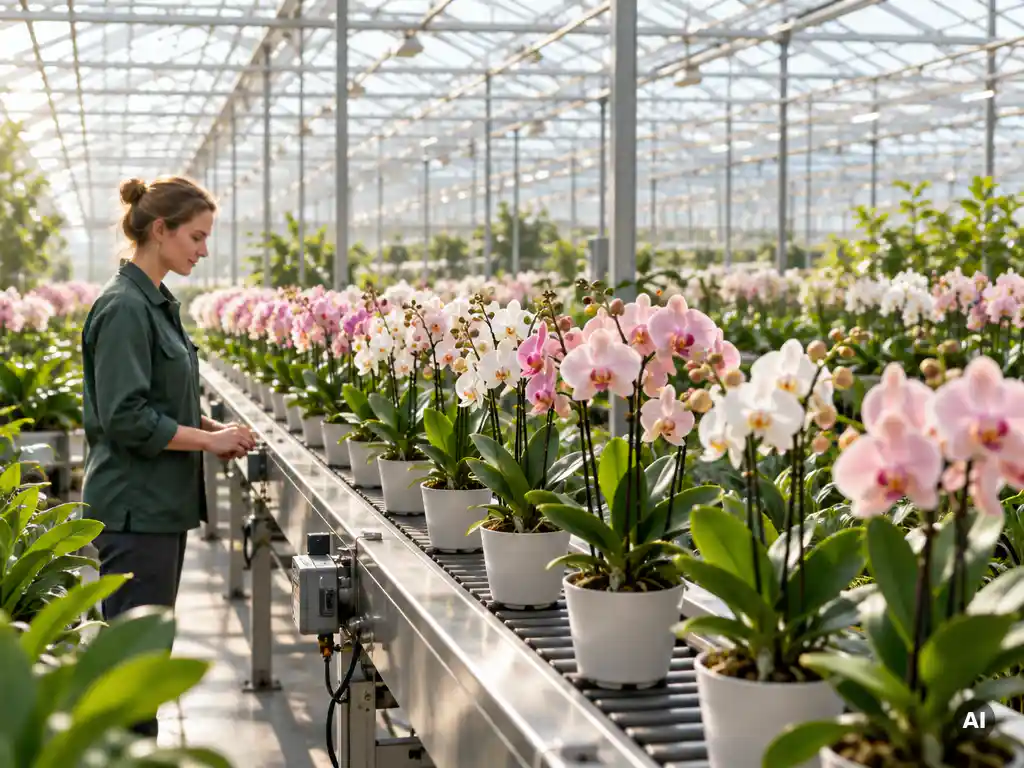
Conveyor belts, roller tracks and buffer tables take over the repetitive movement, so employees can stay at their station and focus on the task that actually requires human skill, such as potting, inspecting or packing. Because the product arrives at a consistent pace, the whole line settles into a rhythm. Bottlenecks that used to appear when one station ran ahead of another are smoothed out by buffering.
Ergonomics and consistency
Ergonomics matter as much as speed. When workers no longer lift and carry all day, physical strain drops, and so does the risk of absenteeism. Work becomes more attractive, which helps with the other half of the labor equation: finding and keeping good people.
Machines also bring consistency. A line equipped with work tables, scales and lighting can be configured so every step happens at the right height, with the right information at hand. Fewer errors, less waste and more uniform quality follow naturally. We build these combinable components in our own workshop in De Lier, so a conveyor belt solution can be tailored to the layout of your greenhouse rather than forcing your layout to fit the machine.
Real Results: From 26 to 6 FTE
Automation can cut staffing needs dramatically: one of our customers went from 26 to 6 FTE for the same output after automating its internal transport.
That figure deserves some context. It reflects a nursery where a large share of the workforce was dedicated to moving product by hand. Once transport, potting and watering were linked in a connected line, most of that manual movement disappeared. The output stayed the same, but the labor needed to achieve it fell sharply.
It is worth stressing that results like these depend on the starting situation. A business with highly manual internal logistics has more to gain than one that already runs a partly automated flow. Still, the principle holds across ornamental growers: wherever people spend their day transporting plants, there is room to reallocate that effort.
The benefits go beyond payroll. Fewer staff means less recruitment pressure, less dependence on temporary agencies, and fewer disruptions when someone calls in sick. The remaining team can be given more skilled, better paid and more interesting work.
A Step-by-Step Route to Automation
The most practical way to automate is to start small with a mobile conveyor, learn from daily use, and expand toward fixed systems as the benefits become clear.
Many growers hesitate because automation sounds like a large, irreversible investment. A staged approach removes much of that risk. A flexible, mobile belt can be deployed in one area, such as a busy potting line, and moved when needs change. Renting equipment during a peak period lets a team experience the difference before committing to a purchase.
Once the first step proves its value, the next ones become easier to justify. Buffer tables can be added to even out the flow, roller tracks can connect separate areas, and eventually fixed systems can form the backbone of the production process. Each stage builds on the last, and components are designed to work together, so earlier investments are not wasted.
Planning the sequence matters. Mapping where product moves, where it waits and where people spend the most time helps identify the starting point with the highest return. If you would like a second pair of eyes on your layout, you are welcome to get in touch with us for advice on where to begin.
Common Pitfalls When Automating Internal Transport
The most common pitfalls are automating in isolation, ignoring the wider process, and underestimating how much planning and installation support a connected line requires.
One frequent mistake is automating a single step without considering what comes before and after. If a fast conveyor feeds a station that cannot keep up, the bottleneck simply moves. Looking at the whole flow, from incoming material to dispatch, prevents this and ensures capacity is balanced along the line.
Another trap is working with several separate suppliers for hardware, software and installation. Coordinating between them costs time and often leads to compatibility problems. A single partner who handles everything from design to commissioning keeps the project coherent and the startup smooth.
Finally, some growers overlook the human side. Employees who understand why the change is happening, and who are trained on the new setup, adopt it faster and get more out of it. Framing automation as a way to make the work lighter rather than a threat to jobs makes a real difference.
Looking ahead to 2026 and beyond, the labor market is unlikely to loosen. Nurseries that begin automating internal transport now, even in small steps, will be better placed to keep their costs under control and their output reliable when the next peak season arrives. Visit our website to see how we support growers at every stage of that journey.
Frequently Asked Questions
How do I figure out where my nursery is losing the most labor hours to internal transport?
Start by mapping the physical flow of product from incoming material to dispatch, noting where plants move, where they wait, and where people walk or carry. Then spend a few days tracking how many minutes each employee spends transporting versus potting, inspecting or packing. The stations with the most carrying, pushing and walking are usually the best candidates for your first automation step.
What is the best first piece of equipment to buy if I have never automated before?
A mobile conveyor belt is usually the lowest-risk starting point. It can be deployed on a busy line such as potting, moved when your needs change, and later integrated into a fixed system. Renting one during a peak period is a good way to measure the real time savings before committing to a purchase.
Will automation really work if my nursery is small or family-run?
Yes, because automation does not have to be all-or-nothing. Small nurseries can begin with a single belt, a buffer table or a short roller track and expand as results justify it. The gains depend on how manual your current logistics are, so the more hands-on your internal transport is today, the more you stand to gain, regardless of size.
How can I avoid simply moving the bottleneck to another station?
Look at the whole flow, not just one step, before installing anything. Check the capacity of the stations before and after the new equipment, and add buffer tables where one station tends to run ahead of another. Balancing capacity along the entire line ensures the extra speed at one point actually increases total output.
How do I get my employees on board with automation?
Explain early on why the change is happening and position it as a way to make the work lighter and more interesting, not as a threat to jobs. Involve your team in planning the layout, since they know where the daily frustrations are, and train them on the new setup before it goes live. Staff who understand and help shape the change adopt it faster and get more out of it.
Should I work with one supplier or several for hardware, software and installation?
A single partner that handles design, hardware, software, installation and commissioning is generally the smoother option. It reduces compatibility problems and avoids the time lost coordinating between several parties. It also means one point of contact when you want to expand the line later.
Can I expand my system over time without wasting earlier investments?
Yes, provided you choose combinable components designed to work together. A typical path is a mobile belt first, then buffer tables, roller tracks to connect areas, and eventually fixed systems as the backbone of production. Planning that sequence up front means each stage builds on the previous one rather than replacing it.