

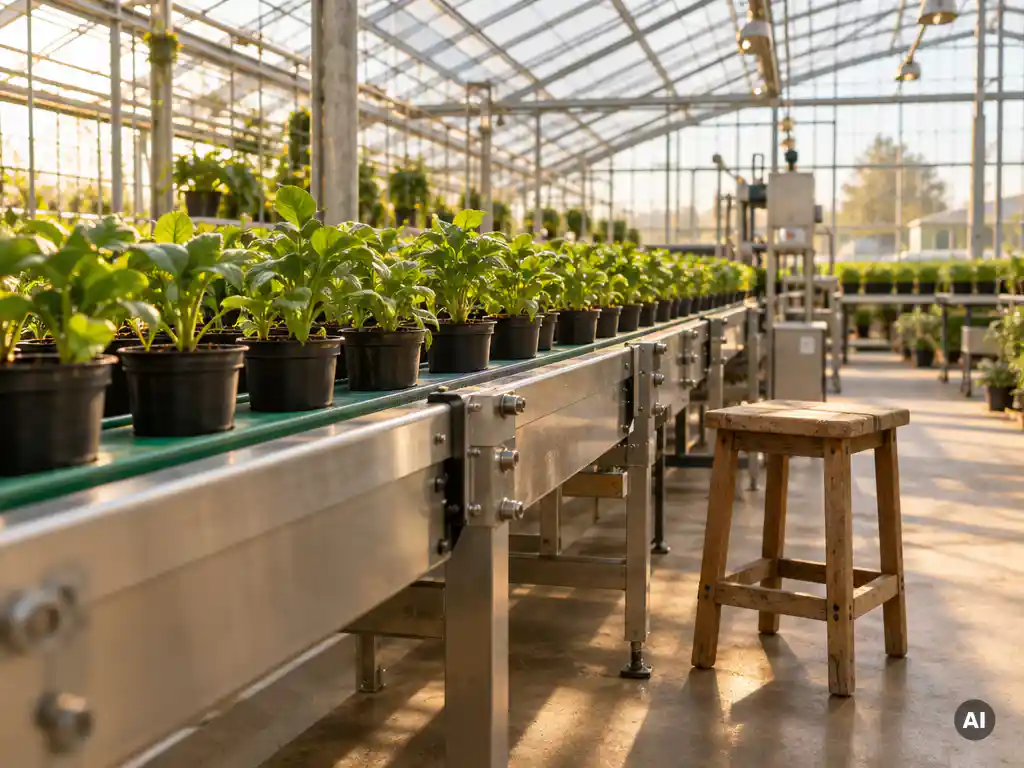
Greenhouse efficiency made practical for nurseries with open vacancies
Every nursery owner knows the feeling: orders are coming in, the greenhouse is full, and the vacancy you posted three months ago is still open. Greenhouse efficiency has become less about squeezing out another percent of yield and more about getting the same work done with fewer hands. The good news is that you do not need a total rebuild of your operation to make a real difference.
In this article, we look at where labor hours quietly disappear, why internal transport is the smartest place to start, and how a stepwise approach keeps risk low. We also share a real result from one of our customers and a practical way to plan your own project.
Where Labor Hours Disappear in Greenhouse Workflows
Most labor hours in a nursery do not vanish in the crop work itself, but in the movement around it: carrying trays, pushing carts, stacking pots and walking plants from one station to the next. This handling adds up quickly, and it rarely shows up as a line item in your planning.
Think about a typical day. Plants travel from the potting line to the growing area, then to the sorting table, then to packing and finally to the loading dock. At every step, someone lifts, carries or repositions. Individually, these actions look small. Together, they can take up a large share of the working day.
The cost goes beyond wages. Heavy, repetitive lifting leads to sick leave and staff turnover, which makes the vacancy problem even worse. Seasonal peaks add another layer, forcing you to rely on temporary workers who need training and often leave just as they become productive.
Once you see handling as the hidden drain on greenhouse efficiency, the next question is obvious: how do you take it out of human hands?
Internal Transport Automation as the Quickest Win
Automating internal transport is usually the fastest route to labor savings because it removes repetitive handling without changing how you grow. Your crop, your layout and your methods stay the same. Only the walking and carrying disappear.
Conveyor belts, buffer tables, roller conveyors and potting machines take over the movement of plants between process steps. Employees stay at their stations, where they do the work that actually requires skill and attention, such as checking quality, sorting and packing. The result is a smoother flow, fewer bottlenecks and a more ergonomic workplace.
These machines can also be combined. A transport belt can be fitted with work tables, scales or lighting, so a single line handles several tasks at once. That flexibility matters in a nursery, where product mix and volumes change from season to season.
Because the technology fits around existing processes, it also tends to pay back faster than larger, more disruptive investments. Still, many owners hesitate, and that is where a gentle starting point helps.
Starting Small With Mobile Conveyors and Rentals
You can begin automating with a single mobile conveyor or a rental during your busiest weeks, which lets you test the benefits before committing to a fixed installation. This is how many of our customers get started.
A mobile belt can be moved to wherever the bottleneck is. If it makes a difference in one area, you will see it immediately in how many people the job requires and how quickly it gets done. If you prefer not to buy yet, renting covers a seasonal peak without a long-term commitment.
From there, growth is natural. Many nurseries add a second belt, then a buffer table, then link the pieces into a continuous line. Eventually the mobile units give way to fixed systems that form the backbone of the production process. Each step is based on what you have already seen working in your own greenhouse, rather than on a promise on paper.
It is a calm, low-risk way to improve greenhouse efficiency, and the results can be larger than most owners expect.
From 26 to 6 FTE: A Real Result
One of our customers went from 26 FTE to just 6 FTE for the same output after automating their internal transport. The volume did not shrink and the quality did not drop. The work simply no longer depended on people moving plants by hand.
That kind of outcome rarely comes from a single machine. It comes from looking at the whole flow, removing manual handling step by step, and connecting the pieces into a coherent line. Fewer people are needed, errors go down, and the remaining team does more valuable and less strenuous work.
For a family-run nursery facing open vacancies and rising wage costs, this changes the conversation. Instead of asking how to fill twenty positions, the question becomes how to run a lean, reliable operation with a smaller, more stable team. Your results will depend on your crop, layout and volumes, but the principle holds across most nurseries.
Planning an Automation Project That Fits Your Nursery
A good automation project starts by mapping where your plants travel and where people spend their time, then tackling the biggest bottleneck first. A short walk through your process with a pen and paper often reveals more than a spreadsheet.
A few questions help set the direction:
- Which steps require the most people for the least skilled work?
- Where do plants wait, pile up or get moved more than once?
- Which peaks force you to hire temporary staff?
- What would you want the system to do in five years, as you grow?
With those answers, you can choose a first step, whether that is a rented mobile belt or a fixed line in a key area, and keep the next stages in mind so everything fits together later. Having hardware, software and installation come from one partner also keeps the process simple and avoids coordination headaches between suppliers.
If you are unsure where to begin, we are happy to think along with you. You can get in touch with us for practical advice based on more than thirty years of experience in the horticulture sector. Sometimes a single conversation is enough to find the quickest win in your greenhouse.
Frequently Asked Questions
How do I measure how much time my team currently spends on internal transport and handling?
Start with a simple observation exercise: for one or two representative days (and once during a peak week), note how many people are involved in carrying, pushing carts, stacking and repositioning plants at each process step. Multiply the time spent by your hourly labor cost to get a baseline. Even rough numbers will show you which step is the biggest drain and where a first conveyor or buffer table will have the most impact.
What is the best first machine to buy if I have never automated before?
A mobile conveyor belt is usually the best entry point because it is flexible, relatively low-cost and can be placed right at your biggest bottleneck. Because it is mobile, you can test it in different areas and see immediately how many people the job requires. If you are still unsure, renting one during your busiest weeks lets you validate the benefit before making a purchase decision.
Will automating internal transport mean I have to lay off staff?
Not necessarily. Many nurseries use automation to cover vacancies they cannot fill anyway and to reduce their dependence on temporary seasonal workers. Remaining employees move away from heavy, repetitive carrying toward more skilled tasks such as quality control, sorting and packing, which also tends to lower sick leave and improve retention.
How do I avoid creating new bottlenecks when I automate one part of the process?
Speeding up one step often just moves the queue to the next one, so look at the whole flow before you buy. Buffer tables are a practical tool here, as they absorb differences in speed between stations. Plan your first step with the next two or three stages in mind, so each added machine fits into a continuous line later on.
Can conveyor systems handle different plant types, pot sizes and seasonal changes in product mix?
Yes, as long as the system is designed with flexibility in mind. Transport belts can be combined with work tables, scales or lighting, and modular components can be rearranged or extended as your assortment changes. When you discuss a project, share your full range of pot sizes, tray types and peak volumes so the setup can be specified to cover them.
How do I know whether renting or buying is the right choice for my nursery?
Renting makes sense if your labor shortage is mostly seasonal or if you want to prove the concept before investing. Buying is the better choice once you have seen consistent results in a specific area and the machine is used year-round. Many growers rent or buy a single mobile unit first and then move to fixed installations once they know where automation delivers the most value.
What should I prepare before talking to an automation supplier?
Bring a simple sketch of your greenhouse layout showing how plants travel from potting to loading, along with the number of people at each step and your peak and off-peak volumes. Also note your biggest pain points, such as piles of waiting plants or tasks that require temporary staff, and what you want your operation to look like in five years. This lets the supplier propose a realistic first step that fits your long-term plan.