
Greenhouse efficiency: why competitors with automation produce faster and cheaper
Walk through two greenhouses of similar size and you may see very different pictures. In one, a team of people carries trays, pushes carts, and walks the same routes hundreds of times a day. In the other, belts and tables move the product while a handful of people focus on the work that actually needs human hands. The second grower is not working harder. That grower has simply made greenhouse efficiency a priority, and the gap shows up in speed, cost, and margins.
For many family-run nurseries, the staffing problem is already a daily reality. Vacancies stay open for months, seasonal peaks call for expensive temporary workers, and physically heavy work leads to absence and turnover. Here is how those pressures add up, and how automated internal transport helps close the gap.
Where Labor Costs Quietly Drain Greenhouse Margins
Labor costs drain margins because so much paid time goes to moving product rather than growing, potting, or packing it. Walking, lifting, and pushing carts do not add value to a plant, yet they fill a large share of the working day in many nurseries.
The costs also hide in places that rarely show up on a single line of the budget. Temporary agency workers cost more per hour and need time to learn the routines. Sick leave from repetitive, physically demanding tasks leaves gaps that others have to fill. High turnover means training starts over again and again.
Add yearly wage increases to this, and the pressure builds from both sides. Costs rise while selling prices stay flat, so margins shrink slowly enough that it is easy to miss until a competitor undercuts you. That competitor is often the one who stopped treating internal transport as manual work.
How Automated Internal Transport Speeds Up Production
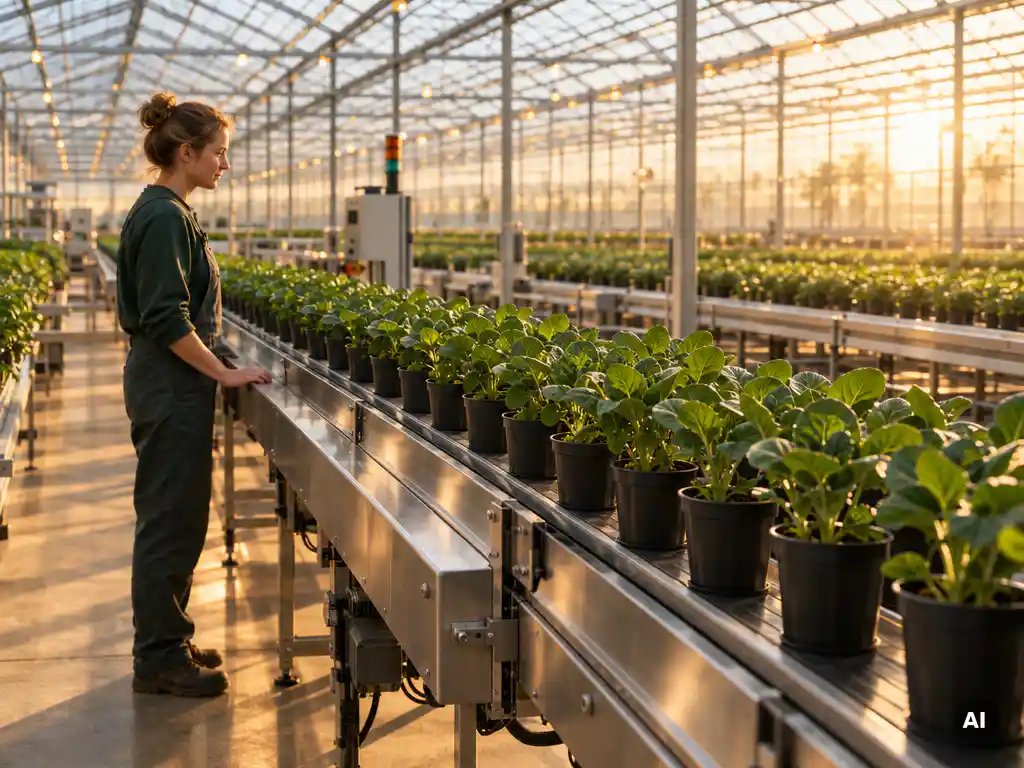
Automated internal transport speeds up production by moving product continuously and consistently, without waiting for someone to be free. Trays, pots, and crates travel along fixed routes at a steady pace, so each workstation receives what it needs when it needs it.
This steadiness matters more than raw speed. In a manual setup, the flow depends on who is available, who is on break, and who is covering for a sick colleague. With conveyor belts, buffer tables, and roller tracks, the line keeps running, and bottlenecks become visible and fixable.
Automation also makes the work lighter. When people no longer lift and carry all day, they stay fit longer, make fewer errors, and keep a better pace through the afternoon. Components such as potting machines and watering stations can be linked to the same line, and work tables, scales, and lighting can be added where a task needs them. Together they turn separate steps into one efficient processing line.
What Fewer FTEs Mean for Cost Per Unit
Fewer FTEs lower the cost per unit because labor is usually one of the largest cost components in plant production. When the same output requires fewer people, every pot, tray, or crate carries a smaller share of the wage bill.
The effect can be dramatic. In our own projects, we have seen customers go from 26 FTEs to 6 for the same output. That is not a marginal gain. It changes the cost structure of the whole operation and gives the grower room to compete on price or to protect margins when the market gets tough.
Lower cost per unit is only part of the benefit. A smaller, more stable team means less dependence on the labor market, fewer seasonal scramble weeks, and less time spent recruiting and training. The business becomes more predictable, which makes planning, investing, and growing much easier.
Starting Small With Mobile Belts and Rental
The easiest way to begin is with a mobile conveyor belt, and renting before buying removes most of the risk. Nobody has to redesign the entire nursery on day one.
A mobile belt can be placed where the pressure is highest, for example during a peak period or at the most labor-intensive step in the process. Renting lets you see what it does for your own team, your own layout, and your own product before committing to a larger investment. If it works, and in our experience it often does, the next step is easy to take.
From there, growers can build step by step toward fixed systems, adding belts, buffer tables, or potting machines as the need and the budget allow. Because everything comes from one supplier, including hardware, software, and installation, the parts fit together from the start. We handle the process from advice to installation, so you do not have to coordinate between several parties.
Closing the Gap With Automated Competitors
Closing the gap starts with finding the single most labor-intensive transport step in your operation and automating that first. Every nursery has one, and it is usually obvious to the people who work there.
The competitors who produce faster and cheaper did not get there with one big leap. Most of them started with a limited investment, learned what worked, and expanded from there. Since the technology is modular, the same path is open to nurseries of 10 hectares as well as 200.
If you are unsure where to begin, a conversation is a good first step. We have supported growers in horticulture for over three decades, and we are happy to look at your situation and suggest a practical starting point. You can get in touch with us to talk through your layout, your peak periods, and the options for renting a first belt.
With wages continuing to rise and skilled people remaining scarce, the question for 2026 is less about whether to automate and more about how soon to start. The sooner internal transport takes care of itself, the sooner your team can focus on what actually grows the business.
Frequently Asked Questions
How do I identify which transport step in my nursery to automate first?
Start by tracking where people spend the most time walking, lifting, or pushing carts over one typical week, including a peak period. The step that consumes the most labor hours or causes the most waiting at downstream workstations is usually the best candidate. Ask your team as well, since the people doing the work can often point out the bottleneck right away.
What should I check before renting a mobile conveyor belt?
Measure the available space and the route the product needs to travel, and note the size and weight of your trays, pots, or crates. Check that there is a power supply nearby and enough room for people to work alongside the belt safely. It also helps to define a clear goal for the trial, such as saving a set number of labor hours during a peak week, so you can judge the results objectively.
Will automated internal transport mean I have to lay off staff?
Not necessarily. Most nurseries use automation to fill vacancies that are already open and to reduce reliance on expensive temporary workers. Existing employees can move from heavy carrying work to more skilled tasks such as quality control, potting, and packing, which are more rewarding and better for retention.
What are common mistakes when automating greenhouse transport for the first time?
The most common mistake is trying to automate everything at once instead of tackling the biggest bottleneck first. Another is choosing components from different suppliers that don’t fit together, which creates integration problems later. Also avoid ignoring ergonomics: work tables, lighting, and scales placed along the line make a big difference in how well people can keep up the pace.
Can a small or mid-sized nursery benefit from automation, or is it only for large operations?
Because the technology is modular, it works for nurseries of all sizes, from around 10 hectares to 200 or more. Smaller growers can begin with a single mobile belt or a buffer table and expand as the budget allows. Often the labor shortage is felt even more strongly in smaller family businesses, so the payoff can be significant.
How do I measure whether automation is actually paying off?
Compare labor hours per 1,000 pots, trays, or crates before and after the change, and track your cost per unit over the same period. Also look at softer indicators like sick leave, overtime, temporary staff hours, and how long it takes to train new people. Using the rental period as a test lets you gather this data before you commit to a permanent installation.
Can I link existing machines, like potting machines or watering stations, to a new conveyor line?
In most cases, yes. Modular conveyor systems are designed so that potting machines, watering stations, buffer tables, and work tables can be connected into a single line. It’s best to share your current layout and equipment with the supplier up front so they can advise on how to integrate it all smoothly, including any software needed to coordinate the steps.