

Greenhouse efficiency without temporary workers: is it really possible?
Every grower knows the pattern. The season ramps up, the vacancies stay open, and the agency invoices keep growing. If you are chasing greenhouse efficiency in a tight labour market, the question is no longer whether temporary workers are convenient, but whether the business can run well without leaning on them so heavily.
The short answer is yes, in many cases it can. The trick is to look at where hours actually disappear and to automate those steps first. Here is how that works in practice for nurseries and potted plant growers.
Where nurseries lose hours to manual handling
Most lost hours in a nursery do not come from growing itself. They come from moving plants, pots, trays and trolleys from one place to another, again and again, by hand.
Think about a typical day. Plants are carried from the potting line to the buffer area, from the buffer area to the greenhouse, and later to the packing station. Each move seems small, but together they add up to a large share of the daily workload. They also happen to be the most physically demanding tasks, which drives sick leave and staff turnover.
Seasonal peaks make this worse. When volume spikes, the instinct is to bring in more people, but extra hands in a crowded process rarely improve output proportionally. New temporary workers need instruction, make more mistakes, and often leave right when they have finally learned the routine.
Once you map these flows honestly, a pattern emerges: the biggest savings sit in repetitive internal transport, not in the skilled work that actually needs a human eye.
Automating internal transport to cut labour needs
Automating internal transport reduces labour needs because machines take over the repetitive carrying and sorting, while people focus on tasks that require judgement, such as quality checks and crop care.
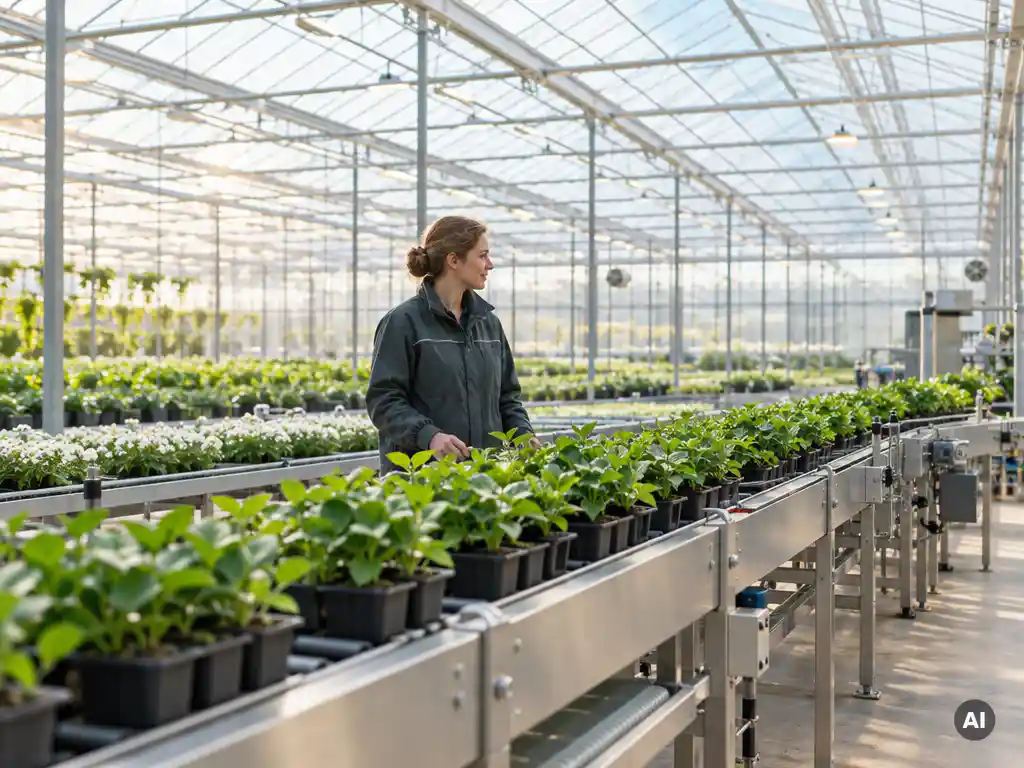
The building blocks are simpler than many growers expect. Conveyor belts, roller tracks, buffer tables, potting machines and watering stations can be combined into one continuous line. Add work tables, scales or lighting where needed, and the line becomes a complete processing station rather than a collection of separate machines.
Why a connected flow matters
A single machine saves a few steps. A connected flow saves entire jobs. When plants move automatically from potting to buffering to packing, nobody has to push trolleys between stations, and bottlenecks become visible instead of hidden behind extra staff.
Ergonomics improve too. Fewer heavy lifts and less bending mean healthier employees, lower absenteeism and a workplace that is easier to recruit for. That alone can ease the very staffing problem that pushed growers towards temporary workers in the first place.
For growers exploring this route, our range of conveyor belts is a practical place to start, since belts are usually the backbone that everything else connects to.
From 26 to 6 FTE: a real result
One of our customers went from 26 to 6 FTE while keeping the same output, which shows how much of a nursery’s workforce can be tied up in manual transport and handling.
That outcome did not come from a single machine. It came from rethinking the whole process: where plants enter the line, how they are buffered, how they are watered and potted, and where they leave. Each step was automated or streamlined until the people on the floor were doing only the work that truly needed them.
It is worth being realistic here. Not every nursery will see the same ratio, because every layout, crop and volume is different. But the principle holds across the sector: when internal transport is automated, the number of people needed for the same output drops sharply, and so does the dependence on temporary labour.
The financial effect follows naturally. Lower wage costs, fewer agency fees, less time spent recruiting and training, and more predictable production all support healthier margins in a market where costs keep rising.
Starting small with mobile belts and rental
You do not have to automate everything at once. The most practical entry point is a mobile conveyor belt, ideally tried through rental during a busy period before any larger investment is made.
Renting lets a grower test the effect on real work with real plants. Within a few weeks it becomes clear how many hours are saved, how the team reacts, and where the next improvement should be. That removes much of the risk and hesitation that often keeps businesses stuck in the same manual routine.
From there, growth can be gradual. Many growers move from mobile belts to fixed systems, then add buffer tables, potting machines or watering stations as the benefits become obvious. Because the machines are designed to be combined, each step builds on the previous one instead of replacing it.
If you are unsure where to begin, get in touch with us and we will think along with you about the process, the layout and the most sensible first step for your nursery.
Common pitfalls when reducing temporary staff
The most common pitfall is automating the wrong thing first. Investing in a flashy machine at a step that is not actually a bottleneck delivers little, while a simple belt in the right place can free up several people.
Another frequent mistake is treating machines and people as separate worlds. Employees who are involved early, who understand why the change is happening and who are trained on the new line tend to adopt it faster. Those who feel it is imposed on them often work around it.
Growers also underestimate the value of one coordinated solution. Mixing equipment from several suppliers can lead to compatibility issues, unclear responsibility when something breaks, and delays during installation. A single partner handling hardware, setup and follow-up keeps the implementation smoother.
Finally, avoid expecting an overnight switch. Reducing reliance on temporary workers works best as a phased plan: map the flows, automate the heaviest repetitive steps, measure the results, then expand. With that approach, greenhouse efficiency without constant temporary staffing is not wishful thinking in 2026, but a realistic and achievable goal.
Frequently Asked Questions
How do I know which step in my nursery to automate first?
Start by mapping a normal working day and timing how many people and hours go into each transport or handling step, such as potting to buffer, buffer to greenhouse, and greenhouse to packing. The step where the most people are tied up in repetitive carrying or where plants regularly queue up is your bottleneck. Automating that step first, often with a simple conveyor belt, usually gives the fastest payback.
How long does it take to see results after introducing a mobile conveyor belt?
Most growers notice a difference within the first days, and within a few weeks of use on real work you can usually quantify the hours saved. To measure it properly, record the number of people and the time needed for a specific task before the belt arrives, then compare after two to four weeks. This gives you hard numbers to decide on a next step.
What should I check before renting or buying a conveyor belt?
Measure the available space and the route plants will take, and note the pot sizes, tray types and volumes you handle at peak. Also consider belt length, height adjustability, and whether it can later be connected to buffer tables, potting machines or watering stations. Sharing these details with the supplier helps ensure the belt fits your layout both now and as you expand.
How can I get my employees on board with automation?
Involve them early by explaining that the goal is to remove heavy, repetitive work, not to replace skilled staff. Ask the people who do the job daily where the biggest frustrations are, and let them test the equipment during a rental period. Proper training on the new line and visible benefits, such as less lifting and bending, make adoption much smoother.
Will automation work for a smaller nursery, or is it only for large operations?
It works at smaller scales too, because you can start with a single mobile belt instead of a full line. Even a small business loses many hours to carrying and moving plants, so the savings can be proportionally significant. Renting for a busy period lets you test the benefit without a large upfront investment.
Can I still use temporary workers during peaks after automating?
Yes, but the role changes. With internal transport automated, temporary staff can be used for tasks that need extra hands without a long learning curve, and you will need far fewer of them. Because the flow is streamlined, new people also become productive faster and make fewer mistakes.
How do I build a phased automation plan without overspending?
Begin with a flow analysis, pick the one or two heaviest repetitive steps, and automate those first, ideally via rental. Measure the results, then add components like buffer tables, potting machines or watering stations one step at a time. Working with a single partner who supplies compatible equipment and handles setup keeps each phase building on the last instead of requiring rework.