

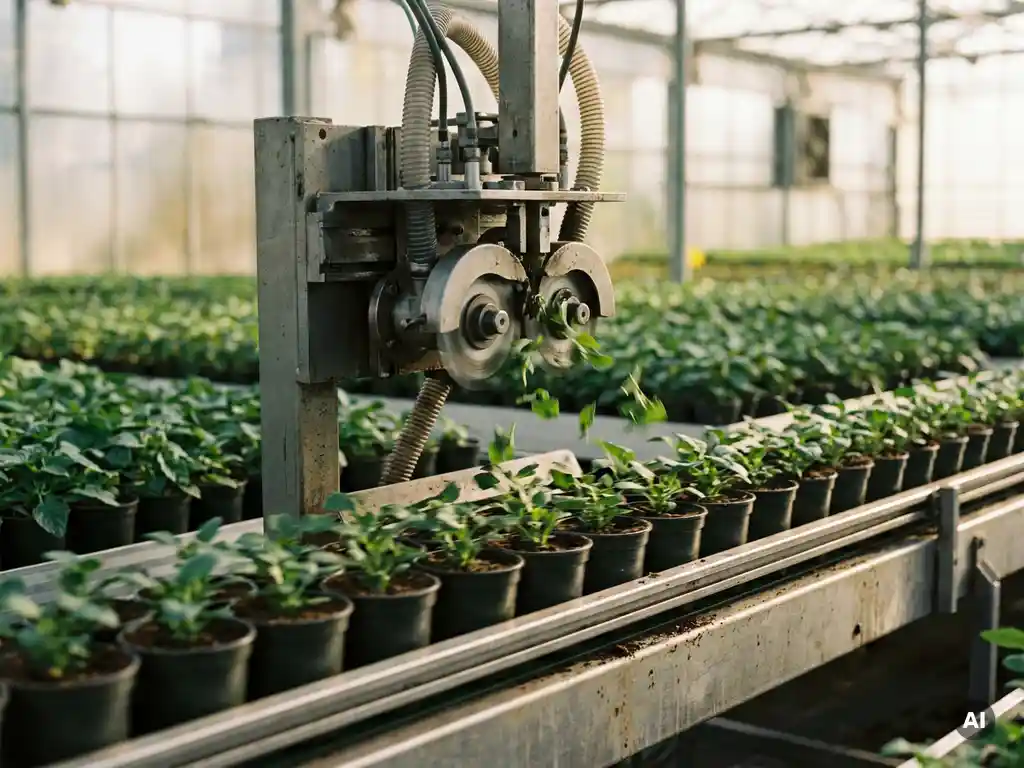
How accurate are automatic topping machines at high speeds?
Automatic potting machines maintain high accuracy at speed when they are built with the right controls and soil handling systems. At top performance, a well-engineered machine can fill up to 8,000 pots per hour with consistent soil volume and depth, provided the machine uses proper detection technology rather than relying on manual operator adjustments. The sections below unpack exactly what drives accuracy, where cheaper machines fall short, and how to choose the right machine for your operation.
What affects potting accuracy as machine speed increases?
Potting accuracy at high speeds depends primarily on three factors: soil flow consistency, chain or conveyor stability, and the control system managing fill depth and rotation speed. When any one of these elements is poorly engineered, increasing the speed amplifies the problem rather than simply scaling output.
Soil flow is the most common source of inaccuracy. As throughput increases, the machine must deliver a precise volume of growing medium to each pot in a shorter window. If the feed mechanism cannot regulate flow reliably, particularly with heavier or coarser mixes like peat blends or bark substrates, pots end up overfilled, underfilled, or unevenly compressed.
Conveyor and chain stability matter just as much. A fully guided chain keeps pots aligned and moving at a controlled, predictable rate. Without it, pots can shift slightly as the line accelerates, causing the filling head to miss its mark. The result is inconsistent potting depth and variable compaction across a batch.
Finally, the control system determines how well the machine adapts in real time. Machines with advanced PLC controls and programmable settings for pot size, bore depth, and rotation speed can maintain accuracy across a full production run. Machines without these controls require manual recalibration as conditions change, which is impractical at high volumes.
How many pots per hour can an automatic potting machine handle without losing accuracy?
A professionally engineered automatic potting machine can process up to 8,000 pots per hour while maintaining consistent fill quality. This capacity applies to machines equipped with stable conveyor systems, precise soil metering, and programmable PLC controls. Below this threshold, accuracy is primarily a question of machine quality rather than speed itself.
It is worth distinguishing between rated capacity and reliable capacity. Many machines list a maximum throughput figure, but that number is only meaningful if the machine can sustain it without drift in fill volume or depth. Reliable capacity is the speed at which the machine consistently produces pots within an acceptable tolerance, and this is the figure that matters on the production floor.
For most professional growers in ornamental horticulture and pot plant cultivation, daily output requirements fall well within the 8,000 pots per hour range. The real challenge is not reaching that number, it is reaching it with every pot filled to the same standard, regardless of where it falls in the production run.
Why do cheaper potting machines struggle with consistency at high volumes?
Cheaper potting machines lose consistency at high volumes because they compromise on the components that manage soil flow and pot positioning under load. At low speeds, these compromises are often invisible. As throughput increases, the weaknesses in the feed system, chain guidance, and control logic become amplified and directly visible in the finished pots.
The most common failure points in budget machines include:
- Inadequate soil handling: Lighter feed mechanisms struggle with dense or fibrous growing media, causing irregular fill volumes as the machine speeds up.
- Unstable conveyor systems: Without a fully guided chain, pots shift during transport, leading to misaligned fills and inconsistent bore depth.
- Limited programmability: Basic machines lack the ability to store and recall settings for different pot sizes or soil types, forcing operators to adjust manually, and manually means inconsistently.
- Higher maintenance frequency: Components that are not built for sustained high-speed operation wear faster, and breakdowns during peak season carry a disproportionate cost.
For growers who work with a variety of pot sizes or soil mixes, these limitations become particularly costly. A machine that performs adequately with a standard peat mix may produce visibly uneven results when the substrate changes, exactly the situation where you need reliability most.
What’s the difference between automatic soil detection and manual adjustment?
Automatic soil detection means the machine continuously monitors soil levels and adjusts fill volume in real time without operator input. Manual adjustment means an operator must stop, observe, and recalibrate the machine when fill quality drifts. The practical difference is the gap between consistent output across an entire production run and gradual quality decline that goes unnoticed until it shows up in the product.
With manual adjustment, accuracy depends on how attentive the operator is and how quickly they catch drift. During a busy production day, with staff managing multiple tasks, small inconsistencies in fill volume can accumulate across thousands of pots before anyone intervenes. By that point, the batch is already compromised.
Automatic soil detection removes this dependency. The system reads soil levels continuously and corrects fill volume without interrupting the line. This is particularly valuable at high speeds, where the window for human intervention is narrow and the cost of drift is high. It also reduces the skill requirement for operating the machine, which matters when trained staff are in short supply during seasonal peaks.
Touchscreen programming complements automatic detection by allowing operators to store settings for different pot sizes, bore depths, and soil types. Switching between configurations becomes a matter of selecting a saved profile rather than recalibrating from scratch, which saves time and eliminates another source of human error.
How does potting machine accuracy affect plant quality and auction results?
Potting machine accuracy directly determines soil compaction consistency, which in turn affects root development, water retention, and plant uniformity across a batch. Inconsistent fill depth or variable compaction produces uneven plants, and uneven plants perform poorly at auction, where buyers assess batches on their uniformity rather than their individual best specimens.
For growers supplying auction markets, the commercial stakes are straightforward. A batch where 95% of pots are filled correctly but 5% are underfilled or over-compressed will not achieve the same price as a uniformly filled batch. Buyers at professional horticultural auctions set prices based on consistency, and a single inconsistent delivery can affect the relationship with a buyer far beyond that transaction.
Beyond auction results, accurate potting affects crop management throughout the growing cycle. Pots with inconsistent soil volume require more frequent individual attention, watering schedules become harder to standardize, and growth rates diverge across the batch. This increases labour costs and complicates planning, particularly for growers running tight production cycles ahead of seasonal demand.
Should you buy or rent a potting machine to test accuracy before committing?
Renting a potting machine before buying is a practical way to verify that the machine handles your specific soil mix, pot sizes, and production volumes before making a capital commitment. For growers replacing an older machine or investing in automation for the first time, a trial period removes the guesswork from the decision and provides real production data rather than specifications on paper.
The case for renting first is strongest when:
- You work with a non-standard growing medium that may challenge the machine’s soil handling system.
- You are unsure whether the standard model or a more advanced configuration suits your operation.
- You want to assess the machine’s performance during a peak production period before committing to ownership.
- You are making your first investment in automated potting and want to build confidence before a full purchase.
Buying outright makes more sense when you have already tested the machine or have reliable reference points from similar operations. If the machine fits your line, integrates with your existing transport and sorting equipment, and is supported by the manufacturer’s own service team, the long-term economics of ownership are typically more favourable than continued rental.
How MartinStolze helps with potting machine accuracy
We design and build our potting machines entirely in-house, from engineering and programming through to assembly and installation. This means every component is developed to work together, and accuracy at high speeds is built into the machine rather than patched in afterwards.
Our offer for professional growers includes:
- The Stolze 3030 and 3030 PRO, both capable of up to 8,000 pots per hour, with PLC controls and touchscreen programming for pot sizes from 7 to 30 cm.
- Automatic soil detection on the 3030 PRO, ensuring consistent fill volume without manual intervention, even at full production speed.
- A fully guided chain system for stable pot positioning and reduced maintenance requirements.
- Seamless integration with our conveyor systems and sorting lines, so your entire potting line works as a single coordinated system.
- Both purchase and rental options, including a trial period, so you can verify performance with your own soil mix and pot sizes before committing.
- On-site support from our own technicians, plus training in our demo and instruction facility in De Lier.
If you want to find out which configuration is the right fit for your operation, get in touch with us and we will walk you through the options based on your specific cultivation setup and production volumes.
Frequently Asked Questions
What pot sizes and soil types work best with automatic potting machines?
Most professional automatic potting machines are engineered to handle pot sizes ranging from 7 to 30 cm, covering the majority of ornamental and pot plant cultivation needs. Soil type has a bigger impact on performance than pot size — machines with robust soil handling systems can work reliably with peat blends, bark substrates, and coarser growing media, while budget machines tend to struggle with anything denser or more fibrous than a standard peat mix. If you work with non-standard substrates, it is worth testing the machine with your specific mix before purchasing, either through a rental trial or an on-site demonstration.
How do I know if my current potting machine is causing inconsistencies in my crop?
The clearest signs are visible differences in plant uniformity across a batch — uneven growth rates, inconsistent watering needs, or variable root development are often traceable back to inconsistent soil compaction and fill volume at the potting stage. If your team is frequently adjusting individual pots after filling, or if your watering schedule requires more exceptions than it should, the potting machine is worth investigating. Comparing fill depth and compaction across a sample of 20–30 pots from a single run is a straightforward way to measure whether your machine is producing within an acceptable tolerance.
What maintenance does an automatic potting machine require to stay accurate over time?
Regular maintenance on a well-built automatic potting machine typically involves cleaning the soil feed mechanism to prevent buildup that disrupts flow, inspecting the conveyor chain for wear and tension, and checking the filling head alignment periodically. Machines with a fully guided chain system generally require less frequent maintenance than those with open conveyor designs, since stable pot positioning reduces mechanical stress on the system. The most important rule is to follow the manufacturer's maintenance schedule consistently — deferred maintenance during peak season is the most common reason accuracy degrades mid-production run.
Can an automatic potting machine be integrated into an existing production line, or does it require a full line rebuild?
In most cases, a professional automatic potting machine can be integrated into an existing production line without a full rebuild, provided the conveyor heights, transport speeds, and pot flow direction are compatible. The key is to work with a supplier whose machines are designed with integration in mind and who can assess your current line layout before installation. Challenges typically arise when the existing transport equipment runs at a different speed than the potting machine's output, which can usually be resolved with buffer sections or speed adjustments rather than replacing the entire line.
How long does it take to switch between different pot sizes or soil configurations on a programmable potting machine?
On a machine with touchscreen programming and saved profiles, switching between pot sizes or soil configurations typically takes just a few minutes — it is largely a matter of selecting the correct saved profile and making any minor mechanical adjustments to accommodate a different pot diameter. Without programmable settings, the same changeover can take 20–30 minutes of manual recalibration and test runs, which adds up significantly if you switch configurations multiple times per week. For operations running several pot sizes across a production week, programmability is one of the highest-return features to prioritise when choosing a machine.
What should I look for when comparing potting machine suppliers to ensure I'm getting reliable after-sales support?
The most important indicator of reliable after-sales support is whether the supplier services their own machines with in-house technicians rather than outsourcing repairs to third parties — this directly affects response time when something goes wrong during peak season. Ask specifically about parts availability, average response time for service calls, and whether training is included as part of the purchase. Suppliers who manufacture their machines entirely in-house are generally better positioned to diagnose and resolve technical issues quickly, since the same team that built the machine supports it in the field.
Is automated potting cost-effective for smaller growing operations, or is it mainly justified at high volumes?
Automated potting becomes cost-effective earlier than many smaller growers expect, particularly when you factor in labour costs, consistency benefits, and the commercial impact of plant uniformity at auction. Even at modest volumes, the reduction in manual labour and the improvement in batch consistency can justify the investment within a single growing season. For operations that are not yet ready to purchase, a rental arrangement with a trial period is a practical way to run the numbers against your actual production costs before making a capital commitment.
Related Articles
- How do you maintain consistent topping depth at high production speeds?
- How do you compare two potting machines with different hourly capacities?
- Can fewer operators maintain the same pots-per-hour output with automation?
- What is the real difference between a standard and PRO potting machine?
- Why do greenhouses use conveyor belts?