
How automation raises greenhouse efficiency during seasonal peaks
Where Seasonal Peaks Break Greenhouse Workflows
Peaks break workflows because internal transport and handling scale poorly with manual labor: more plants mean more walking, lifting and waiting, and every extra person adds coordination overhead. The bottleneck is rarely the growing itself. It is the movement of pots, trays and trolleys between potting, watering, sorting and shipping.
During busy weeks, vacancies often stay open for months, and agencies charge premium rates for short-term staff who still need training. Newcomers work more slowly and make more mistakes, which hurts both quality and speed. Meanwhile, heavy physical work increases sick leave and turnover among the people who do know the nursery.
The result is a familiar cycle. Output slows exactly when demand rises, overtime costs climb, and margins shrink while competitors with more automation deliver faster and cheaper. Understanding this pattern makes it easier to see which tasks deserve automation first.
Automation Tools That Absorb Peak Workloads
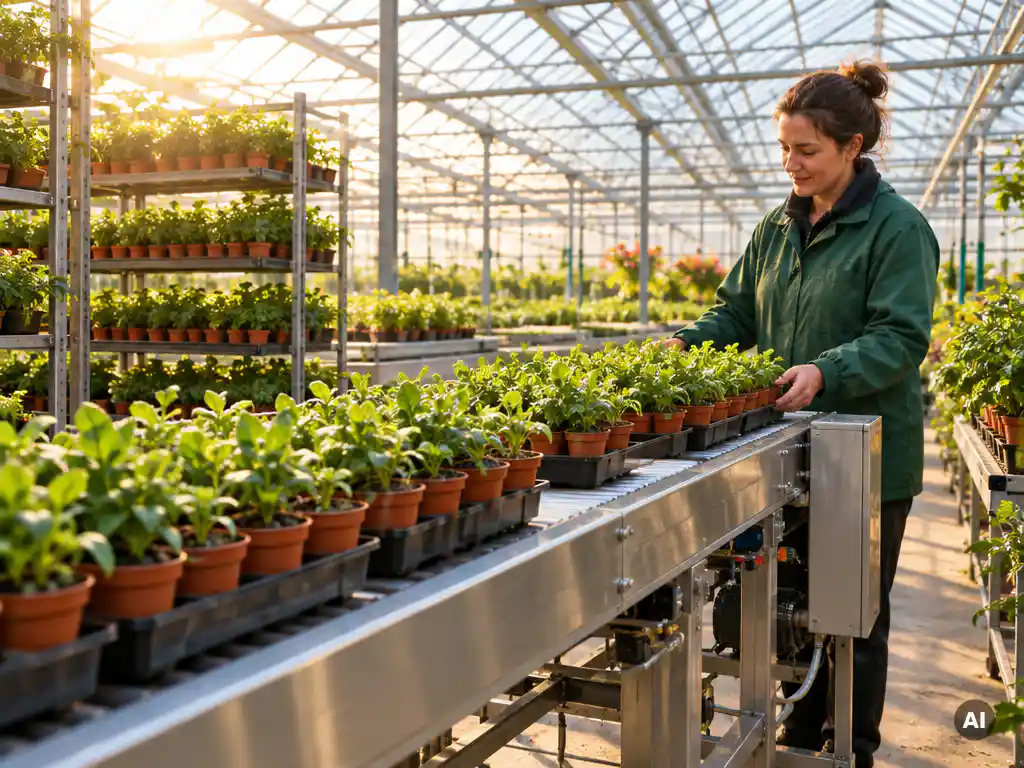
The most effective tools for peak periods are those that remove repetitive internal transport and handling, such as conveyor belts, buffer tables, potting machines, roller conveyors and watering stations. Together they create a continuous flow where plants move on their own instead of being carried or pushed by hand.
Conveyors and Buffer Tables
A conveyor belt replaces the constant shuttling of trolleys and crates between workstations. Add a buffer table and the line gains breathing room: when one station slows down, the others keep working instead of standing idle. This smooths out the uneven rhythm that typically causes congestion at peak times. Our conveyor belts can be combined with work tables, scales and lighting, so one line can handle sorting, weighing and quality checks without extra walking.
Potting Machines and Watering Stations
Potting is one of the most labor-intensive jobs in spring. A potting machine keeps pace consistently regardless of the time of day, and it takes much of the physical strain out of the work. Watering stations add the same reliability to crop care, delivering uniform results while freeing people for tasks that genuinely need human judgment, such as inspecting plants and solving problems.
Because these machines are designed to work together, a nursery can build a line that matches its crop and layout, rather than forcing the crop to fit the equipment.
Fewer Hands, Same Output: Real Labor Savings
Automating internal transport lets a nursery produce the same output with far fewer people, and in practice the savings can be dramatic. One of our customers went from 26 to 6 FTEs for the same output after automating their internal flow. That is not a marginal gain; it changes the entire cost structure of the business.
Labor savings go beyond payroll. Fewer people on the floor means less training, simpler planning and less dependence on a tight labor market. Ergonomic equipment also reduces physical strain, which tends to lower absenteeism and make the remaining jobs more attractive and easier to fill.
Quality benefits too. A machine repeats the same movement the same way every time, so there are fewer damaged plants, fewer mix-ups and more predictable throughput. For a grower, that predictability is what turns a chaotic peak into a manageable one.
Starting Small With Mobile Conveyors and Rental
The easiest way to start is with a mobile conveyor belt, either bought or rented for a single peak period. This approach lets a grower see the effect in daily operations before committing to a larger investment, which removes much of the risk from the first step.
A step-by-step path works well for many nurseries. Begin with a mobile belt at the busiest bottleneck, measure how much time and labor it saves, and then expand with buffer tables, potting machines or fixed systems as the results prove themselves. Many customers rent equipment during a peak and gradually grow into a fully automated line.
We deliver hardware, software and installation from a single source, so there is no juggling of multiple suppliers. That keeps implementation smooth and shortens the time between decision and a working line.
Preparing Your Nursery for the Next Peak
Preparation starts with mapping where time and people are lost today. Walk the route a plant takes from potting to shipping, note every point where it waits, gets carried or needs an extra pair of hands, and rank those points by how much labor they consume during busy weeks. The top of that list is usually the best place to automate first.
Timing matters as well. Equipment ordered or rented well before the season can be installed, tested and understood by the team without the pressure of a full order book. A calm February is a far better moment to learn a new line than a hectic April.
Finally, think in phases rather than all at once. A simple first step this year can grow into an integrated system over the following seasons, always built around the nursery’s own crops and layout. If you want to talk through where to begin, get in touch with our team and we will discuss the process with you, from first belt to full line.
Frequently Asked Questions
How do I know which bottleneck to automate first in my greenhouse?
Walk the full route a plant takes from potting to shipping and log every point where it waits, is carried, or needs an extra person. Time these steps during a busy week and rank them by labor hours consumed. The step that eats the most people-hours, often internal transport between potting and watering, is usually the best candidate for a first conveyor or buffer table.
How far in advance should I order or rent equipment before the spring peak?
Aim to have equipment installed and tested at least four to six weeks before your busiest period, which for many nurseries means ordering or reserving in late autumn or early winter. This gives your team time to learn the line, fine-tune the layout and fix small issues before the order book fills up. Popular rental equipment can be booked up early in the season, so reserving ahead also protects your options.
What should I measure to find out whether a mobile conveyor is really paying off?
Before installing it, record baseline figures for the bottleneck: plants handled per hour, number of people involved, and overtime hours. Repeat the same measurements after a week or two with the belt in place. Also track damaged or mixed-up plants and sick days, since quality and ergonomic improvements are part of the return alongside labor hours saved.
Will automation work in a small or irregularly shaped nursery?
Yes. Mobile and modular equipment is designed to be fitted around your crops and layout rather than the other way around. Start with a single mobile conveyor or buffer table at the tightest point and expand only if the results justify it. A supplier can also help you sketch a line that fits narrow aisles or older greenhouse structures.
How do I get my team on board with automation if they worry about losing their jobs?
Be clear that the goal is to remove heavy, repetitive work and reduce dependence on temporary staff, not to replace your experienced people. Involve them early by asking where they lose the most time or strain themselves most, and let them test a rented machine during a calm period. Staff are then free to focus on higher-value tasks such as plant inspection, problem solving and quality control.
What are common mistakes when automating a greenhouse for the first time?
The most frequent mistakes are automating everything at once, choosing equipment before mapping the actual workflow, and installing during the peak when nobody has time to learn the system. Another is ignoring buffer capacity, which lets one slow station stall the whole line. Phase the project, start at the biggest bottleneck, and add buffer tables so the line keeps flowing when individual stations slow down.
Can I combine a rented machine with a later permanent installation?
Absolutely, and it is a popular route. Renting during a peak lets you see the real effect on labor and throughput before committing capital. If the results are good, you can add compatible components such as potting machines, watering stations or fixed conveyors over the following seasons, building toward a fully integrated line without replacing what you already have.