
How do conveyor belts improve efficiency in horticulture?
In modern greenhouse and horticultural operations, moving plants, pots, and produce from one point to another is one of the most time-consuming and physically demanding tasks workers face every day. As labour costs rise and efficiency expectations grow, more growers and production managers are turning to conveyor belt systems to address these challenges. Whether you run a nursery, a distribution centre, or a vegetable processing facility, understanding how horticultural conveyor belt solutions work can help you make smarter decisions for your operation.
This article answers the most common questions growers ask before investing in conveyor technology, from the basics of what these systems are to how they integrate with existing equipment on the production floor.
What are conveyor belts in horticulture and why do they matter?
Conveyor belts in horticulture are mechanised transport systems designed to move plants, pots, trays, and produce along a production line without manual carrying or pushing. They matter because they directly replace the most repetitive and physically exhausting part of greenhouse work, allowing staff to focus on higher-value tasks while the system handles continuous internal transport.
Unlike general industrial conveyor systems, horticultural conveyor belts are built to withstand the specific conditions found in greenhouses and processing facilities: high humidity, soil contamination, water exposure, and the need to handle fragile plant material gently. A standard industrial belt repurposed for a nursery will quickly show its limitations, both in durability and in fitness for purpose.
The importance of these systems goes beyond simple convenience. In a busy nursery or packing centre, internal transport can account for a significant portion of daily labour hours. Every metre a worker walks while carrying a tray or pot is a metre that could be eliminated with the right conveyor solution. Over the course of a working week, this adds up to measurable savings in time, energy, and cost.
How do conveyor belts improve efficiency in greenhouse operations?
Conveyor belts improve efficiency in greenhouse operations by creating a continuous, uninterrupted flow of material through the production process. Instead of workers transporting goods in batches, the belt moves product steadily from one workstation to the next, eliminating waiting time, reducing bottlenecks, and allowing each team member to stay focused at their station.
The efficiency gains appear in several areas at once. Throughput increases because the production line no longer depends on the pace of individual workers carrying loads. Consistency improves because every plant or pot moves through the same process in the same sequence. And because fewer people are needed for transport tasks, the workforce can be deployed more strategically across the operation.
Buffer belts play a particularly important role here. When one part of a production line runs faster than another, a buffer conveyor absorbs the difference and prevents the entire system from stalling. This kind of flow management is difficult to achieve with manual transport but becomes straightforward once a well-designed conveyor system is in place.
What types of conveyor belts are used in horticulture?
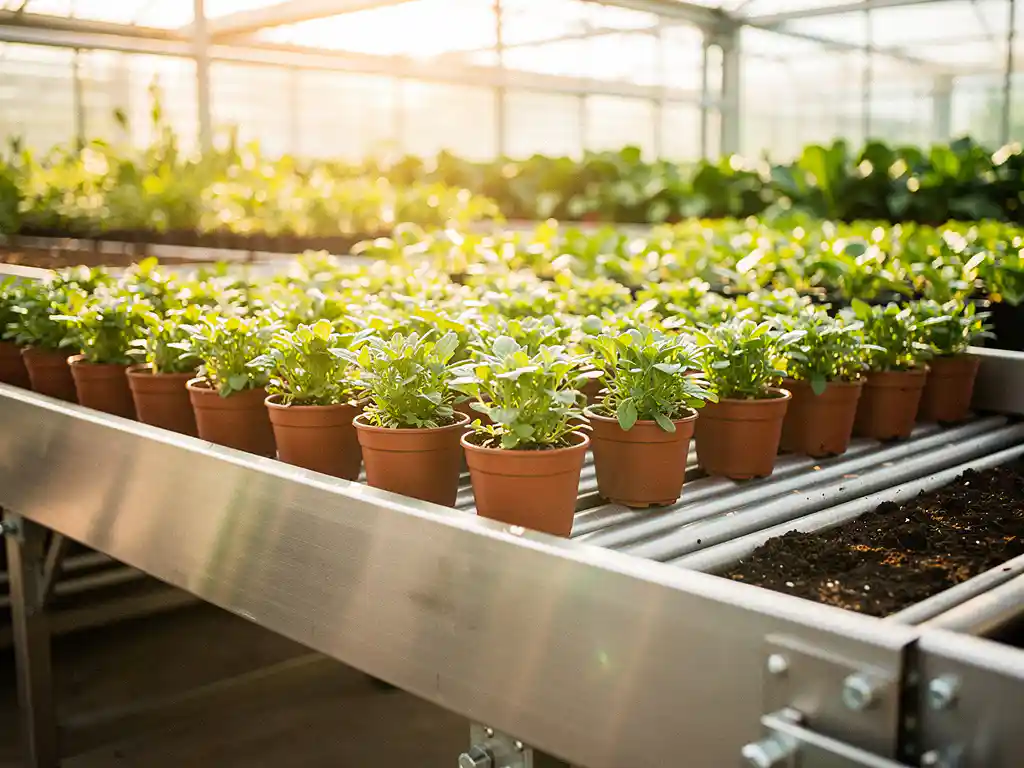
Horticulture uses several types of conveyor belts, each suited to a specific function within the production or distribution process. The main categories include mobile conveyor belts, fixed conveyor belts, buffer belts, roller conveyors, ground-level belts, and elevator belts for vertical transport between levels.
Here is how each type serves a distinct purpose:
- Mobile conveyor belts can be repositioned as needed, making them ideal for operations where layouts change seasonally or where flexibility is a priority.
- Fixed conveyor belts form the backbone of permanent production lines, providing reliable, high-capacity transport between fixed workstations.
- Buffer belts absorb differences in speed between sections of a line, preventing congestion and keeping production flowing smoothly.
- Roller conveyors are well suited for heavier loads and for gentle accumulation of product without pressure damage.
- Ground-level belts transport soil, substrate, or other bulk materials directly at floor level.
- Elevator belts move product between different heights, connecting floors or raised workstations within a facility.
We design and manufacture all of these types in-house, and because every component is built with the greenhouse environment in mind, the materials are selected for resistance to moisture, soil, and the kind of continuous use that horticultural operations demand.
What’s the difference between fixed and mobile conveyor systems?
The key difference between fixed and mobile conveyor systems is flexibility versus permanence. Fixed systems are installed as a permanent part of a production layout and optimised for consistent, high-volume throughput. Mobile systems can be repositioned quickly to adapt to changing tasks, locations, or seasonal demands within the same facility.
Fixed conveyor systems
Fixed conveyors are the right choice when your production layout is stable and your throughput requirements are predictable. They are typically integrated with other machinery such as potting machines, sorting lines, and packaging stations, forming a seamless automated line. Because they are permanently installed and engineered for the specific space, they can be optimised for speed, ergonomics, and flow in a way that a mobile system cannot fully replicate.
Mobile conveyor systems
Mobile conveyors offer a level of adaptability that suits operations where tasks or locations shift regularly. A nursery that works in different greenhouse compartments throughout the year, for example, benefits from being able to move the conveyor to where the work is. Mobile systems are also a practical starting point for businesses that want to experience the benefits of horticultural conveyor belts before committing to a full fixed installation. We offer rental options for exactly this reason, giving growers a low-threshold way to test the impact before making a permanent decision.
How can conveyor belts reduce physical strain and absenteeism?
Conveyor belts reduce physical strain and absenteeism by eliminating the repetitive carrying, lifting, and walking that cause musculoskeletal injuries in greenhouse workers. When the belt does the transporting, workers no longer need to carry heavy loads or cover long distances on the production floor, which directly lowers the physical burden on their bodies over the course of a working day.
Greenhouse and nursery work is physically demanding by nature. Workers in manual transport roles can walk several kilometres per shift while carrying pots, trays, or crates. Over time, this leads to back problems, joint strain, and fatigue-related errors. The result is not just discomfort for individual workers but measurable costs for the business in the form of sick days, reduced productivity, and higher staff turnover.
Ergonomic conveyor systems address this directly. By bringing the work to the worker rather than sending the worker to the work, a well-designed conveyor layout keeps staff in comfortable, stationary positions for most of their shift. Adjustable-height worktables integrated with the conveyor line further reduce bending and reaching. The outcome is a healthier workforce and a more stable, productive operation.
How do you integrate conveyor belts with existing greenhouse equipment?
Integrating conveyor belts with existing greenhouse equipment starts with a detailed assessment of your current layout, workflow, and machinery. The conveyor system is then designed to connect with your existing potting machines, sorting lines, robots, or packaging stations, creating a unified production flow rather than a collection of separate processes.
Successful integration depends on a few key factors:
- Compatibility of belt speeds and heights ensures that product moves smoothly from one piece of equipment to the next without manual intervention or the risk of damage.
- Modular system design allows individual conveyor sections to be added, removed, or reconfigured as your operation grows or changes.
- Electrical and control integration means that the conveyor system can be synchronised with other automated machinery, so the entire line responds as a single coordinated system.
- On-site installation and commissioning by experienced engineers ensures that the system performs as designed from day one, with adjustments made based on the actual conditions of your facility.
We handle every stage of this process in-house, from engineering and manufacturing to installation and ongoing maintenance. Because all of our conveyor products are designed to work together, building a complete and integrated line from our range is straightforward. If your facility already uses third-party equipment, our engineering team works to ensure compatibility so that the new conveyor system enhances rather than disrupts what you already have in place.
Frequently Asked Questions
How do I know if my operation is ready for a conveyor belt system?
A good starting point is to track how many labour hours per week are spent purely on internal transport — moving plants, pots, trays, or produce from one point to another. If that figure is significant, or if you are experiencing bottlenecks, high absenteeism, or difficulty scaling production, a conveyor system is likely to deliver a clear return on investment. Many growers begin with a mobile or rental unit to measure the impact before committing to a permanent installation.
What is the typical return on investment for a horticultural conveyor system?
ROI varies depending on the size of the operation, current labour costs, and the complexity of the system installed, but most growers see measurable savings within the first year through reduced labour hours, lower absenteeism, and increased throughput. A useful way to estimate ROI is to calculate the hourly cost of your current manual transport tasks and compare it against the annualised cost of the conveyor system. In high-volume nurseries and packing centres, payback periods of one to three years are common.
Can conveyor belts handle delicate or irregularly shaped plant material without causing damage?
Yes, provided the system is designed with the right belt surface, speed settings, and transition points for your specific product. Horticultural conveyor belts are engineered to move fragile material gently, using soft belt surfaces, controlled speeds, and smooth transfer zones that minimise impact and tipping. If you grow a variety of crops or pot sizes, a system with adjustable settings and modular components gives you the flexibility to handle different products without risking damage.
What maintenance does a horticultural conveyor belt system require?
Regular maintenance typically includes cleaning belt surfaces to remove soil, substrate, and organic debris, checking belt tension and alignment, lubricating moving parts, and inspecting drive components for wear. Because greenhouse environments involve water, humidity, and soil exposure, using components specifically rated for these conditions significantly reduces maintenance frequency and extends the system's service life. A structured maintenance schedule, ideally supported by the manufacturer, will prevent unplanned downtime during peak production periods.
Is it possible to expand or reconfigure the conveyor system as my operation grows?
Modular conveyor systems are specifically designed with future expansion in mind, allowing you to add sections, change the layout, or integrate new equipment without replacing the entire system. When planning an initial installation, it is worth discussing your growth projections with the engineering team so that the system is sized and configured to accommodate future capacity from the outset. This avoids costly retrofitting later and ensures the infrastructure keeps pace with your business.
What should I look for when choosing a conveyor belt supplier for my greenhouse or nursery?
Look for a supplier with direct experience in horticultural environments rather than general industrial conveyor manufacturers, as the specific demands of greenhouse operations require purpose-built solutions. Key factors to evaluate include whether the supplier designs and manufactures in-house, whether they offer on-site installation and commissioning, and whether they provide ongoing maintenance support. A supplier who can handle everything from initial engineering to long-term servicing gives you a single point of accountability and reduces the risk of compatibility issues.
Are there rental or trial options available before committing to a full installation?
Yes, rental options for mobile conveyor units are available and represent a practical, low-risk way to experience the operational benefits before making a permanent investment. A rental period allows you to measure actual throughput improvements, assess how staff adapt to working alongside the system, and identify which areas of your facility benefit most from automated transport. This real-world data makes it much easier to specify and justify a full fixed installation with confidence.
Related Articles
- What happens when a topping machine becomes the bottleneck in your production line?
- What is the difference between manual and automated pot topping?
- How do you scale up pot plant production without hiring more staff?
- What is the real difference between a standard and PRO potting machine?
- How do ergonomic solutions reduce sick leave in horticulture?