
How do order volumes determine the potting machine capacity you need?
Your order volume determines your required potting machine capacity directly: match your peak daily output target to a machine’s pots-per-hour rating, then build in a buffer of at least 20 to 30 percent for soil variation, pot size changes, and line stoppages. For most professional growers, this calculation points clearly toward either an entry-level machine or a high-capacity model like the Stolze 3030, which handles up to 8,000 pots per hour. The questions below walk through each factor that shapes that decision.
How many pots per hour do you actually need?
To find your required potting machine pots per hour, divide your total daily pot target by the number of productive hours in your shift, then multiply by 1.25 to 1.3 as a practical buffer. A grower targeting 20,000 pots in an eight-hour day needs a machine rated for at least 3,125 pots per hour under ideal conditions, which in practice means choosing a model rated closer to 4,000 or more.
The calculation sounds simple, but several variables push the real number higher than growers expect. Pot size changes slow throughput temporarily. Soil consistency affects fill speed. Brief stops for maintenance, refilling, or operator breaks reduce effective run time. When you add these factors together, a machine running at its rated maximum for a full shift is rarely realistic. Building in that buffer is not overcaution; it is standard production planning.
It also helps to think in seasonal peaks rather than annual averages. If your busiest two weeks of the year require twice your normal daily output, your capacity decision should be anchored to that peak, not to a comfortable mid-season average.
What happens when potting capacity falls short of demand?
When your potting machine cannot keep pace with demand, the consequences ripple across your entire operation. Staff pile up at the potting station waiting for output, downstream transport and sorting lines run below capacity, and delivery deadlines become harder to meet. In auction-driven horticulture, missing a delivery window is not just inconvenient; it directly affects revenue.
Understaffed manual potting introduced as a stopgap creates a second problem: inconsistency. Different employees apply different pressure, fill pots to different depths, and work at different speeds. That inconsistency shows up as variable pot density, uneven plant establishment, and quality complaints at the point of sale. A machine running at the right capacity eliminates that variation entirely.
The hidden cost of undercapacity is often not the missed pots themselves but the overtime, the quality rejections, and the organizational stress that accumulates during peak periods. Growers who have experienced one peak season with an undersized machine rarely repeat the mistake.
How does soil mix type affect potting machine performance?
Soil mix composition directly affects how smoothly a potting machine fills pots and how consistently it performs over a full shift. Mixes with a high proportion of coarse bark, perlite, or chunky compost create more friction and irregular flow through the auger or belt, which can reduce effective throughput and increase the risk of blockages. Fine, homogeneous mixes flow more predictably and allow machines to run closer to their rated capacity.
This matters most when comparing machines at different price points. Entry-level potting machines are typically calibrated for standard peat-based mixes and may struggle with heavier or more textured substrates. A more robust machine with a stronger drive system and adjustable fill settings handles a wider range of soil types without losing consistency or requiring frequent manual intervention.
If your operation uses multiple soil mixes across different crop varieties, look for a machine that allows fill depth and rotation speed to be adjusted and saved as presets. Switching between profiles without recalibrating by hand saves significant time across a busy production week.
What’s the difference between entry-level and high-capacity potting machines?
The key difference between entry-level and high-capacity potting machines is not just speed but reliability, consistency, and integration capability under sustained production pressure. Entry-level machines typically handle lighter soil mixes, offer fewer programmable settings, and are designed for lower daily volumes. High-capacity machines are built to run continuously at full speed across demanding shifts without performance degradation.
Entry-level machines
Entry-level potting machines suit smaller operations or growers who pot intermittently rather than in continuous production runs. They are lower in upfront cost and sufficient for straightforward soil mixes and standard pot sizes. Their limitations appear under pressure: reduced throughput with heavier substrates, fewer saved programs for different pot configurations, and less sophisticated fill detection.
High-capacity machines
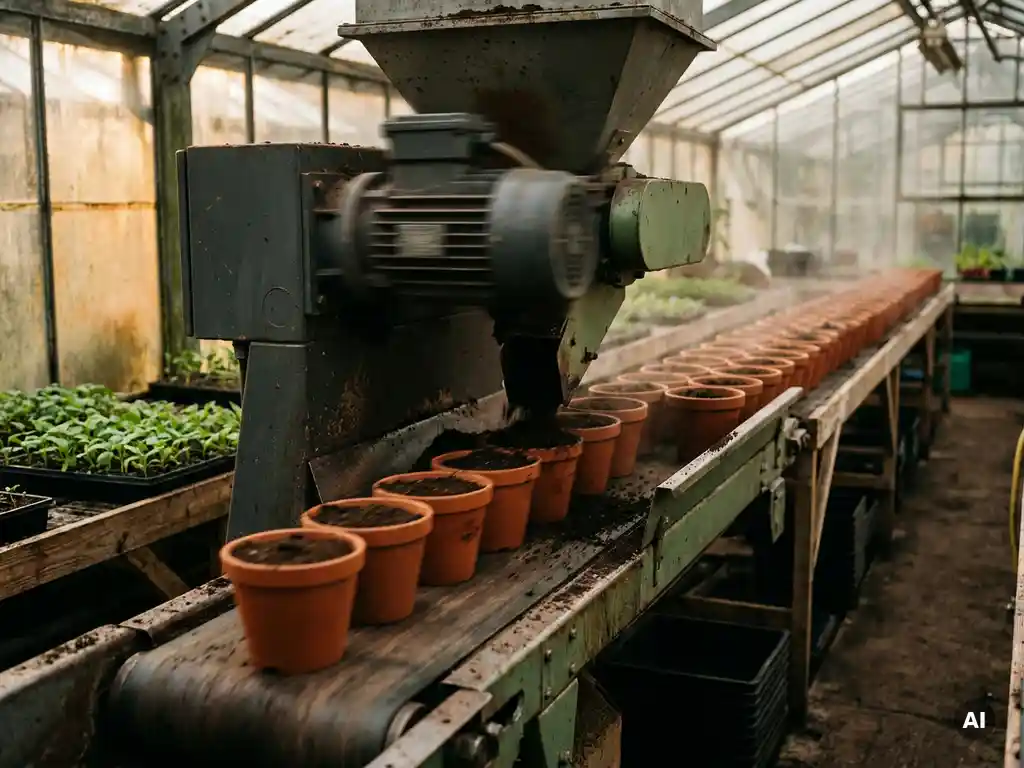
High-capacity machines like the Stolze 3030 PRO are designed for operations where consistency and uptime are non-negotiable. Automatic soil detection ensures every pot receives the correct fill volume without manual adjustment. A fully guided chain system improves stability at high speeds. Touchscreen controls allow operators to program and switch between pot sizes, bore depths, and soil feed rates quickly. The result is fewer stoppages, more consistent output, and lower maintenance overhead across the season.
The investment gap between entry-level and high-capacity narrows considerably when you account for labor savings, reduced waste from inconsistent filling, and the cost of unplanned downtime during peak periods.
Should you buy or rent a potting machine for seasonal peaks?
Renting a potting machine makes sense when your peak demand is concentrated in a short seasonal window and your off-season volume does not justify the capital outlay of ownership. Buying is the better choice when you pot continuously throughout the year or when you need a machine that integrates permanently into a larger automated production line.
For growers who are uncertain about which model suits their operation, renting first provides a practical trial period. Running a machine through an actual production peak reveals real-world throughput, soil compatibility, and operator experience far more clearly than any specification sheet. If the machine performs well, the decision to purchase becomes straightforward. If it falls short, you have avoided a costly commitment.
Hybrid approaches also work well. Some operations rent a second machine to supplement their owned unit during the busiest weeks, keeping permanent investment proportional to baseline demand while preserving flexibility for peaks.
How does potting machine capacity connect to the rest of your production line?
A potting machine’s output capacity is only useful if the rest of your production line can absorb it. If your potting machine produces 6,000 pots per hour but your conveyor belts or sorting lines are sized for 3,000, the bottleneck simply moves downstream. Matching capacity across all stages of the line is what determines real throughput, not the rating of any single machine.
This is why production line design should start with your output target and work backward through each stage: potting, transport, topping, sorting, and dispatch. Every element needs to handle the same peak volume without creating queues or delays. Buffer tables between stations help absorb short-term mismatches, but they are not a substitute for properly matched equipment.
Integration also affects quality. When a potting machine feeds directly into a matched transport system, pots move smoothly without tipping or shifting, which protects fill consistency and reduces plant stress. A well-matched line runs with fewer operators, less manual handling, and more predictable output from start to finish.
How Martin Stolze helps you match potting capacity to your operation
We design and build our potting machines entirely in-house, from engineering and programming through to assembly and installation. That means we can configure a solution that fits your specific crop, soil mix, pot range, and daily volume target rather than offering a one-size-fits-all product.
- Stolze 3030 and 3030 PRO: Both models handle pots from 7 to 30 cm and reach up to 8,000 pots per hour. The PRO adds automatic soil detection, a fully guided chain for stability at high speeds, and programmable touchscreen controls for fast changeovers between pot sizes and soil types.
- Full line integration: Our potting machines connect seamlessly with our own conveyor belts, topping machines, tray fillers, and sorting lines, so capacity is matched across every stage of your production process.
- Buy or rent: Both options are available, including a trial period so you can validate performance in your own operation before committing to a purchase.
- On-site support: Our own technicians handle installation, training, and ongoing maintenance, supported by a dedicated demo and training facility in De Lier.
Whether you are replacing an aging machine, scaling up for a new season, or building a new potting line from scratch, we are ready to help you find the right configuration. Get in touch with our team to discuss your production requirements and explore which solution fits your operation best.
Frequently Asked Questions
How do I calculate the right buffer percentage for my specific operation?
Start with the standard 25–30% buffer, then adjust upward based on your specific risk factors: if you regularly switch between three or more pot sizes in a single shift, add another 5–10%. Operations using non-standard soil mixes or running single-operator lines should also lean toward the higher end of the buffer range. The goal is to ensure your machine's rated capacity covers your real-world throughput, not just your theoretical daily target.
What are the most common mistakes growers make when choosing a potting machine?
The most frequent mistake is sizing for average daily output rather than peak seasonal demand, which leaves operations scrambling during their busiest and most revenue-critical weeks. A close second is underestimating the impact of soil mix variability on throughput — a machine that performs well with a standard peat mix may lose 15–20% of its effective speed with a coarser, bark-heavy substrate. Always test or consult with the manufacturer using your actual soil mix specifications before committing to a model.
How long does it typically take to install and commission a new potting machine?
For a standalone potting machine, installation and basic commissioning typically takes one to two days when handled by the manufacturer's own technicians. Integrating the machine into a full production line — including conveyor belts, topping machines, and sorting systems — can extend that timeline to several days depending on line complexity. Scheduling installation well outside your peak season gives your team time to train on the equipment and resolve any calibration issues before production pressure builds.
Can a high-capacity potting machine run efficiently at lower speeds during quieter periods?
Yes — machines like the Stolze 3030 PRO are designed with adjustable feed rates and programmable settings, so they can be dialled back to match lower-volume requirements without sacrificing fill consistency. Running at reduced speed during off-peak periods also reduces wear and can extend the machine's service life. The key advantage of a high-capacity machine is flexibility: it scales up reliably when demand spikes and scales down cleanly when it doesn't.
What maintenance routine should I follow to keep my potting machine running at full capacity?
Daily maintenance should include clearing soil buildup from the auger, belt, and fill chute, checking drive belts or chain tension, and inspecting fill sensors for accuracy. Weekly checks should cover lubrication points, motor connections, and any wear on high-contact components like the pot guide chain. Following the manufacturer's maintenance schedule closely — rather than waiting for performance to drop — is the most reliable way to prevent unplanned downtime during peak production periods.
How do I know when it's time to replace an existing potting machine rather than repair it?
The clearest signal is when repair costs and unplanned downtime together start to approach 20–30% of the machine's annual productive value. Other indicators include an inability to handle newer soil mixes or pot sizes your operation has adopted, and the absence of programmable settings that slow changeovers between crop varieties. If your current machine is consistently holding back throughput during peak periods despite being well-maintained, the operational cost of keeping it outweighs the capital cost of upgrading.
Is it possible to expand a potting line's capacity later without replacing the potting machine itself?
In many cases, yes — if your potting machine still has headroom in its rated capacity, the bottleneck may lie in downstream components like conveyor belts, buffer tables, or sorting lines rather than in the machine itself. Conducting a line audit that measures throughput at each stage will identify where the constraint actually sits. If the potting machine is the limiting factor, modular line designs make it possible to swap or upgrade individual components without rebuilding the entire system from scratch.
Related Articles
- What should you look for when comparing professional topping machines?
- How do you calculate realistic pots per hour for your nursery?
- Can a potting machine handle different substrate types without adjusting?
- How do soil mix properties affect potting machine performance?
- How do you integrate a potting machine into your existing workflow?