

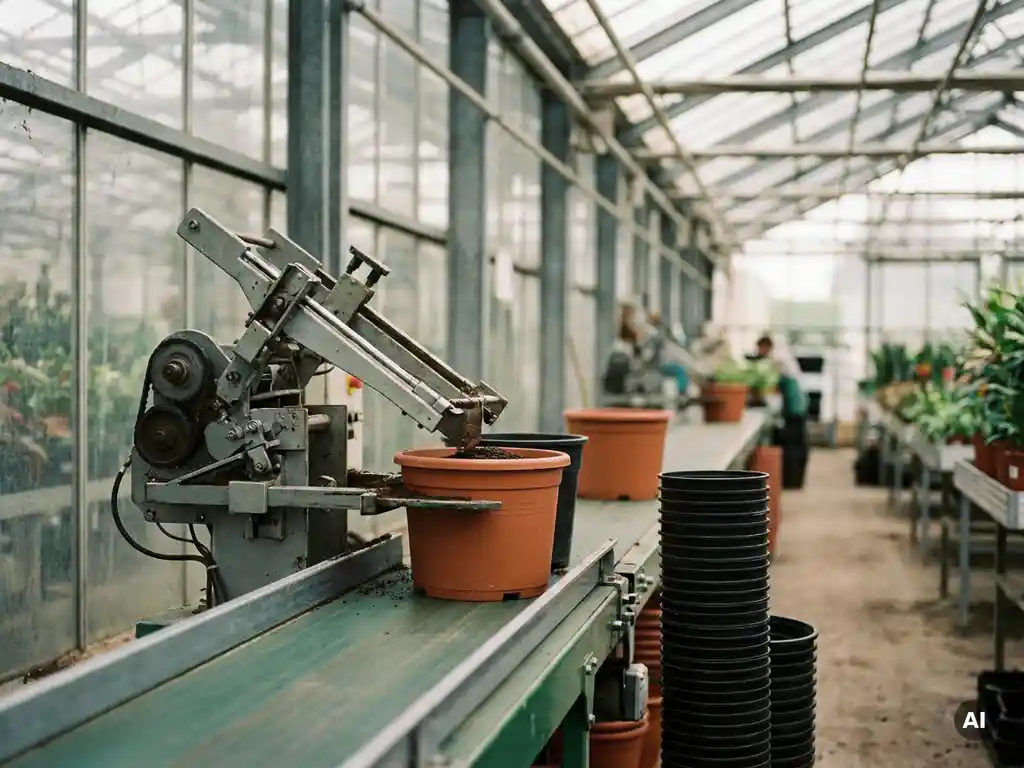
How do production breaks affect your average pots per hour?
Production breaks reduce your average potting machine pots per hour more than most growers expect. Even a single unplanned stop of five to ten minutes can drop your effective hourly output by 10 to 20 percent when you account for restart time, line clearing, and the disruption to your team’s rhythm. The sections below break down exactly how breaks affect your numbers and what you can do about it.
What counts as a production break on a potting line?
A production break on a potting line is any interruption that stops pots from moving through the machine, whether planned or unplanned. This includes scheduled pauses like shift changes and lunch breaks, as well as unplanned stops caused by soil blockages, mechanical faults, empty trays, conveyor jams, or operator error. Every second the line stands still counts against your hourly output.
Many growers underestimate how many events qualify as breaks. Beyond the obvious full stops, micro-interruptions also erode your pots per hour count. These are brief slowdowns or hesitations caused by inconsistent soil flow, a pot that tips on the belt, or an operator stepping away to adjust something manually. Individually, they seem minor. Cumulatively, over an eight-hour shift, they can represent a significant share of lost capacity.
- Planned breaks: Shift handovers, scheduled maintenance windows, lunch and rest pauses
- Unplanned mechanical stops: Soil blockages, chain slippage, sensor faults, conveyor jams
- Operator-caused pauses: Manual adjustments, pot size changes, refilling soil bins
- Micro-interruptions: Inconsistent soil flow, tipping pots, brief slowdowns in belt speed
How much does a single break reduce your hourly pot count?
A single ten-minute unplanned stop on a line running at 5,000 pots per hour costs you roughly 833 pots in lost output during the stop alone. Add two to five minutes for restart and stabilisation, and the real loss climbs to over 1,000 pots per incident. At three unplanned stops per shift, that is more than 3,000 pots below your theoretical maximum.
The impact compounds when you factor in the restart curve. After a stop, operators need time to clear the line, check the cause, and bring the machine back to full speed. During this ramp-up phase, output is lower than the rated capacity. The longer and more frequent the stops, the wider the gap between your machine’s rated pots per hour and your actual daily production figure.
Why do unplanned stops happen more often than planned ones?
Unplanned stops occur more frequently than planned ones because most of their causes are invisible until they become a problem. Soil mix variations, worn components, and inconsistent pot supply are not announced in advance. By the time the machine signals a fault, production has already stopped, and the cause needs to be diagnosed before the line can restart.
The most common drivers of unplanned downtime on a potting line include:
- Soil mix issues: Wet, compacted, or fibrous substrates block augers and filling units without warning
- Wear on mechanical parts: Chains, bearings, and filling cups degrade gradually, then fail suddenly
- Sensor drift or failure: Older machines without automatic detection rely on operators to notice problems
- Supply interruptions: Empty pot stacks or soil bins that run out mid-cycle halt the entire line
Planned stops, by contrast, are built into the schedule and their duration is controlled. They do not require diagnosis time, and the team is prepared to restart efficiently. This is why unplanned stops cost proportionally more output per minute than planned ones.
What’s the difference between a manual and an automated restart?
A manual restart requires an operator to identify the fault, clear the blockage or reset the component, and then manually bring the machine back to the correct settings. This typically takes three to eight minutes depending on the cause. An automated restart, supported by sensors and PLC controls, detects the fault, alerts the operator, and in many cases resumes operation with minimal manual input, cutting restart time to under two minutes.
The practical difference in output is significant. On a line running at 6,000 pots per hour, saving five minutes per restart event adds 500 pots back into your shift total. Across a full growing season with multiple stops per day, the cumulative difference between manual and automated restart capability can represent a meaningful share of total annual output.
Automated restart also reduces the risk of incorrect settings after a stop. When an operator manually resets parameters, there is room for error in soil depth, rotation speed, or bore depth. Machines with programmable touchscreen controls and saved pot profiles eliminate this risk by restoring the correct configuration automatically.
How do you calculate your real average pots per hour?
Your real average pots per hour is your total pots produced in a shift divided by the total time the line was scheduled to run, including all stops. This is different from your machine’s rated capacity, which reflects performance under ideal, uninterrupted conditions. The gap between these two numbers is your efficiency loss.
To calculate it accurately:
- Record the total number of pots produced in a full working shift
- Divide by the total scheduled production hours (not just the time the machine was running)
- Compare this figure to your machine’s rated pots per hour
- Track stop events separately: how many, how long, and what caused them
Once you have this data across several shifts, patterns emerge. You will see whether your losses come primarily from planned breaks, unplanned stops, or slow restarts. That breakdown tells you where to focus improvement efforts, whether that is better soil supply management, preventive maintenance, or a machine upgrade.
When should you consider upgrading your potting machine?
You should consider upgrading your potting machine when your real average pots per hour consistently falls more than 15 to 20 percent below your machine’s rated capacity, when unplanned stops are becoming frequent and unpredictable, or when your current machine cannot handle your soil mix reliably. If seasonal peaks are exposing the limits of your setup, that is a strong signal that your equipment is no longer matched to your production demands.
Other indicators that an upgrade makes sense:
- Inconsistent pot fill quality that leads to complaints or rework
- Increasing maintenance frequency and spare parts costs
- Operators spending significant time managing the machine rather than supporting the line
- Your current machine lacks programmable settings, making pot size changeovers slow
- You are planning to scale volume and the current setup cannot grow with you
The question is not just whether your machine still runs, but whether it is still the right tool for your current scale and soil conditions. A machine that worked well five years ago at lower volumes may now be the bottleneck holding your entire line back.
How we help you maximise pots per hour
At MartinStolze, we have spent more than three decades engineering potting machines that are built around real production conditions, not ideal ones. Our approach to maximising your effective pots per hour is practical and concrete:
- Automatic soil detection on the Stolze 3030 PRO ensures consistent pot fill without operator intervention, eliminating a key source of micro-interruptions
- Programmable touchscreen controls let you save settings for every pot size and soil mix, so restarts and changeovers take seconds rather than minutes
- Fully guided chain system for greater mechanical stability and fewer unplanned stops caused by chain drift or misalignment
- Seamless integration with conveyor systems to keep the full line moving without bottlenecks before or after the potting station
- Production in-house, from design to assembly, meaning we know every component and can support you quickly when something needs attention
- Hire option available, so you can test the machine in your own production environment before committing to a purchase
If your current setup is costing you more pots per hour than you can afford to lose, we are ready to help you find the right solution. Contact us to discuss your production situation and see how a Stolze potting machine fits into your line.
Frequently Asked Questions
How many production stops per shift is considered normal for a potting line?
For a well-maintained potting line, one to two minor unplanned stops per shift is a realistic benchmark, with zero being the goal for planned interruptions outside of scheduled breaks. If you are experiencing three or more unplanned stops per shift regularly, that is a signal that something systematic — soil supply, worn components, or operator workflow — needs to be addressed. Tracking stop frequency over two to four weeks gives you the baseline you need to set a realistic improvement target.
What is the fastest way to reduce micro-interruptions on a running potting line?
The quickest wins typically come from improving soil supply consistency and pot feed reliability, since these are the two most common sources of micro-interruptions that do not trigger a full machine stop. Start by checking your substrate for moisture variation and fibre content, and ensure your pot stacks are being replenished before they run low rather than after they run out. Small process discipline changes — like assigning a dedicated operator to monitor supply rather than splitting attention across tasks — can noticeably improve your effective pots per hour within a single shift.
How do I know if my losses are coming from planned breaks or unplanned stops?
The most reliable method is to log every stop event separately during at least five consecutive shifts, noting the time, duration, and cause for each one. Once you have that data, calculate the total minutes lost to planned breaks versus unplanned stops and compare the two. Most growers find that unplanned stops account for a disproportionate share of lost output despite feeling less disruptive in the moment, which makes them the higher-priority target for improvement.
Can changing my soil mix reduce unplanned downtime without upgrading my machine?
Yes, in many cases adjusting your substrate can meaningfully reduce blockage-related stops without any equipment changes. Reducing moisture content, breaking up compacted batches before they enter the hopper, and screening out oversized fibrous material are all practical steps that lower the load on your auger and filling units. That said, if your machine consistently struggles with the soil types your crops require, a substrate adjustment is a workaround rather than a solution — and upgrading to a machine with more robust soil handling becomes the more cost-effective long-term choice.
How long does a pot size changeover typically take, and how can I speed it up?
On older machines without programmable settings, a pot size changeover can take anywhere from 15 to 30 minutes, including mechanical adjustments, test runs, and operator recalibration. On machines with saved pot profiles and touchscreen controls, the same changeover can be completed in under two minutes. If you are running multiple pot sizes across a week, the cumulative time saved by programmable changeovers can easily exceed an hour of productive output per shift.
Is it worth tracking pots per hour if my operation is relatively small?
Yes — in fact, smaller operations often benefit more from tracking because every lost pot represents a larger percentage of their total daily output. You do not need sophisticated software to start; a simple shift log recording total pots produced, scheduled run time, and stop events is enough to identify your biggest losses. Even identifying and eliminating one recurring stop cause can add hundreds of pots per shift, which at scale across a growing season translates directly into revenue.
What should I look for when trialling a new potting machine in my own facility?
Focus your trial on real-world conditions rather than peak performance: run the machine with your actual soil mix, your pot sizes, and your team — not under optimised demo conditions. Track effective pots per hour across full shifts, note how long restarts take after any stop, and assess how quickly your operators can learn the controls and manage changeovers independently. Pay particular attention to how the machine handles your most challenging substrate, since that is where differences in build quality and soil detection capability become most visible.
Related Articles
- How do you calculate realistic pots per hour for your nursery?
- How do you calculate the required potting capacity for peak season?
- How do you scale up pot plant production without hiring more staff?
- How do soil mix properties affect potting machine performance?
- When should a nursery invest in a conveyor belt system?