

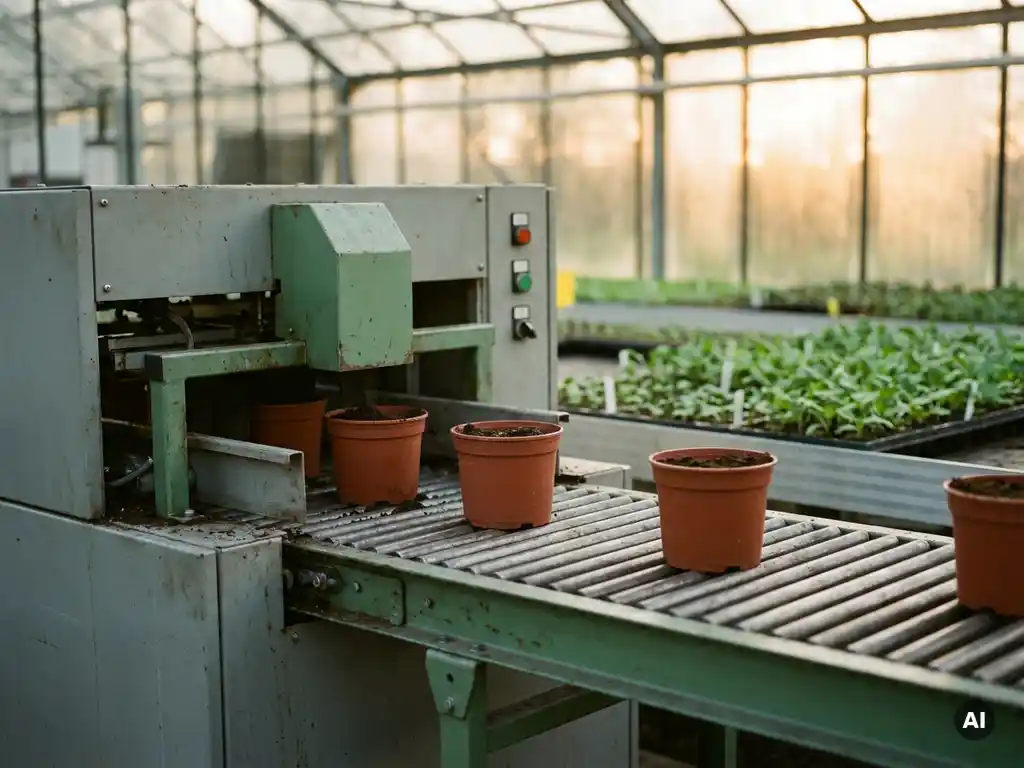
How do short production stops affect total pots produced per day?
Short production stops can cost a grower hundreds of pots per day, even when each individual pause lasts only a few minutes. When a potting machine runs at several thousand pots per hour, a handful of brief interruptions throughout a shift quietly erode output in a way that rarely shows up on a single stopwatch but adds up dramatically by the end of the day. The sections below break down exactly how this happens and what you can do about it.
How much output does a single 5-minute stop actually cost?
A single 5-minute stop on a potting machine running at 6,000 pots per hour costs you 500 pots. That is not a rounding error, it is a full tray cycle, a delivery batch, or a meaningful slice of a daily production target. At 8,000 pots per hour, the same pause removes roughly 667 pots from your total before the line even restarts.
The hidden cost goes beyond the lost pots themselves. Every stop also carries a restart cost: the seconds it takes to clear a jam, re-check soil fill consistency, or re-engage the conveyor. In practice, a “5-minute stop” often means 6 or 7 minutes of actual downtime once you factor in the recovery. Over a full production day, that gap between the clock and reality compounds significantly.
For growers working toward auction deadlines or filling large retail orders, even a modest reduction in pots per hour across several stops can mean the difference between meeting a delivery and falling short. This is why stop frequency matters just as much as machine speed when evaluating true daily capacity.
Why do short stops happen more often than long breakdowns?
Short stops happen more often than long breakdowns because they are triggered by minor, recurring causes that are easy to overlook until they become a pattern. Soil bridging in the hopper, a pot that feeds slightly off-centre, a sensor that needs a quick clean, none of these cause a machine to fail completely, but each one pauses the line for a moment.
Long breakdowns are memorable precisely because they are rare. A snapped chain or a failed motor is an event that gets logged, reported, and fixed with urgency. Short stops, by contrast, feel routine. Operators often absorb them as part of the rhythm of the shift without recording them or escalating them. This means the cumulative impact of micro-stops is almost never fully visible to management unless it is specifically measured.
Soil mix composition is one of the most common drivers of short stops. Coarser or wetter mixes can clump, causing irregular feeding and inconsistent pot fill. Machines that are not designed to handle a range of substrate types will pause more frequently when the mix changes between batches or suppliers.
What is the difference between a micro-stop and planned downtime?
A micro-stop is an unplanned interruption lasting a few minutes or less, caused by a minor fault that an operator can resolve without tools or specialist help. Planned downtime is a scheduled pause, such as a shift break, a cleaning cycle, or a routine maintenance window, that is built into the production schedule and accounted for in daily output targets.
The distinction matters because planned downtime is factored into capacity calculations before the day begins. A grower who schedules a 15-minute cleaning break at midday knows exactly how many pots that pause will cost and plans accordingly. Micro-stops, on the other hand, are invisible in the plan. They arrive unannounced, at random intervals, and their cumulative effect is almost never captured in the day’s output report.
This asymmetry means that many growers who believe their line is running efficiently are actually losing a significant portion of potential output to micro-stops they have not measured. Tracking stop frequency, even informally, gives a far more accurate picture of where pots per hour are actually being lost.
How does stop frequency affect end-of-day pot totals?
Stop frequency has a compounding effect on end-of-day pot totals that grows larger the more often stops occur. Four 5-minute stops in a shift cost 2,000 pots at 6,000 pots per hour. Eight stops of the same length cost 4,000 pots, the equivalent of losing a full hour of production without any single stop lasting longer than five minutes.
The relationship is straightforward but easy to underestimate because each individual stop feels minor in the moment. A grower who experiences one brief pause every hour across a ten-hour shift has effectively lost an hour of output by the time the last pot is filled. When that same grower is trying to hit a target of 50,000 pots in a day, the gap between plan and reality becomes very real very quickly.
Frequency also affects operator fatigue. Each stop requires attention, a physical intervention, and a mental reset. Over a long shift, the accumulated effort of managing repeated micro-stops reduces the pace at which operators work between stops, creating a secondary drag on output that does not appear in any stop log.
Which potting machine features reduce unplanned stops?
The features that most reliably reduce unplanned stops are automatic soil detection, a fully guided chain system, and programmable settings for different pot sizes and substrate types. Together, these elements address the most common causes of micro-stops before they interrupt the line.
- Automatic soil detection ensures that each pot receives a consistent fill regardless of variation in the substrate. Without it, the machine relies on fixed timing, which breaks down when the mix is wetter, drier, or coarser than expected.
- A fully guided chain keeps pots stable throughout the filling cycle, reducing the misfeeds and jams that cause the majority of operator-resolved stops.
- Touchscreen programming with saved presets for different pot sizes and boring depths means that changeovers between batches happen quickly and without manual recalibration, eliminating a common source of setup-related stops.
- Quieter, lower-maintenance drive systems reduce the frequency of wear-related pauses that accumulate over a season of heavy use.
A machine that handles a wide range of pot sizes, from 7 cm to 30 cm, without requiring significant mechanical adjustment between runs also reduces the downtime associated with product changeovers, which is a stop category that growers with diverse cultivation programmes encounter regularly.
When should a grower consider upgrading to reduce stop-related losses?
A grower should seriously consider upgrading when stop-related losses are consistently reducing daily pot totals by more than 5 to 10 percent of planned output, when micro-stops are requiring operator intervention more than a few times per hour, or when the current machine cannot reliably handle the substrate types the operation uses.
Other clear signals include seasonal peaks where the line simply cannot keep up with demand, and situations where the cost of lost output over a growing season exceeds the investment threshold for a newer machine. Growers who have been running the same machine for many years often find that modern designs have moved significantly in terms of soil handling, stability, and programmability, meaning the gap between current performance and what is possible has widened considerably.
For operations that are uncertain about committing to a purchase, trialling a machine before buying is a practical way to measure the actual impact on pots per hour under real production conditions. Seeing the stop frequency data from a newer machine running alongside your current process makes the decision much easier to justify.
How MartinStolze helps reduce stop-related output losses
We design and build our potting machines in-house, which means every component is engineered to work together and minimise the micro-stops that quietly drain daily output. Here is what that means in practice for your production line:
- Stolze 3030 PRO with automatic soil detection – consistent fill quality across varying substrate types, with no manual adjustment needed between batches
- Fully guided chain system – fewer misfeeds, fewer jams, and a more stable pot flow at up to 8,000 pots per hour
- Touchscreen with saved presets – fast changeovers between pot sizes and boring depths, reducing setup-related stops to seconds
- Quieter, lower-maintenance drive – less wear-related downtime across a full growing season
- Seamless integration with our conveyor systems – the entire line runs as one coordinated process, not a series of independent machines that need to be manually re-synced after every stop
- Buy or hire, including a trial period – so you can measure the real impact on your pots per hour before committing
If stop-related losses are affecting your daily totals and you want to understand what a different machine could realistically deliver in your situation, get in touch with us and we will walk through your current setup together.
Frequently Asked Questions
How do I start measuring micro-stops on my current potting line?
The simplest starting point is a paper-based tally sheet at the machine, where operators mark the time and reason for every stop lasting more than 30 seconds. After a week of consistent logging, patterns in cause and frequency become clear enough to prioritise which issues to address first. If you want more precision, basic production counters or even a spreadsheet comparing planned versus actual pots at the end of each shift will reveal the cumulative gap that micro-stops are creating.
Can soil mix changes between suppliers really cause that many additional stops?
Yes, and this is one of the most underestimated sources of micro-stops in commercial potting operations. Different suppliers produce mixes with varying moisture levels, particle sizes, and organic content, all of which affect how freely the substrate flows through the hopper and into the pot. A machine calibrated for one mix will often over- or under-fill when the batch changes, triggering manual corrections or sensor-triggered pauses that add up quickly across a shift.
What is a realistic target for stop frequency on a well-maintained potting machine?
On a modern, well-maintained machine running a consistent substrate, unplanned stops should occur no more than once or twice per hour, and many operations running optimised lines report even fewer. If your current line is stopping more than three or four times per hour, that frequency alone is worth investigating as a priority, since the cumulative pot loss at that rate can easily exceed 10 percent of daily planned output. Benchmarking your own stop log against this range gives you a concrete starting point for improvement.
Does operator experience significantly affect how many micro-stops occur during a shift?
Operator experience affects how quickly stops are resolved more than how often they occur, since most micro-stops are caused by machine or substrate factors rather than human error. However, experienced operators do tend to anticipate recurring issues, such as a hopper that bridges at a certain fill level, and intervene before a full stop is triggered. Investing in clear operating procedures and brief training on the most common stop causes can meaningfully reduce both stop frequency and resolution time, regardless of experience level.
Is it worth tracking micro-stops separately from other downtime in my production reports?
Absolutely, and this separation is often where growers first discover just how much output they are losing. Lumping micro-stops into a general downtime category masks their frequency and makes it impossible to identify the specific causes driving the losses. A simple split between planned downtime, unplanned short stops under five minutes, and longer unplanned breakdowns gives you three distinct data sets that each point to different types of corrective action.
How long does it typically take to see a reduction in stop frequency after upgrading to a newer potting machine?
Most growers notice a measurable reduction in stop frequency within the first few production days on a new machine, particularly in the categories of misfeeds and substrate-related pauses. The full benefit typically becomes clear within the first two to three weeks, once operators are comfortable with the new controls and any changeover presets have been configured for the operation's standard pot sizes and mixes. A trial period before purchase is specifically valuable for capturing this data under your own real-world conditions rather than relying on manufacturer estimates.
What should I document before contacting a potting machine supplier about upgrading?
Before reaching out, it helps to have a rough picture of your current daily pot target, the pot sizes and substrate types you run most frequently, and if possible, an estimate of how often your line stops unplanned during a typical shift. You do not need precise figures, but knowing whether you run one pot size or ten, and whether your substrate mix varies between batches, allows a supplier to give you a much more specific and useful recommendation rather than a generic one.
Related Articles
- What are the benefits of using a topping machine after potting?
- How does material particle size affect topping machine performance?
- Is pots per hour the best metric for comparing potting machines?
- How long does it take to pot 50,000 plants with a high-capacity machine?
- What is the role of automation in modern horticulture?