

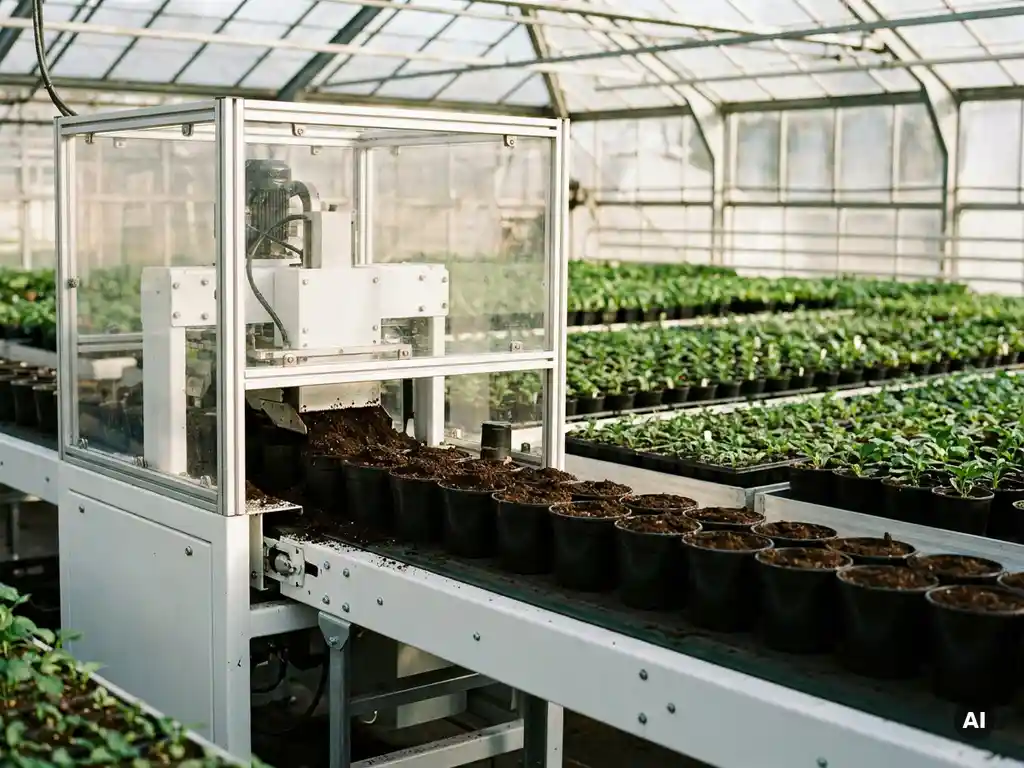
How do you calculate how long it will take to pot 10,000 plants?
To pot 10,000 plants, divide the total number of pots by your machine’s actual output per hour. If your potting machine reliably produces 2,000 pots per hour under real working conditions, you are looking at roughly five hours of production time. The key word is “reliably” because rated capacity and real-world output are rarely the same number.
Several variables shape that estimate: pot size, soil mix, operator experience, and how your line is set up. Understanding each one helps you plan your production schedule with confidence rather than guesswork. The questions below walk through every factor that matters.
What factors affect how fast a potting machine works?
A potting machine’s speed is shaped by five main factors: pot size, soil mix consistency, machine settings, operator skill, and how well the surrounding line keeps up with the machine. No single factor works in isolation: they interact, and a bottleneck in any one area slows the entire process.
- Pot size: Smaller pots move through the line faster. Larger pots take more soil and more time per cycle.
- Soil mix: Coarse, fibrous, or wet mixes can slow soil flow and cause blockages, especially on machines not designed to handle demanding substrates.
- Machine settings: Bore depth, rotation speed, and soil feed rate all need to match the pot and substrate combination.
- Operator experience: A well-trained operator keeps the line running smoothly, catches problems early, and minimises downtime.
- Line integration: If your conveyor cannot keep pace with the potting machine, the machine will idle, waiting for empty pots or space to move filled ones.
Getting these factors aligned before a production run, rather than adjusting on the fly, is what separates a smooth shift from a frustrating one.
How do you calculate potting time for a large batch?
The calculation is straightforward: divide the total number of pots by your machine’s actual output per hour. For 10,000 plants at a realistic output of 2,500 pots per hour, you get four hours of net machine time. Always add a buffer of 10 to 20 percent for changeovers, refilling soil, and short pauses.
A practical formula looks like this:
- Establish your machine’s actual output per hour (not the rated maximum; more on that below).
- Divide total pots needed by that figure: 10,000 ÷ 2,500 = 4 hours.
- Add your buffer: 4 hours × 1.15 = approximately 4 hours and 36 minutes of planned production time.
- Factor in any pot size changes mid-run, which require reprogramming and a short stop.
If you are running multiple pot sizes in the same batch, calculate each size group separately and add the results together. Mixing pot sizes in a single calculation leads to inaccurate planning.
What’s the difference between rated capacity and actual output?
Rated capacity is the maximum number of pots per hour a machine can produce under ideal, uninterrupted conditions. Actual output is what you consistently achieve during a real production shift, accounting for brief stops, soil refills, operator pace, and line coordination. In practice, actual output is typically 70 to 85 percent of rated capacity.
This gap exists for good reasons. Rated figures are measured in controlled conditions with a specific pot size, a free-flowing soil mix, and no interruptions. On your floor, the soil hopper needs refilling, trays need repositioning, and the occasional pot jams the line. None of that is unusual: it is simply normal production reality.
When comparing machines, always ask suppliers for actual throughput figures from real installations rather than peak laboratory numbers. A machine rated at 8,000 pots per hour that delivers 6,500 consistently is more useful to your planning than one rated at 10,000 that regularly falls short. Our conveyor systems are designed to match the throughput of the potting machine, so the line as a whole reaches its realistic potential rather than creating bottlenecks.
How does pot size change your potting time estimate?
Pot size directly affects how many pots per hour your machine can process. Smaller pots, such as 7 cm or 9 cm, move through the line quickly and require less soil per cycle, so output is higher. Larger pots, such as 23 cm or 30 cm, take more fill time and occupy more space on the conveyor, reducing the number of pots completed per hour.
As a rule of thumb, moving from a small pot to a large pot can cut your hourly output by 30 to 50 percent, depending on the machine and the substrate. This has a significant effect on your time estimate for a batch of 10,000 plants. A run of 10,000 pots in a 9 cm size might take two hours; the same quantity in a 25 cm size could take four hours or more.
When planning a production day that includes multiple pot sizes, schedule the size changes strategically. Grouping all pots of the same size together minimises reprogramming stops and keeps your throughput consistent. Modern machines with programmable touchscreen controls make switching between pre-saved pot size settings faster, which reduces the time penalty of mid-run changes.
When does it make sense to rent a potting machine instead of buying?
Renting a potting machine makes sense when your potting volume is seasonal, when you want to trial a machine before committing to a purchase, or when your current machine is temporarily out of service. Buying makes more sense when potting is a year-round core activity and your volumes justify the investment.
Growers who pot intensively for six to eight weeks around spring peaks often find that rental covers their needs without the capital commitment of ownership. Rental also removes the uncertainty of choosing the wrong specification: you can run a real production batch and confirm that the machine handles your soil mix and pot sizes before signing a purchase agreement.
How MartinStolze helps you plan and optimise your potting line
We help professional growers move from rough estimates to reliable production planning. Our Stolze 3030 and Stolze 3030 PRO potting machines are built and programmed entirely in-house, which means we understand exactly how they perform across different pot sizes, soil mixes, and line configurations. Here is what we offer:
- Accurate capacity advice: We provide realistic output figures based on your specific pot size and substrate, not just peak laboratory numbers.
- Complete line integration: Our potting machines connect seamlessly with our own conveyor systems, topping machines, and sorting lines for a consistent throughput from start to finish.
- Rental with trial option: Test the machine in your own production environment before deciding to buy, with full support from our own technicians.
- Training and support: Our demo and training facility in De Lier means your operators get hands-on experience before the machine arrives on your floor.
- Programmable settings: Pre-save configurations for each pot size so changeovers are fast and your planned schedule stays on track.
Whether you are planning a single seasonal run or building a fully automated potting line, we are ready to help you calculate what you need and configure the right solution. Get in touch with our team and we will work through the numbers with you.
Frequently Asked Questions
How do I know if my current potting line setup is creating a bottleneck?
The clearest sign of a bottleneck is your potting machine idling — waiting for empty pots to arrive or for filled pots to clear the conveyor. Track your machine's actual cycle time against your conveyor speed: if the machine is consistently pausing between cycles, the surrounding line is not keeping pace. Logging short stoppages over a full production shift will quickly show you where time is being lost and which part of the line needs attention.
What is a realistic buffer percentage to add to my potting time calculation, and what should it account for?
A buffer of 10 to 20 percent is a practical starting point for most operations. The lower end suits experienced operators running a single pot size with a well-flowing soil mix; the higher end is more appropriate for mixed-size batches, demanding substrates, or newer operators still building speed. Your buffer should cover soil hopper refills, occasional pot jams, brief operator breaks, and any mid-run reprogramming for size changes.
Can I run different soil mixes through the same potting machine without reconfiguring it each time?
Most professional potting machines can handle a range of substrates, but the soil feed rate and bore depth settings typically need adjusting when you switch between mixes with significantly different textures or moisture levels. Coarser or wetter mixes in particular tend to require slower feed rates to prevent blockages. On machines with programmable touchscreen controls, you can pre-save substrate-specific settings alongside your pot size profiles, which makes switching faster and more consistent.
How much does operator experience actually affect throughput, and how can I close that gap quickly?
Operator experience can account for a 15 to 25 percent difference in effective throughput, mainly through faster problem detection, smoother soil refilling routines, and fewer unplanned stops. The quickest way to close that gap is structured hands-on training before the production run begins, ideally on the actual machine your team will be using. Facilities that offer demo and training sessions — where operators can practice on real equipment with real substrates — consistently see faster ramp-up times on the production floor.
What should I ask a potting machine supplier before accepting their capacity figures?
Ask for actual throughput data from real customer installations using a pot size and soil mix comparable to yours, rather than peak laboratory ratings. Specifically, request the average pots-per-hour figure achieved over a full production shift, including normal stoppages. Also ask how the machine performs with your specific substrate — fibrous or high-peat mixes behave very differently from free-flowing media — and whether the quoted figure assumes a fully integrated conveyor line or a standalone setup.
Is it worth investing in programmable settings if I only run one or two pot sizes regularly?
Even with just two pot sizes, programmable settings pay off over time by eliminating manual readjustment errors and reducing changeover time to a matter of seconds rather than minutes. The more consistent benefit, however, is repeatability: saved profiles ensure the machine runs at the correct settings every time, regardless of which operator is on shift. If you ever expand your range or take on contract potting work, those saved profiles become even more valuable.
What are the most common mistakes growers make when planning a large potting batch for the first time?
The most frequent mistake is using the machine's rated capacity rather than its real-world output as the basis for the schedule, which leads to underestimating production time and missing deadlines. A close second is failing to account for pot size changes mid-run — each changeover adds unplanned downtime that compounds across a long shift. Planning each pot size group as a separate calculation, adding a realistic buffer, and confirming your conveyor can match the machine's pace will prevent the majority of first-run scheduling problems.
Related Articles
- Can a topping machine automatically detect whether a pot is present?
- Which production step determines your actual pots per hour?
- Can a potting machine handle different substrate types without adjusting?
- What is the difference between a basic and advanced potting machine?
- How do you scale up internal transport as a nursery grows?