

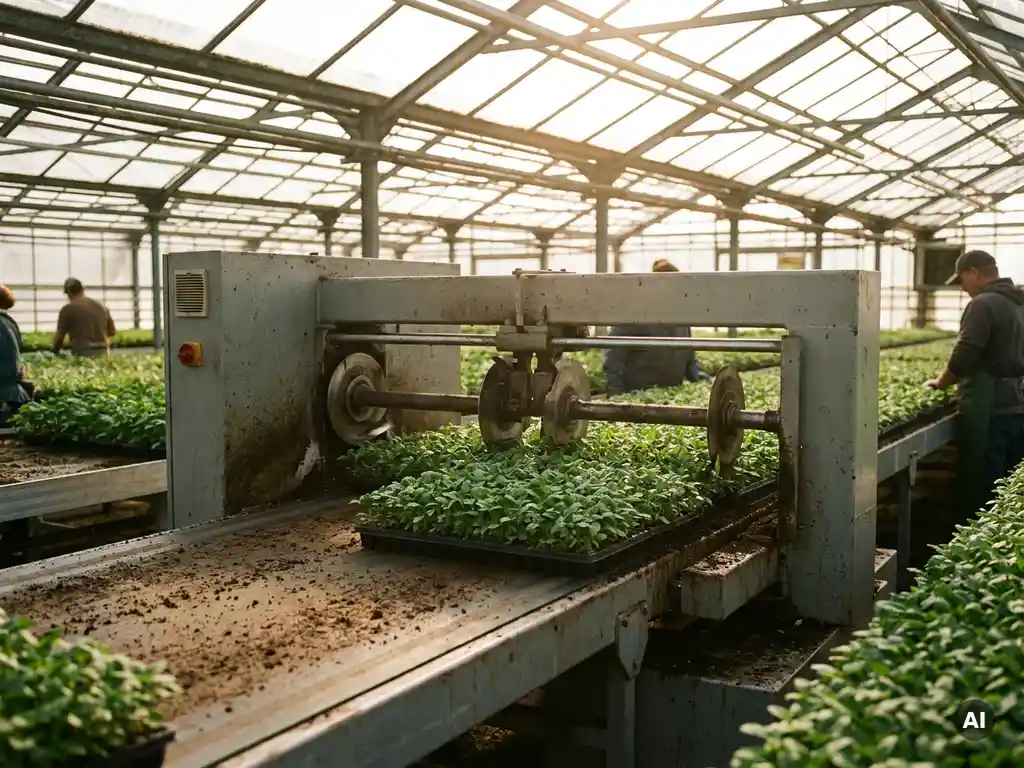
How do you choose a topping machine for a high-volume nursery?
Choosing a potting machine for a high-volume nursery comes down to matching output capacity, soil mix compatibility, and integration capability to your specific production demands. For most professional growers, the right machine is one that handles peak-season volumes without bottlenecks, delivers consistent pot fill quality, and connects cleanly with the rest of the production line. The questions below unpack each decision point so you can choose with confidence.
What output capacity do you actually need from a potting machine?
The output capacity you need depends on your peak daily volume, not your average. Calculate the maximum number of pots you need to fill in a single shift during your busiest week of the year, then choose a machine rated comfortably above that number. Undersizing a potting machine creates bottlenecks precisely when you can least afford them.
A useful starting point is to map your auction or delivery deadlines against your available shift hours. If you need 20,000 pots filled in an eight-hour shift, a machine rated at 3,000 pots per hour leaves almost no margin for changeovers, maintenance pauses, or unexpected slowdowns. A machine rated at 6,000 to 8,000 pots per hour gives you the headroom to work at a sustainable pace and still meet the deadline.
Also consider how your volume is likely to grow. Buying a machine sized exactly for today’s throughput means you may be shopping again within a few seasons. Investing in a higher-capacity machine now is almost always more cost-effective than replacing a machine that has become the limiting factor in your operation.
What features separate a basic potting machine from a professional one?
A basic potting machine fills pots mechanically at a fixed setting. A professional potting machine adds programmable controls, automatic soil detection, and consistent fill accuracy across different pot sizes and soil mixes. The practical difference shows up in product quality, labour requirements, and long-term reliability.
Key features that distinguish professional-grade machines include:
- Touchscreen controls with programmable presets: Operators can store settings for different pot sizes, drilling depths, and rotation speeds, reducing setup time when switching between crops.
- Automatic soil detection: Sensors verify that each pot receives the correct fill before it moves on, preventing underfilled or overfilled pots from reaching the sales floor.
- Fully guided chain systems: These reduce vibration and wear, making the machine quieter and less maintenance-intensive over time.
- Wide pot size range: A professional machine typically handles pots from 7 cm up to 30 cm without requiring significant mechanical adjustment.
- PLC-based control: Programmable logic controllers allow precise, repeatable operation and make fault diagnosis straightforward.
These features matter most when you are running high volumes with a small team. Every manual adjustment or quality check that can be automated reduces labour dependency and the risk of inconsistent results across a long shift.
Can a potting machine handle any soil mix?
Not every potting machine handles every soil mix equally well. Mixes with a high proportion of coarse bark, perlite, or fibrous material can jam or wear out the dosing mechanism on lighter machines. A professional machine built with robust components and adjustable feed settings will handle a much wider range of substrates reliably.
Before selecting a machine, test it with your actual soil mix rather than a standard peat substrate. The key variables to assess are moisture content, particle size, and the proportion of coarse or fibrous material. A mix that clumps when wet or bridges inside the hopper will cause problems on machines with narrow feed openings or fixed auger speeds.
If your growing operation uses multiple substrate types across different crops, look for a machine where feed speed and dosing depth are independently adjustable. This allows the operator to tune the machine to each mix without mechanical intervention, keeping downtime to a minimum when switching between product lines.
How does a potting machine integrate with the rest of a production line?
A potting machine integrates with a production line by connecting to upstream soil feeding systems and downstream conveyors, topping machines, and sorting lines. The key is matching conveyor speeds and pot spacing so that each station in the line operates at the same throughput without creating queues or gaps.
In a well-designed potting line, pots move from tray filling through the potting machine, on to a conveyor system, and then to a topping machine or watering station before reaching the sorting or dispatch area. Each handoff point needs to be calibrated so that the potting machine is never waiting for pots and never producing faster than the downstream equipment can handle.
Practical integration considerations include:
- Belt speed synchronisation: Conveyors feeding into and out of the potting machine must run at compatible speeds to prevent pots tipping or piling up.
- Footprint and layout: The physical arrangement of the line affects how efficiently operators can move between stations and how easily maintenance access is maintained.
- Control compatibility: If the line uses a central control system, the potting machine should be able to communicate with it or, at minimum, be started and stopped in sequence with the other stations.
- Scalability: A modular line can be extended with additional stations as production volume grows, without replacing the entire setup.
Should you buy or rent a potting machine for your nursery?
Buying a potting machine makes sense when you run high volumes consistently throughout the year and want full control over the machine’s configuration and maintenance schedule. Renting is the better choice when you need to cover a seasonal peak, want to evaluate a specific model before committing, or prefer to keep capital expenditure low in the short term.
For most established nurseries with year-round production, ownership offers the lowest cost per pot over time. You can customise the machine to your exact substrate and pot range, and you are not dependent on rental availability during the periods when demand is highest across the industry.
Renting becomes particularly valuable in two scenarios. First, if your operation is scaling and you are not yet certain which machine configuration fits your future production line, a rental period lets you work with the machine under real conditions before making a long-term investment. Second, if you have a short but intense seasonal window, renting avoids the cost of owning a machine that sits idle for eight months of the year. Some suppliers offer trial rental arrangements that can convert into a purchase, which removes much of the risk from the initial decision.
What should you check before choosing a potting machine supplier?
Before choosing a potting machine supplier, verify that they manufacture their own machines, provide installation and training support, offer spare parts with short lead times, and have technicians who can reach your site quickly when something goes wrong. A supplier who only distributes machines from a third-party manufacturer has limited ability to support you when you need it most.
Specific things to evaluate during supplier selection:
- In-house production: Suppliers who design and build their own machines understand the engineering at every level and can modify configurations to match your specific requirements.
- Demo and testing facilities: A reputable supplier should be able to run your soil mix through the machine before you buy, so you can see actual performance rather than relying on specification sheets.
- After-sales service structure: Ask how service calls are handled, what the typical response time is, and whether the supplier has technicians based in your region.
- References from comparable operations: Speak with other growers at a similar scale and with a similar crop profile. Their experience with the machine and the supplier’s service will tell you more than any brochure.
- Flexibility on commercial terms: A supplier who offers both purchase and rental options, and who is willing to structure a trial period, signals confidence in their product and a genuine interest in a long-term relationship.
How MartinStolze helps you choose the right potting machine
We are a Dutch technical production company with more than three decades of experience in nursery automation, and we build our potting machines entirely in-house, from design and programming through to assembly and installation. That means we can configure the machine to your specific crop, pot range, and soil mix, and we stand behind every component because we made it.
Here is what working with us looks like in practice:
- Machine range matched to your volume: The Stolze 3030 and Stolze 3030 PRO both reach up to 8,000 pots per hour and handle pots from 7 to 30 cm. The PRO adds automatic soil detection, a fully guided chain, and quieter operation for the most demanding environments.
- Full line integration: Our potting machines connect directly with our own conveyor systems, topping machines, tray fillers, and sorting lines, so you get a complete production line from a single supplier.
- Demo and training in De Lier: We test your soil mix in our own demo facility before you commit, and we train your operators on-site after installation.
- Buy or rent, including trial periods: We offer both purchase and rental arrangements, so you can start with lower risk and convert to ownership when you are ready.
- Our own technicians: Installation, maintenance, and service are handled by our own team, not a third-party network.
Ready to find the right configuration for your nursery? Get in touch with our team and we will help you work through the options based on your actual production requirements.
Frequently Asked Questions
How long does it typically take to install and commission a potting machine in an existing nursery?
Installation and commissioning time depends on the complexity of your production line, but most standalone potting machine setups can be completed within one to two days. If the machine is being integrated into a full line with conveyors, topping machines, and sorting equipment, allow three to five days for installation, calibration, and operator training. Planning the installation during a low-production period reduces disruption and gives your team time to get comfortable with the machine before peak season begins.
What maintenance routine should I put in place to keep a potting machine running reliably?
A daily maintenance routine should include cleaning residual soil from the dosing mechanism, checking belt tension, and inspecting sensors for dirt or misalignment. Weekly checks should cover lubrication points, chain tension, and wear on high-contact components such as the auger and dosing plates. Keeping a stock of commonly replaced spare parts — seals, belts, and sensor components — on-site significantly reduces unplanned downtime, particularly during peak season when waiting on parts is not an option.
Can one potting machine operator run the machine alone, or do you always need a full team?
A professional potting machine with programmable presets and automatic soil detection can realistically be monitored by a single trained operator once it is running at a stable setting. However, you will typically need additional people at other points in the line — loading trays, managing pot flow, and handling output at the dispatch end. The more automated the surrounding line, the smaller the team you need overall, which is one of the strongest arguments for investing in full line integration rather than a standalone machine.
What happens if my soil mix changes seasonally — will I need to reconfigure the machine every time?
If your machine has independently adjustable feed speed and dosing depth, switching between substrate types is largely a matter of loading the correct preset rather than making mechanical changes. Professional machines with PLC-based controls allow you to store separate programmes for each mix you use, so the changeover can take as little as a few minutes. The important step is to test and save those settings during a quiet period rather than troubleshooting a new mix mid-shift during a busy production run.
How do I calculate the return on investment for a potting machine at my scale?
Start by calculating your current cost per pot using manual or semi-manual methods — factoring in labour hours, error rates, and the cost of inconsistent fill quality such as plant losses or customer returns. Then compare that against the machine's purchase price spread across its operational lifespan, plus ongoing maintenance costs. For most high-volume nurseries, a professional potting machine pays for itself within two to four seasons, with the savings accelerating as labour costs rise and production volumes grow.
What are the most common mistakes nurseries make when buying their first potting machine?
The most common mistake is sizing the machine to average daily volume rather than peak volume, which creates bottlenecks exactly when the pressure is highest. A close second is choosing a machine without testing it on the actual soil mix used in production — a machine that performs well on standard peat may struggle with a coarse bark or perlite-heavy substrate. Finally, many growers underestimate the importance of after-sales support and only discover the supplier's service limitations when the machine goes down during a critical production window.
Is it possible to upgrade a potting machine later, or do you need to buy a new one to access advanced features?
This depends entirely on the machine's design and the supplier's support model. Machines built on a modular platform with PLC-based controls can often be upgraded with additional sensors, improved dosing components, or enhanced software without replacing the entire unit. Before purchasing, ask the supplier specifically which features can be added after installation and what the upgrade path looks like as your production needs evolve — a supplier who builds their own machines in-house is far better positioned to support this than one who resells third-party equipment.
Related Articles
- How accurate are automatic topping machines at high speeds?
- At what hourly production target does automation become necessary?
- What questions should you ask before buying a potting machine in 2026?
- Can a potting machine handle different substrate types without adjusting?
- When does manual potting become too slow for your nursery?