

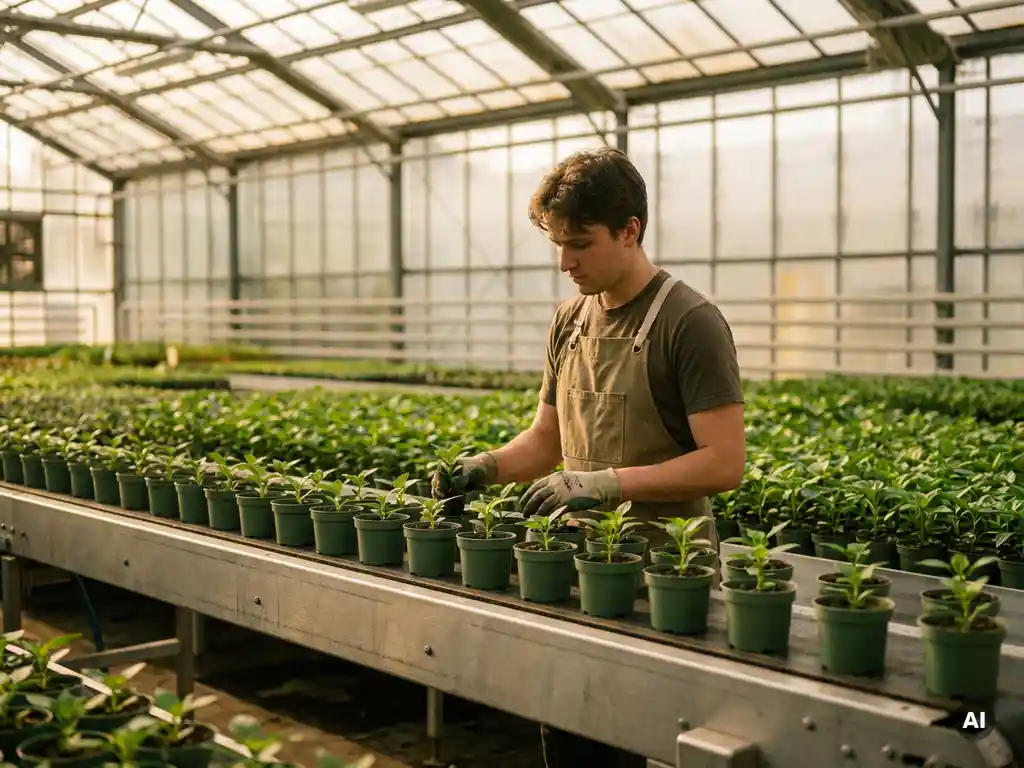
How do you compare manual labor productivity with machine output?
A potting machine produces dramatically more pots per hour than manual labor can. A professional machine like the Stolze 3030 reaches up to 8,000 pots per hour, while even a skilled manual team rarely exceeds a few hundred per hour under sustained conditions. The gap is not just about speed, it is about consistency, labor cost, and what your operation can realistically scale to. The sections below break down every dimension of that comparison so you can make a fully informed decision.
How much faster is a potting machine than manual potting?
A modern potting machine is typically 10 to 30 times faster than manual potting, depending on pot size, soil type, and team size. Where a well-organized manual crew might pot 300 to 600 pots per hour per person, a single automated potting machine can reach 4,000 to 8,000 pots per hour, with one operator managing the entire line.
The speed advantage compounds over a full working day. Manual workers slow down as fatigue sets in, especially during repetitive bending and lifting. A machine maintains its output from the first hour to the last. During peak season, when every hour counts before delivery to the auction, that sustained throughput is the difference between meeting your schedule and falling behind.
Pot size matters too. Smaller pots (7 to 9 cm) move through a machine at the highest rates, while larger formats (25 to 30 cm) naturally reduce throughput, but still far outpace what hands can do at scale.
What factors affect manual labor productivity in potting operations?
Manual labor productivity in potting operations is affected by worker fatigue, team experience, soil mix consistency, and the physical ergonomics of the workstation. No two workers pot at exactly the same rate, and that variability compounds across a full shift and a full season.
The most significant factors include:
- Fatigue: Repetitive scooping, pressing, and bending reduce output and accuracy as the shift progresses.
- Experience level: Seasonal or temporary workers take time to reach a reliable rhythm, and turnover resets that curve every year.
- Soil mix: Heavy, fibrous, or wet mixes are harder to handle manually and slow filling significantly.
- Workstation setup: Poor ergonomics force awkward postures that reduce speed and increase injury risk over time.
- Team coordination: Bottlenecks at one station slow the entire line, even if individual workers are performing well.
These factors do not operate independently. A tired worker handling a difficult soil mix in a poorly designed workspace can produce a fraction of the theoretical maximum, and that is the reality for many operations during high-pressure periods.
How do you calculate the true cost per pot for manual versus machine potting?
The true cost per pot is calculated by dividing total operational cost, labor, overhead, and error-related waste, by the number of usable pots produced per hour or per shift. For manual potting, labor typically dominates this number. For machine potting, the machine’s amortized cost replaces most of that labor expense.
To compare accurately, include the following in your calculation:
- Labor cost: Hourly wages multiplied by the number of workers required, including supervisory time.
- Output volume: The number of correctly filled, sellable pots per hour, not just pots touched.
- Waste and rework: Underfilled or overfilled pots that need correction or are discarded.
- Machine cost (amortized): Purchase or rental cost divided across the expected productive hours over the machine’s lifespan.
- Downtime and maintenance: Any hours where the line is not running due to breakdowns or adjustments.
In most professional potting operations, the cost per pot drops significantly once a machine replaces three or more manual workers. The crossover point depends on your volume, but operations running tens of thousands of pots per week typically see the economics favor automation clearly.
What’s the difference between consistent machine output and variable human output?
Machine output is consistent because every pot receives the same fill volume, bore depth, and compaction level, defined once and repeated thousands of times without deviation. Human output varies because individuals differ in technique, strength, and attention, and because those variables shift throughout the day as fatigue builds.
In practice, variable human output creates two downstream problems. First, inconsistent soil density affects root development and plant quality, buyers and auction standards notice. Second, variation in pot weight causes issues on automated sorting and transport lines that expect uniform loads.
A machine with automatic soil detection, such as the Stolze 3030 PRO, goes further by adjusting fill in real time to account for changes in the soil mix itself. This means consistent results even when the substrate shifts between batches, something no manual team can replicate reliably at volume.
For growers supplying retail chains or auction markets with strict quality requirements, this consistency is not a convenience. It is a commercial requirement.
When does automating potting actually pay off?
Automating potting pays off when the combined savings in labor, reduced waste, and increased throughput exceed the total cost of the machine over its working life. For most professional operations, this break-even point arrives within one to three growing seasons, depending on annual volume and current labor costs.
The clearest signals that automation makes financial sense include:
- You regularly need three or more workers dedicated to potting during peak periods.
- Seasonal labor is difficult to find, expensive, or unreliable.
- Quality inconsistencies are causing rejections or complaints.
- Your current output cannot keep pace with orders during peak weeks.
- Manual potting is contributing to worker absenteeism or injury claims.
For growers who are uncertain about the investment, rental is a practical way to validate the return before committing to a purchase. Running a machine through an actual production season gives you real numbers from your own operation, not estimates.
How do you measure productivity after switching to a potting machine?
After switching to a potting machine, productivity is measured by tracking pots per hour, labor hours per thousand pots, waste rate, and downtime. Comparing these figures against your pre-automation baseline gives a clear picture of the actual improvement achieved.
Set up a simple measurement framework from day one:
- Pots per hour: Record actual output at regular intervals across the shift, not just peak rates.
- Labor allocation: Note how many people are now needed to run the potting line versus before.
- Defect rate: Track pots that are underfilled, overfilled, or otherwise rejected at inspection.
- Downtime: Log any stops, planned maintenance, adjustments, or faults, to calculate true uptime.
- Cost per thousand pots: Recalculate this figure monthly to see the trend as operators become more familiar with the machine.
Most growers find that productivity continues to improve in the weeks after installation as the team learns to optimize settings for their specific soil mix and pot range. The first season’s data is your baseline for future investment decisions.
How MartinStolze helps you maximize potting output
We build and support potting machines that are designed specifically for the demands of professional ornamental and pot plant cultivation. Our machines are developed, assembled, and installed entirely in-house, which means we control quality at every step and stand behind every machine we deliver.
Here is what working with us looks like in practice:
- The right machine for your operation: We help you choose between the Stolze 3030 and the Stolze 3030 PRO based on your pot sizes, soil mix, and target output, up to 8,000 pots per hour.
- Full integration: Our conveyor systems connect seamlessly with the potting machine to create a complete, efficient production line.
- Training and support: We train your team in our own demo and instruction facility in De Lier, and our own technicians handle installation and service.
- Buy or rent: Both options are available, including a trial period, so you can validate the return before making a long-term commitment.
If you want to know exactly what a potting machine would deliver for your specific operation, get in touch with us and we will work through the numbers together.
Frequently Asked Questions
Can a potting machine handle all types of soil mixes, including peat, coco coir, or bark-based substrates?
Most professional potting machines, including the Stolze 3030, are designed to handle a wide range of substrate types, but performance can vary depending on moisture content, fiber length, and bulk density. Very wet or extremely fibrous mixes may require adjustments to auger speed or fill settings. The Stolze 3030 PRO goes a step further with automatic soil detection that compensates for batch-to-batch variation in real time, making it particularly well-suited to operations that switch between substrate types throughout the season.
How many operators does a potting machine actually require to run efficiently?
A fully set-up potting machine line typically requires one to two operators — one managing the machine and settings, and optionally one person handling plant placement or tray management downstream. This compares to three to six or more workers needed to match similar output manually. The exact staffing depends on how your conveyor and downstream handling are configured, which is why integrating the potting machine with a connected conveyor system makes such a significant difference to total labor efficiency.
What are the most common mistakes growers make when first switching to automated potting?
The most common mistake is underestimating the setup and calibration phase — operators who rush past the initial settings often see inconsistent fill volumes or higher defect rates in the first weeks. A second frequent error is failing to track a proper pre-automation baseline, which makes it impossible to accurately measure the ROI after switching. Taking the time to train your team thoroughly, log output data from day one, and fine-tune settings for your specific soil mix and pot range will dramatically shorten the learning curve and improve results.
Is it worth automating potting if I only run one or two peak seasons per year?
Yes, in many cases — particularly if those peak seasons are intensive and labor-dependent. A machine that runs at high throughput for even eight to twelve weeks per year can still deliver a strong return if it replaces multiple seasonal workers and reduces quality-related rejections. Renting rather than purchasing is an especially practical route for operations with shorter or more concentrated seasons, as it lets you capture the productivity benefits without committing to full ownership costs upfront.
How long does installation and setup typically take before a potting machine is fully operational?
For a professionally installed potting machine like the Stolze 3030, installation is typically completed within one to two days when done by the manufacturer’s own technicians. Operator training is usually conducted on-site or at the manufacturer’s instruction facility and covers machine settings, soil calibration, basic maintenance, and troubleshooting. Most operations are running at or near target output within the first week, with further optimization happening naturally over the first few weeks as operators become familiar with their specific soil and pot combination.
What maintenance does a potting machine require, and how does that affect uptime?
Routine maintenance for a potting machine typically includes daily cleaning to prevent soil buildup, regular inspection of auger components and conveyor belts, and periodic lubrication of moving parts. When performed consistently, this preventive maintenance keeps unplanned downtime to a minimum and extends the machine’s working life significantly. Choosing a machine backed by the manufacturer’s own service technicians — rather than third-party contractors — ensures faster response times and access to the right parts when servicing is needed.
How do I know whether the Stolze 3030 or the Stolze 3030 PRO is the right choice for my operation?
The core Stolze 3030 is well-suited to operations with a consistent soil mix and a defined pot size range, where predictable, high-volume output is the primary goal. The Stolze 3030 PRO adds automatic soil detection and real-time fill adjustment, making it the stronger choice for operations that work with variable substrates, multiple soil suppliers, or strict quality requirements from retail or auction buyers. The best way to determine which model fits your specific situation is to speak directly with MartinStolze — they will assess your pot sizes, target throughput, and substrate profile to give you a concrete recommendation.