
How do you create a smooth workflow in a packing center?
Running a packing center is a constant balancing act between speed, accuracy, and the well-being of your team. When products need to move from one station to the next without delays, every part of your internal transport setup matters. Whether you grow flowers, vegetables, or potted plants, a smooth workflow in your packing center directly affects how much you can process in a day and how hard your team has to work to achieve it. Understanding how to build that workflow around the right tools, including a well-designed conveyor belt horticulture setup, is the first step toward a more productive operation.
This article walks through the most common questions packing center managers ask when they want to improve internal transport and reduce the friction that slows their teams down. Each section gives you a direct, practical answer you can act on.
What makes a packing center workflow efficient?
An efficient packing center workflow keeps products moving continuously from intake to output, with minimal waiting, lifting, or unnecessary movement. Efficiency comes down to three factors: a logical layout that matches the physical flow of products, consistent throughput at every station, and automation that removes repetitive manual handling from the equation.
When each station in your packing center feeds directly into the next without gaps or bottlenecks, your team spends time adding value rather than waiting or walking. A well-designed layout means products arrive at the right height, at the right speed, and in the right sequence. This reduces physical strain on workers and keeps the line moving at a steady pace throughout the shift.
Efficiency also depends on flexibility. Packing centers in horticulture often handle different product types or volumes across seasons. A workflow that can be adjusted quickly, without major downtime or reconfiguration, allows you to respond to demand without losing momentum.
What are the biggest workflow bottlenecks in packing centers?
The most common workflow bottlenecks in packing centers are manual product transport between stations, uneven throughput speeds, and insufficient buffer capacity. When workers carry or push products from one point to another, they become the slowest link in the chain, and that single constraint can stall the entire line.
Uneven throughput is another major issue. If one station processes products faster than the next can receive them, products pile up and workers stop to wait. This creates a stop-start rhythm that is both inefficient and tiring. Without buffer capacity to absorb these fluctuations, the whole line suffers every time one station slows down.
Physical strain and absenteeism are also real operational bottlenecks, even if they are not always recognized as workflow problems. Workers who spend their shifts lifting, bending, or walking long distances tire faster and make more errors. Over time, this leads to higher absenteeism and reduced output, particularly during peak seasons when you can least afford it.
How do conveyor belts improve workflow in a packing center?
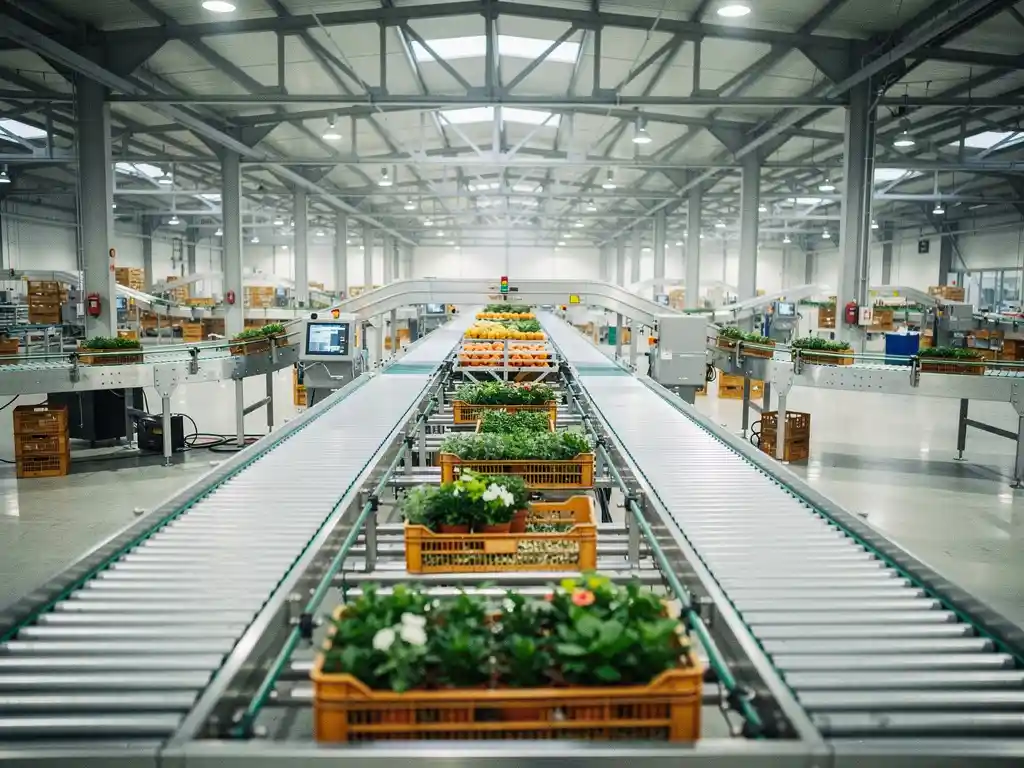
Conveyor belts improve packing center workflow by automating the movement of products between stations, eliminating manual transport, and creating a continuous, consistent flow. Instead of workers carrying products across the floor, a conveyor belt delivers them at the right height and speed, freeing your team to focus entirely on their task at each station.
In horticulture packing centers specifically, conveyor belts are designed to handle the conditions of the environment, including moisture, soil, and the delicate nature of plants and produce. A well-placed conveyor system connects intake, sorting, weighing, and packing stations into a single uninterrupted line. This removes the gaps between stations that cause waiting and fatigue.
Buffer belts play an important supporting role here. They absorb the natural speed differences between stations, holding products temporarily so that downstream stations are never starved and upstream stations are never forced to stop. The result is a packing line that runs smoothly even when individual stations fluctuate in speed.
What’s the difference between fixed and mobile conveyor systems?
Fixed conveyor systems are permanently installed and integrated into the layout of your packing center, while mobile conveyor systems are freestanding units that can be repositioned as needed. The right choice depends on how consistent your workflow is and how much flexibility your operation requires.
Fixed conveyor systems
Fixed systems are ideal for packing centers with a stable, high-volume workflow where the layout does not change frequently. They offer the highest throughput, can be fully integrated with other machinery such as potting machines and sorting lines, and are built to handle continuous operation. Because they are engineered specifically for your space, they make the most of every square meter.
Mobile conveyor systems
Mobile systems, such as the EasyMax and Wevab that we produce, give you the ability to reconfigure your packing floor quickly. They are particularly useful for operations that handle different product types across seasons, or for businesses that want to test automation before committing to a permanent installation. Mobile belts can also be used in greenhouses and moved between locations as work progresses. For many growers, they serve as a practical first step into automated internal transport.
How do you choose the right conveyor belt for a packing center?
Choosing the right conveyor belt for a packing center comes down to four key factors: the type of products you handle, your required throughput, the available space and layout, and whether you need a fixed or mobile solution. Getting these four elements right ensures the belt you choose works with your operation rather than around it.
- Product type: Delicate plants and produce require gentle handling and specific belt surfaces. Make sure the belt material and speed settings are appropriate for what you are moving.
- Throughput: Calculate how many units need to move per hour at peak capacity. This determines belt width, speed, and whether buffer capacity is needed.
- Layout and space: Measure your available floor space and identify where the belt needs to connect existing stations. Elevation changes may require elevator belts or incline sections.
- Fixed or mobile: If your workflow is consistent and volume is high, a fixed system offers the best return. If flexibility matters, start with a mobile solution.
It is also worth considering the environment. Packing centers in horticulture are often humid, with soil and water present throughout the working day. Conveyor belts in these settings need to be built from materials that resist corrosion and are easy to clean. A belt that is not suited to the environment will require frequent maintenance and replacement, which adds cost and downtime over time.
How do you get started with automating your packing center transport?
The best way to get started with automating your packing center transport is to map your current workflow first, identify your biggest bottleneck, and solve that single problem before expanding. Trying to automate everything at once is rarely the right approach, especially if you are new to internal transport automation.
Start by walking your packing floor and noting where products wait, where workers walk the most, and where errors or slowdowns happen most often. That point is your starting point for automation. In many packing centers, the biggest gain comes from connecting two stations that are currently linked by manual carrying, since even a short conveyor belt between those points can free up significant time and reduce physical strain.
If you are unsure whether automation is the right investment for your operation, renting a conveyor system is a low-commitment way to experience the difference firsthand. We offer rental options specifically for this reason, so you can see the impact on your workflow before making a long-term decision.
Once you have solved your first bottleneck, the next steps become clearer. A full transport line can be built up gradually, with each addition integrating into what is already in place. Because all our conveyor systems are designed to work together, you can expand your setup over time without replacing what you have already installed. That makes automation a process you can grow into at your own pace, rather than a single large investment you need to get right all at once.
Frequently Asked Questions
How long does it typically take to see a return on investment after installing a conveyor system in a packing center?
Most packing centers begin to see measurable returns within one growing season, primarily through reduced labor hours and increased throughput capacity. The exact timeline depends on your current bottlenecks and volume, but operations that replace heavy manual transport with even a basic conveyor setup often recover the investment faster than expected. Tracking your output per worker-hour before and after installation gives you the clearest picture of the actual gain.
Can conveyor belts handle different product types on the same line, such as potted plants and loose-cut flowers?
Yes, but it requires some planning around belt surface type, speed settings, and spacing. Many horticulture conveyor systems can be configured with adjustable speed controls and interchangeable belt surfaces to accommodate different product categories. If your operation regularly switches between product types, a modular or mobile system gives you the most flexibility to reconfigure quickly between runs without major downtime.
What maintenance does a horticulture conveyor belt require, and how do I keep downtime to a minimum?
Routine maintenance typically includes daily cleaning to remove soil, moisture, and plant debris, along with regular checks of belt tension, rollers, and drive components. In humid horticultural environments, using corrosion-resistant materials and food-safe lubricants extends the lifespan of your system significantly. Scheduling brief weekly inspections during shift changes rather than waiting for a problem to appear is the most effective way to prevent unplanned downtime during peak production periods.
What if my packing center layout is irregular or has limited floor space — can a conveyor system still work?
Irregular layouts and tight spaces are actually one of the most common challenges conveyor systems are designed to solve. Modular conveyor systems can be configured with curves, elevation changes, and incline sections to route products around obstacles and between floor levels. Before assuming a conveyor won't fit your space, it's worth having a layout assessment done, since solutions like compact mobile belts or custom-engineered fixed sections can often work within constraints that initially seem too limiting.
How many workers can realistically be redeployed or relieved of manual transport duties after automating internal transport?
This varies by operation size and current setup, but it is common for packing centers to free up one to three workers from transport duties after automating the main flow between stations. Rather than reducing headcount, most managers redeploy those workers to higher-value tasks such as quality control, packing, or order preparation. During peak seasons, this redeployment can have a significant impact on overall output without the need to hire additional staff.
Is it possible to integrate a conveyor system with existing machinery like potting machines or sorting lines?
Yes, and integration with existing machinery is one of the biggest advantages of a well-planned fixed conveyor system. Conveyor belts can be positioned to feed directly into or receive output from potting machines, weighing scales, labeling equipment, and sorting lines, creating a continuous automated flow across your entire operation. When planning an integration, it is important to match belt heights, speeds, and timing with the input and output specifications of your existing machines to avoid creating new bottlenecks at the connection points.
What is the difference between a buffer belt and a standard transport belt, and do I actually need one?
A standard transport belt moves products from point A to point B at a set speed, while a buffer belt is designed to temporarily accumulate products and release them at a controlled rate to match the pace of the next station. Whether you need one depends on how evenly your stations are matched in speed — if one station consistently processes faster or slower than the next, a buffer belt prevents products from piling up or the line from stalling. For most multi-station packing lines, at least one buffer section is worth including, as it significantly smooths out the natural variation in processing speed across a full shift.
Related Articles
- Can topping machines work with bark, soil and other covering materials?
- Can a topping machine apply an even layer to every pot?
- How can a topping machine reduce repetitive work for nursery employees?
- When should a nursery automate the topping process?
- What is the role of automation in modern horticulture?