

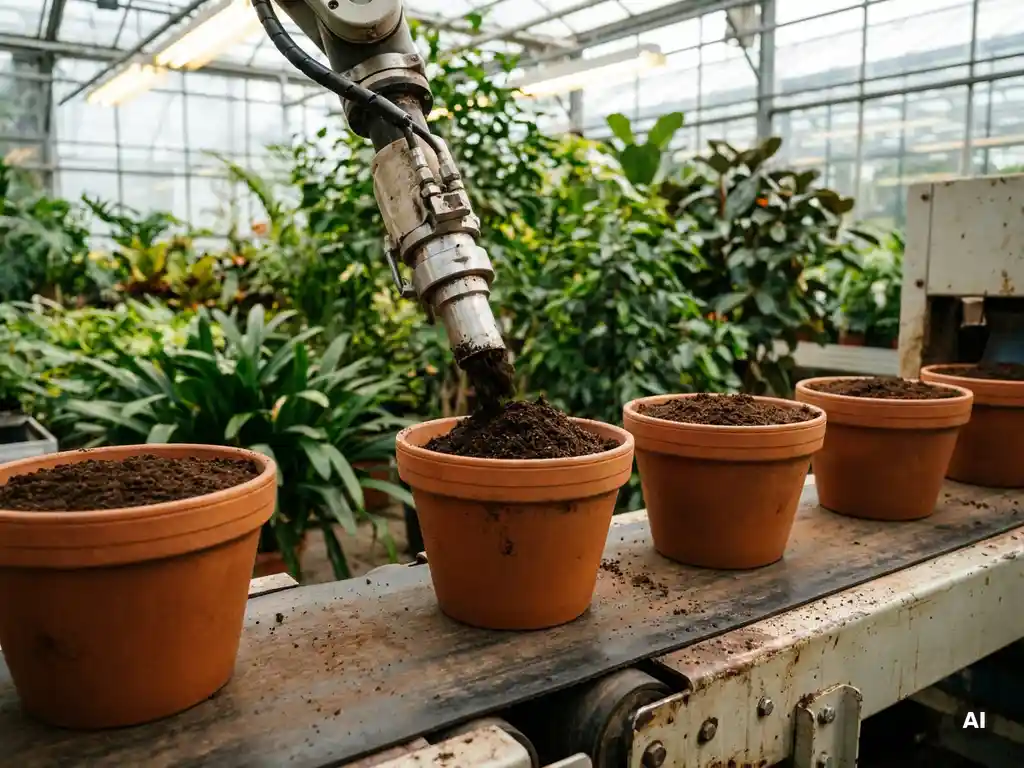
How do you prevent pots from receiving too much topping material?
Pots receive too much topping material when the dispensing mechanism is not calibrated to match the pot size, substrate density, or conveyor speed in use. The most common causes are worn components, incorrect settings, or a substrate that behaves differently from what the machine was originally tuned for. The questions below walk through every dimension of this problem, from root causes to recalibration timing.
What causes pots to receive too much topping material?
Overfilling during the topping stage is almost always the result of a mismatch between the machine’s output rate and the actual volume each pot can accept. The dispensing unit releases material at a fixed rate or duration, and if that rate is set too high relative to pot size or fill depth, excess material spills over or compresses unevenly on top of the growing medium.
Several specific factors drive this:
- Incorrect volume settings: If the topping machine’s dosing duration or gate opening is set for a larger pot than the one currently running, every pot will receive more material than it needs.
- Conveyor speed changes: A slower belt gives each pot more time under the dispensing unit, increasing the amount deposited even if the machine settings have not changed.
- Worn or misaligned dispensing parts: Gaps in augers, rollers, or dosing gates allow material to flow more freely than intended.
- Substrate bridging and sudden release: Fibrous or chunky substrates can bridge inside the hopper and then release in a burst, flooding individual pots.
Understanding which of these is at play is the first step toward a reliable fix.
How does a potting machine measure and control topping volume?
A potting machine controls topping volume through a combination of timed dosing, mechanical gate settings, and, on more advanced models, sensor-based detection. The machine releases a measured quantity of topping material each time a pot passes beneath the dispensing point, with the volume determined by how long the gate stays open, how fast the auger or roller turns, and the bulk density of the substrate in the hopper.
On entry-level machines, this control is largely manual: an operator adjusts a mechanical gate or dial to increase or decrease output, then runs a test batch and weighs or inspects the result. On more sophisticated machines, a PLC (programmable logic controller) manages the dosing sequence. The operator enters pot diameter and desired fill depth into the touchscreen interface, and the controller calculates the appropriate gate timing automatically.
The most precise systems add automatic soil detection, which uses sensors to confirm that a pot is actually present and correctly positioned before triggering the dispense cycle. This prevents material from being released into an empty slot on the conveyor and reduces waste and overfill caused by misaligned pots.
What settings should be checked when topping levels are inconsistent?
When topping levels vary from pot to pot, the first settings to check are conveyor speed, gate timing, and hopper fill level. Inconsistency almost always traces back to one of these three variables changing during a production run, either because of an operator adjustment, a mechanical drift, or a substrate that does not flow evenly.
Work through this checklist in order:
- Conveyor speed: Confirm it matches the value the machine was calibrated for. Even a small drift changes how long each pot sits under the dispenser.
- Gate or dosing duration setting: Check that the programmed value has not been accidentally altered. On touchscreen-controlled machines, compare the active program against the saved reference setting for that pot size.
- Hopper fill level: A nearly empty hopper produces lower material pressure and thinner doses. A full hopper creates higher pressure and denser doses. Keep the hopper at a consistent level during production.
- Auger or roller condition: Inspect for wear, buildup, or partial blockages that cause uneven material flow.
- Pot positioning: Misaligned pots on the conveyor shift relative to the dispensing point, causing some to catch more material on one side than the other.
Addressing these in sequence usually isolates the cause within a short test run.
Does substrate type affect how much topping material is dispensed?
Yes, substrate type has a direct effect on how much topping material is actually dispensed, even when machine settings remain unchanged. Substrates with different bulk densities, moisture levels, or fiber lengths flow through dispensing mechanisms at different rates, meaning the same gate timing can produce noticeably different fill volumes depending on what is in the hopper.
Coarse or fibrous substrates tend to bridge inside hoppers and auger channels, creating irregular flow. Fine, dry substrates flow more freely and can result in higher-than-expected doses. Wet or freshly mixed substrates are heavier and denser, which changes the pressure profile inside the hopper and can cause the machine to dispense more material by weight even if the volume appears similar.
The practical implication is straightforward: any time you switch substrate type or batch, run a calibration check before starting full production. Do not assume that settings saved for one substrate will transfer accurately to another, even if the pot size is identical.
When should topping settings be recalibrated on a potting machine?
Topping settings should be recalibrated whenever you change pot size, switch substrate type, receive a new batch of the same substrate, or notice that fill levels have drifted from the target. Recalibration is not a once-a-season task; it is a response to any change in the variables the machine was originally tuned for.
In practice, the most important recalibration triggers are:
- Pot size changes: Every different diameter or depth requires its own verified settings.
- Substrate batch changes: Even the same substrate product can vary in moisture content and bulk density between deliveries.
- Seasonal restarts: After a machine has been idle, components may have shifted or worn slightly, and a fresh calibration confirms baseline accuracy.
- Visible drift in output quality: If operators report that pots look fuller or lighter than usual, treat this as a recalibration signal rather than a minor variation to tolerate.
- After maintenance or part replacement: Any work on the dispensing mechanism should be followed by a calibration run before production resumes.
Building recalibration into your standard changeover routine prevents small drifts from becoming costly waste or quality complaints.
Can automatic soil detection fully eliminate topping errors?
Automatic soil detection significantly reduces topping errors, but it does not eliminate them entirely. What it reliably prevents is material being dispensed into empty conveyor slots or mispositioned pots, which is one of the most common sources of waste and inconsistency. However, it does not compensate for incorrect gate settings, substrate variability, or mechanical wear in the dispensing unit itself.
Think of automatic detection as a precision trigger rather than a complete quality control system. The sensor confirms that a pot is present and in position before releasing material, which removes the timing errors caused by gaps in the pot flow. But the volume released per trigger is still governed by the machine’s dosing settings and the behavior of the substrate in the hopper.
For growers running high volumes with tight consistency requirements, automatic detection is a meaningful upgrade because it removes one variable from the equation. The remaining variables, substrate characteristics, settings accuracy, and component condition, still require human attention and regular calibration.
How Martin Stolze helps you control topping accuracy
Preventing overfill in your topping process comes down to having a machine that gives you precise, repeatable control and the support to use it correctly. Our potting line solutions are built around exactly that principle.
Here is what we offer to address topping accuracy directly:
- Touchscreen programming for each pot size: Save and recall settings for different pot diameters, fill depths, and substrate types so changeovers are fast and consistent.
- Automatic soil detection on the Stolze 3030 PRO: Sensors confirm pot presence before each dispense cycle, eliminating waste from empty slots and misaligned pots.
- PLC-controlled dosing: The controller manages gate timing and conveyor coordination, reducing the manual guesswork that leads to inconsistent fills.
- Full integration with topping machines and conveyor lines: Our systems are designed to work together, so speed, timing, and positioning stay synchronized across the entire line.
- On-site training and support: Our own technicians help you calibrate settings for your specific substrate and pot range, both at installation and whenever your production changes.
- Rental option with trial period: Test the machine in your own environment before committing to a purchase.
If inconsistent topping levels are costing you substrate, time, or product quality, we are ready to help you find the right setup. Contact us and we will look at your specific situation together.
Frequently Asked Questions
How do I perform a quick calibration check without stopping a full production run?
The fastest method is to pull five to ten pots from the line at regular intervals, weigh them, and compare the topping weight against your target value. If the variance stays within an acceptable tolerance, the line can continue; if it exceeds that threshold, pause and adjust the gate timing or conveyor speed before proceeding. Running this spot-check at the start of each shift and after every hopper refill catches drift early without requiring a full production stop.
What is the most common mistake operators make when switching to a different pot size?
The most common mistake is adjusting only the gate timing or dosing duration while leaving the conveyor speed unchanged. Pot size changes often require both settings to be updated together, because a smaller pot passes the dispensing point faster and accepts a lower volume. Always treat a pot size changeover as a full recalibration event rather than a single-setting tweak, and run a test batch before resuming normal output.
Can hopper design affect how consistently topping material is dispensed?
Yes, hopper geometry plays a significant role, particularly with fibrous or chunky substrates that are prone to bridging. A hopper with steep, smooth internal walls and an agitator or vibration system reduces the risk of material arching over the outlet and releasing in unpredictable bursts. If you are regularly experiencing inconsistent doses with coarse substrates, checking whether your hopper includes an anti-bridging mechanism is a worthwhile step before adjusting machine settings.
Is it possible to use the same saved program for the same pot size but a different substrate?
It is not recommended, even if the pot dimensions are identical. Because bulk density, moisture content, and flow behavior differ between substrate types, the same gate timing will release a different effective volume when the material in the hopper changes. The safer practice is to save a separate program for each combination of pot size and substrate type, clearly labeled, so operators can select the correct profile at the start of each run without guessing.
What are the signs that a dispensing component is worn enough to affect topping accuracy?
The clearest signs are a gradual increase in average fill level over time, inconsistent results that cannot be traced back to substrate or settings changes, and visible gaps or uneven wear on auger flights, roller surfaces, or dosing gate edges. If cleaning and recalibrating the machine does not restore consistent output, inspect the dispensing components physically and replace any parts that show measurable wear. Catching this early prevents substrate waste and avoids quality complaints from customers.
How does conveyor speed interact with topping volume, and how should they be balanced?
Conveyor speed determines how long each pot sits beneath the dispensing point, so it directly multiplies or divides the amount of material a pot receives. A slower belt increases dwell time and raises fill volume; a faster belt reduces it. The correct approach is to set the target conveyor speed first based on your desired throughput, then calibrate the gate timing or dosing duration to match that speed, rather than adjusting conveyor speed as a way to compensate for incorrect dosing settings.
At what point does it make sense to upgrade from a manually adjusted topping machine to a PLC-controlled one?
The upgrade becomes practical when you are running multiple pot sizes or substrate types within the same production week, when operator-to-operator variation is causing measurable inconsistency, or when substrate waste from overfilling is adding up to a significant cost. A PLC-controlled machine with saved programs removes the manual re-tuning step at every changeover and reduces the skill dependency on individual operators. For growers scaling up their production volume or product range, the consistency gains typically justify the investment quickly.