

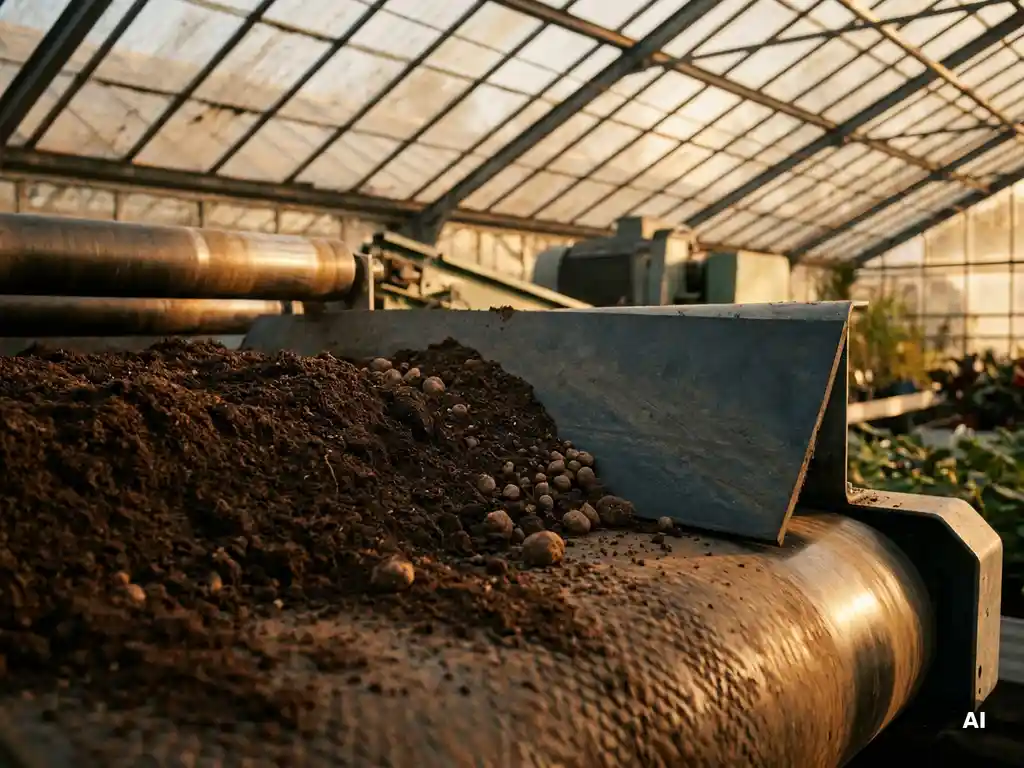
How do you prevent topping material from spilling onto conveyor belts?
The most effective way to prevent topping material from spilling onto conveyor belts is to combine precise machine calibration with the right belt design and consistent pot spacing. When your topping machine deposits substrate at the correct rate and position, and your conveyor system is built to contain loose material, spillage drops dramatically. The sections below walk through each factor in detail, from calibration to maintenance to knowing when your current setup needs an upgrade.
Why does topping material end up on conveyor belts?
Topping material ends up on conveyor belts primarily because of a mismatch between the volume of substrate being dispensed and the capacity of the pot beneath it. When a topping machine deposits more material than the pot can hold, the excess has nowhere to go but onto the belt. Overfill, misalignment, and excessive line speed are the three most common triggers.
Beyond overfill, there are several contributing factors worth understanding:
- Pot misalignment: If pots arrive off-centre beneath the topping unit, substrate lands on the rim or beside the pot entirely.
- Inconsistent pot fill from the potting machine: A pot that is already overfilled with growing medium leaves less room for the topping layer, so even a correctly calibrated topping machine will cause spillage.
- Substrate type and particle size: Fine, loose, or dry substrates scatter more easily than heavier, moist mixes. Bark, perlite, and coarse compost are particularly prone to bouncing off the pot surface.
- Vibration from the conveyor: A belt running on worn rollers or at uneven tension creates vibration that shakes loose material off pot surfaces before it can settle.
Understanding the root cause matters because the fix is different in each case. Spillage caused by calibration requires a settings adjustment; spillage caused by vibration requires a mechanical check. Treating them the same way wastes time and does not solve the problem.
What role does machine calibration play in reducing spillage?
Machine calibration is the single most important factor in reducing topping material spillage. A correctly calibrated topping machine dispenses exactly the right volume of substrate at the right moment, so the material lands inside the pot rather than around it. Even a small offset in timing or dosage volume can result in significant material loss at high throughput speeds.
Calibration covers several adjustable parameters depending on your machine model:
- Dosage volume: Set the output to match the headspace left in the pot after the initial growing medium has been filled. This requires knowing your pot dimensions and your potting machine’s fill depth.
- Dispense timing: The topping unit must release substrate at the precise moment the pot is centred beneath it. Even a fraction of a second off at high line speeds causes the material to miss the target.
- Dispense height: The closer the outlet is to the pot opening, the less the substrate can scatter. Adjust the height for each pot size you run.
- Flow rate: A flow rate that is too high creates a burst of material that overflows; too low, and the substrate dribbles unevenly. Match the flow rate to your line speed.
Modern topping machines with touchscreen controls and programmable presets make this process far more repeatable. Rather than recalibrating manually every time you switch pot sizes, you can store settings for each format and recall them instantly, which reduces human error and keeps spillage consistent across production runs.
Which conveyor belt features help contain loose substrate?
Conveyor belts with raised side edges, textured surfaces, and enclosed transfer points are the most effective at containing loose topping substrate. The belt design itself acts as a secondary containment system, catching material that misses the pot before it falls to the floor or accumulates in the belt mechanism.
When evaluating or specifying a conveyor system for a potting line that includes a topping machine, look for these features:
- Raised side guides or edge profiles: Low side walls along the belt keep stray substrate on the belt surface rather than letting it fall off the sides.
- Textured or cleated belt surface: A slightly rough surface prevents pots from sliding and keeps loose material from migrating along the belt.
- Enclosed transfer points: Gaps between conveyor sections are a primary escape route for fine substrate. Bridging plates or enclosed transfer housings close these gaps.
- Smooth undercarriage access: Belts designed with easy-clean access underneath allow substrate buildup to be removed before it causes jams or contamination.
If you are running a complete integrated line, the connection between the conveyor belts and the topping machine is worth reviewing specifically. A belt that was not designed with topping in mind may lack the containment features needed for your substrate type.
How does pot spacing and line speed affect substrate loss?
Pot spacing and line speed directly affect how much topping material misses its target. When pots are spaced too far apart, the topping machine dispenses substrate into the gap between pots. When line speed is too high relative to the machine’s dispense cycle, the pot has already moved past the optimal position before the material is released.
The relationship between these two variables is straightforward: your line speed and pot spacing must be matched to the cycle time of your topping machine. If the machine takes a fixed amount of time to complete one dispense cycle, the belt speed determines how far the pot travels during that cycle. Running the belt faster than the machine’s cycle allows means pots outpace the dispense timing.
Practical steps to find the right balance:
- Start at a lower line speed and observe where substrate lands relative to the pot opening.
- Adjust pot spacing so that each pot arrives at the dispense point at the same moment in the machine’s cycle.
- Increase speed gradually, checking for spillage at each increment.
- If your machine supports it, synchronise the belt speed electronically with the topping machine’s dispense cycle to maintain the correct ratio automatically.
Consistent pot spacing also matters. Irregular spacing, caused by pots being placed by hand or by a poorly timed upstream machine, creates unpredictable gaps that no amount of calibration can fully compensate for.
What maintenance routine keeps conveyor belts free of substrate buildup?
A daily cleaning routine combined with weekly mechanical checks is the most effective way to keep conveyor belts free of substrate buildup. Substrate that is allowed to accumulate hardens over time, attracts moisture, and eventually causes belt slippage, sensor errors, and mechanical wear that disrupts your entire potting line.
A practical maintenance schedule looks like this:
- After each production shift: Brush or vacuum loose substrate from the belt surface, side edges, and transfer points. Remove any material that has collected beneath the belt on the undercarriage.
- Weekly: Inspect belt tension and roller condition. Loose tension allows the belt to sag and collect substrate in pockets. Worn rollers create vibration that shakes material loose from pots.
- Monthly: Check sensor positions and clean any optical or proximity sensors that detect pot position. Substrate dust on sensors causes false readings, which throw off the topping machine’s dispense timing.
- Seasonally: Inspect belt edges for wear and replace worn side guides. Check all enclosed transfer points for partial blockages from compacted substrate.
The substrate type you use will affect how often cleaning is needed. Fine, dry substrates like perlite or fine bark accumulate faster and require more frequent attention than heavier, moist composts. Adjust your cleaning frequency to match your material.
When should you consider upgrading your potting line setup?
You should consider upgrading your potting line setup when recurring spillage can no longer be resolved through calibration or maintenance alone, or when your current equipment cannot keep pace with your production volume. Persistent substrate loss at high throughput is often a sign that the machine configuration, not the operator, is the limiting factor.
Specific situations that signal an upgrade is worth evaluating:
- You are running multiple pot sizes frequently and recalibration between formats takes significant time, disrupting your schedule.
- Your topping machine lacks programmable presets, meaning every format change relies on manual adjustment and introduces variability.
- Your conveyor belt was not designed for a potting line and lacks the containment features needed for your substrate type.
- Spillage has increased as your line speed has grown, suggesting the machine’s dispense cycle can no longer keep up with throughput demands.
- Substrate buildup is causing repeated mechanical issues despite a consistent maintenance routine.
An upgrade does not always mean replacing everything at once. In many cases, adding a more capable topping machine to an existing conveyor setup, or integrating a belt with better containment features, solves the problem without a full line replacement.
How MartinStolze helps you reduce topping spillage
We design and build complete potting line solutions where every component, from the potting machine to the conveyor system, is engineered to work together. That integration is exactly what prevents the calibration mismatches and containment gaps that cause topping material to end up on your belts. Here is what we bring to the table:
- Matched line configurations: Our topping machines and conveyor belts are designed as a system, so dispense timing, belt speed, and pot spacing are aligned from the start.
- Programmable presets: The Stolze 3030 and 3030 PRO support stored settings for different pot sizes and substrate types, eliminating manual recalibration between runs.
- In-house production and installation: We build every machine ourselves and handle installation, so there are no compatibility surprises between components.
- Training and support: Our team trains your operators in our demo facility in De Lier and supports you with our own service engineers after installation.
- Flexible entry: Both purchase and rental options are available, including trial periods, so you can verify the setup works for your specific substrate and pot range before committing.
If substrate spillage is costing you time and material, we are happy to look at your current setup and advise on the most practical solution. Get in touch with our team and we will help you find the right configuration for your production line.
Frequently Asked Questions
Can I retrofit my existing conveyor belt with containment features, or do I need a completely new system?
In many cases, retrofitting is a viable and cost-effective option. Aftermarket side guides, bridging plates for transfer points, and textured belt surfaces can often be added to an existing conveyor without a full replacement. However, if your current belt was not designed for a potting line at all, the structural limitations may make a purpose-built replacement more practical in the long run — especially if you are scaling up throughput or switching to finer substrate types.
How do I know if my spillage problem is caused by the topping machine or by the conveyor belt?
A simple observation test can help isolate the cause: run the line at a slow speed and watch exactly where the substrate lands. If material is consistently missing the pot opening — landing on the rim or beside it — the issue is likely calibration or dispense timing on the topping machine. If the substrate lands in the pot but still ends up on the belt, the problem is more likely vibration, pot movement, or a lack of containment features on the conveyor itself.
What is the best way to handle multiple pot sizes without recalibrating from scratch each time?
The most efficient approach is to use a topping machine that supports programmable presets, such as the Stolze 3030 or 3030 PRO, which allow you to store settings for each pot format and recall them instantly at the start of a run. If your current machine requires full manual recalibration for each format change, it is worth documenting the correct settings for each pot size in a written log so operators can dial them in consistently without starting from zero every time.
Does the moisture content of the substrate affect how much spillage occurs?
Yes, significantly. Dry, loose substrates like perlite, fine bark, or dry compost have lower particle cohesion and scatter much more easily on impact than moist, heavier mixes. If you are working with particularly dry or fine substrates, lowering the dispense height to reduce the drop distance and slowing the flow rate to avoid a burst effect can both help reduce scatter. Adjusting your cleaning frequency upward is also advisable, as dry substrates accumulate faster in belt mechanisms and around sensors.
How much substrate loss is considered normal, and at what point should I take action?
There is no universal benchmark, but a well-calibrated and properly maintained potting line should produce minimal visible spillage during a normal production run — stray material on the belt surface should be the exception rather than a constant. If you are regularly sweeping significant volumes of substrate from the belt during or after a shift, or if buildup is causing sensor errors or mechanical issues, that is a clear signal that the system needs attention. Tracking material usage against pot output over time is a practical way to quantify losses and justify corrective action.
Can electronic synchronisation between the conveyor and the topping machine really make a noticeable difference?
Yes — electronic synchronisation removes the guesswork from matching belt speed to dispense timing, which is one of the most common sources of spillage at higher throughput speeds. When the two systems communicate directly, the topping machine’s dispense cycle adjusts automatically as belt speed changes, keeping the pot centred under the outlet at the moment of release. This is particularly valuable on lines that run at variable speeds or that need to scale up output without a full recalibration each time.
What should I check first if spillage suddenly increases after a period of running cleanly?
A sudden increase in spillage after a stable period almost always points to a mechanical or sensor change rather than a calibration drift. Start by checking belt tension and roller condition, as a worn or loosened roller introduces vibration that can dislodge substrate from pot surfaces. Next, clean and inspect any position sensors that trigger the topping machine’s dispense cycle — substrate dust on optical or proximity sensors is a frequent cause of mistimed dispenses that develop gradually and then worsen suddenly.