

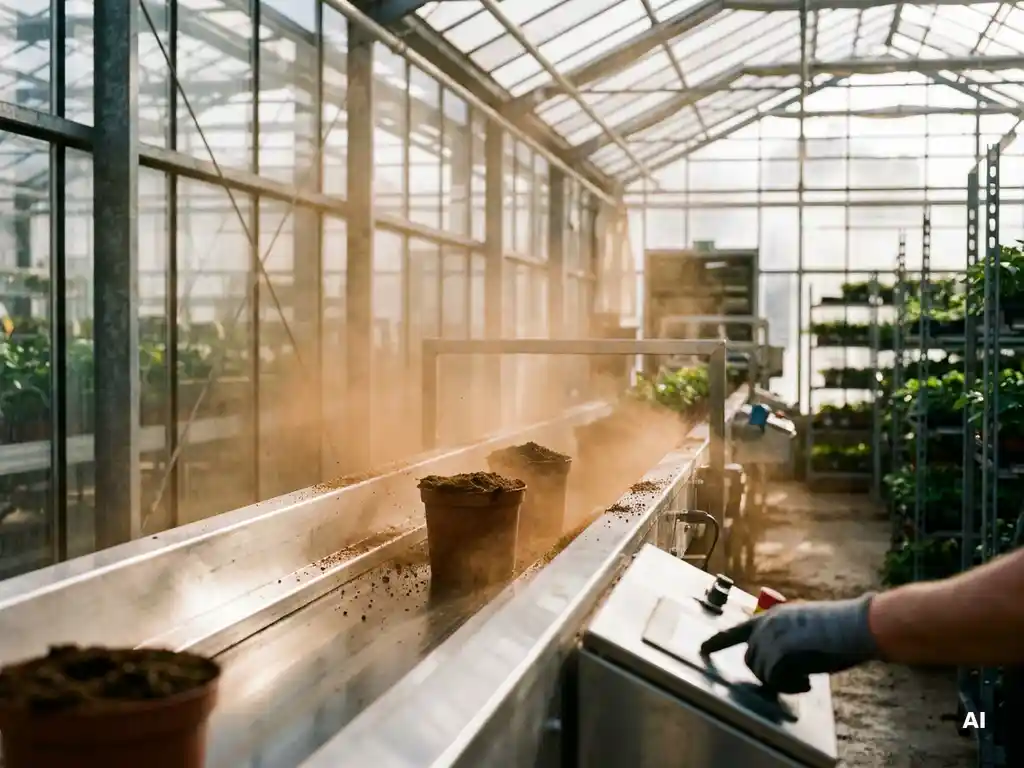
How do you reduce dust around an automated topping station?
The most effective way to reduce dust around an automated potting station is to combine slower conveyor speeds with targeted extraction systems and enclosed transfer points. Dust at a potting line is almost always the result of dry growing media becoming airborne during filling, dropping, or transport. The sections below cover the main causes, the media types that produce the most dust, and the practical steps you can take to keep your working environment clean and your machines running reliably.
What causes dust buildup at a potting station?
Dust buildup at a potting station is caused by fine particles in the growing medium becoming airborne when the substrate is moved, dropped, or vibrated. The main trigger points are the filling head, the conveyor transfer zones, and any area where pots or trays are dropped or jolted. Dry substrate, high machine speeds, and open transfer points all make the problem worse.
At a typical automated potting station, substrate travels from a bulk hopper through a filling mechanism and into pots moving along a conveyor. Every point where the substrate falls, even a short distance, creates a small impact that releases fine particles. Peat, coir, and bark-based mixes all contain a fraction of very fine material that behaves almost like powder when it dries out. Vibration from the conveyor itself can also loosen settled particles and push them into the air. Without any form of containment or extraction, these particles accumulate on surfaces, motors, sensors, and control panels throughout the line.
Which types of growing media produce the most dust?
Peat-based and coir-based growing media tend to produce the most dust at a potting station, particularly when they are stored in conditions that allow them to dry out. Bark-based substrates and perlite mixes can also generate significant airborne particles. The finer the particle size distribution in the mix, the more dust the medium will release during automated handling.
Peat is especially problematic because it contains a high proportion of very fine organic particles that become almost powder-like once moisture levels drop. Coir behaves similarly, with fine fibres that detach easily under vibration or impact. Bark mixes are generally coarser, but the fine fraction that accumulates at the bottom of a storage pile can be just as troublesome. Perlite, used as an additive for drainage, is one of the most significant dust contributors of all because its particles are extremely light and remain suspended in the air for a long time after being disturbed.
Keeping your substrate at the correct moisture level before it enters the machine is one of the simplest ways to reduce dust generation at the source. A substrate that is too dry will always produce more airborne particles than one that is properly conditioned.
How does machine speed affect dust levels on a potting line?
Higher machine speeds directly increase dust levels on a potting line because faster movement creates greater impact forces when substrate drops into pots, and faster conveyors generate more vibration across the entire system. Reducing line speed, even modestly, can produce a noticeable drop in airborne particles without significantly affecting overall output.
The relationship between speed and dust is not always obvious, because operators tend to focus on pots per hour rather than air quality. But at higher speeds, substrate is thrown into pots with more force, transfer points become more turbulent, and the vibration transmitted through the frame increases. All of these factors release more fine particles into the surrounding air.
Modern potting machines with variable speed controls allow you to find a balance between output and dust generation. Running the line at a speed that is appropriate for your specific substrate mix, rather than always at maximum capacity, is a practical way to keep dust under control. Machines with smooth, fully guided chain systems also tend to produce less vibration than older designs, which contributes to lower dust levels across the line.
What practical measures reduce dust at an automated potting station?
The most effective practical measures for reducing dust at an automated potting station are maintaining correct substrate moisture levels, minimising drop heights at filling and transfer points, using conveyor covers or side panels to contain particles, and scheduling regular cleaning of all surfaces and components. These steps can be implemented without major investment and have an immediate impact.
- Control substrate moisture: Condition your growing medium to the right moisture level before it enters the machine. A properly moistened substrate releases far fewer fine particles than a dry one.
- Minimise drop heights: Adjust the filling head and transfer points so that substrate falls the shortest possible distance into the pot. Lower drop heights mean less impact and less dust.
- Add conveyor covers or side panels: Enclosing the sides of your conveyor system keeps airborne particles from spreading across the workspace and makes extraction more effective.
- Slow down at peak dust points: Identify the sections of your line that generate the most dust and reduce speed at those points if your machine allows variable speed control.
- Clean regularly and systematically: Dust that settles on motors, sensors, and control panels will eventually cause problems. A structured daily or weekly cleaning routine prevents buildup from becoming a maintenance issue.
- Position workers upwind or at a distance from the filling head: Where layout allows, place operators away from the highest-dust zones to reduce personal exposure.
Should you use extraction systems or enclosures to control potting dust?
For most professional potting operations, the best approach is to use both extraction systems and enclosures together rather than choosing one over the other. Enclosures contain the dust at its source, and extraction systems remove it from the air before it can settle on equipment or be inhaled by workers. Used in combination, they are significantly more effective than either solution alone.
An enclosure, such as a hood or cover over the filling head and key transfer points, limits the volume of air through which dust can travel. This makes extraction far more efficient because the extraction system only needs to handle a small, defined volume of air rather than an entire open workspace. Without an enclosure, even a powerful extraction unit will struggle to capture fast-moving airborne particles before they spread.
Extraction systems range from simple industrial vacuum units attached to specific dust points to more comprehensive central extraction installations. For smaller operations, a targeted unit positioned at the filling head and one at the main transfer point is often sufficient. Larger, high-volume lines may benefit from a ducted system that connects multiple extraction points across the full length of the potting line.
The choice between a portable unit and a fixed installation depends on your floor space, budget, and whether the line layout changes seasonally. Either way, the extraction unit must be sized correctly for the volume of air it needs to handle, and filters must be cleaned or replaced on a regular schedule to maintain performance.
How does dust affect potting machine maintenance and lifespan?
Dust is one of the most damaging environmental factors for a potting machine because fine substrate particles penetrate bearings, sensors, chain links, and electrical components over time. Machines operating in high-dust environments without adequate protection require more frequent maintenance, experience more unplanned downtime, and have a shorter overall lifespan than those in controlled conditions.
Bearings are particularly vulnerable. Fine peat or coir dust acts as an abrasive when it enters a bearing housing, accelerating wear on the rolling elements and races. What would normally be a multi-year service interval can be shortened significantly in a dusty environment if bearings are not properly sealed and regularly inspected.
Sensors and electronic components are also at risk. Dust that settles on optical sensors can cause false readings or complete failures, disrupting the automated operation of the line. On machines with touchscreen controls or PLC systems, dust ingress into control cabinets can cause intermittent faults that are difficult to diagnose and expensive to repair.
Chain systems accumulate substrate particles in the links and rollers, increasing friction and accelerating wear. A fully guided or enclosed chain design reduces the surface area exposed to dust and makes cleaning easier. Regular lubrication, combined with systematic cleaning of the chain and drive components, is essential for maintaining performance in any potting environment.
The practical takeaway is straightforward: every hour you invest in dust control is an hour saved on reactive maintenance. Keeping your machine clean and your working environment as dust-free as possible is not just a matter of air quality; it is a direct investment in the reliability and longevity of your equipment.
How MartinStolze helps you manage dust on the potting line
At MartinStolze, we design and build our potting machines with the realities of dusty growing environments in mind. Our Stolze 3030 and Stolze 3030 PRO are built for reliability in professional potting operations where substrate quality, line speed, and environmental conditions all vary. Here is what that means in practice:
- Fully guided chain system: The 3030 PRO features a fully guided chain that reduces vibration across the line, which directly lowers the amount of dust generated during operation.
- Quieter, lower-maintenance design: Reduced mechanical noise and fewer moving parts exposed to the substrate mean less opportunity for dust to cause component wear.
- Automatic soil detection: Consistent, precise filling reduces overfill and spillage, which are common secondary sources of dust on a potting line.
- Seamless integration with conveyors: Our machines connect directly with our own conveyor systems, allowing enclosed transfer points to be designed into the line from the start rather than added as an afterthought.
- Full support from our own engineers: We guide you through machine setup, maintenance schedules, and line configuration to help you get the most out of your investment.
Whether you are setting up a new line or looking to improve an existing one, we are happy to think through the right configuration for your specific substrate and output requirements. Get in touch with our team and we will help you find a solution that keeps your operation running cleanly and efficiently.
Frequently Asked Questions
How often should I clean my potting machine to prevent dust-related damage?
For most professional potting operations, a daily wipe-down of sensors, control panels, and filling heads combined with a more thorough weekly clean of bearings, chain systems, and drive components is a practical baseline. The right frequency ultimately depends on your substrate type, line speed, and daily run hours — operations using dry peat or perlite-heavy mixes may need to clean more frequently. Building cleaning into your end-of-shift routine, rather than treating it as an occasional task, is the most reliable way to prevent dust from becoming a maintenance problem.
What is the ideal moisture level for growing media to minimise dust on a potting line?
Most professional growers aim for a substrate moisture level of around 50–60% of the medium's water-holding capacity before it enters the machine, though the exact target varies by mix composition. At this level, fine particles clump together enough to resist becoming airborne without making the substrate too wet to flow freely through the filling mechanism. If you are unsure of the right level for your specific mix, a simple squeeze test — the substrate holds its shape when compressed but does not release water — is a reliable field check.
Can I retrofit dust control measures to an existing potting line, or do I need a new machine?
Most dust control improvements can be retrofitted to an existing line without replacing the machine itself. Adding side panels or hoods over the filling head and transfer points, attaching a targeted industrial extraction unit, and adjusting conveyor speed settings are all modifications that can be made to an existing setup. Where the machine design makes enclosure difficult — for example, on older open-frame conveyors — a new line with integrated enclosed transfer points will deliver better long-term results, but retrofitting is a cost-effective first step for most operations.
Are there any health and safety regulations I should be aware of regarding potting dust?
Yes — airborne organic dust from substrates like peat, coir, and bark is classified as a respiratory hazard in most European jurisdictions, and employers are legally required to assess and control worker exposure under occupational health and safety legislation such as the EU's Chemical Agents Directive and national working conditions acts. In practice, this means conducting a dust exposure risk assessment, implementing engineering controls (extraction, enclosures) before relying on personal protective equipment, and providing appropriate respiratory protection where residual exposure remains. If you are unsure of your obligations, your national occupational health authority or an industrial hygienist can help you carry out a compliant assessment.
How do I know if my extraction system is powerful enough for my potting line?
The key indicator is whether the extraction unit can capture airborne particles at the source before they travel more than a short distance from the filling head or transfer point — if you can see dust clouds forming and drifting despite the extractor running, the unit is either undersized, poorly positioned, or has a clogged filter. Extraction systems are rated by airflow volume (m³/h) and static pressure; a supplier or industrial ventilation specialist can calculate the required capacity based on your line length, number of extraction points, and substrate type. Checking and replacing filters on a regular schedule is equally important, as a filter at even 50% capacity significantly reduces extraction performance.
Does the type of pot or tray affect how much dust is generated during filling?
Yes, pot geometry and material can influence dust levels at the filling stage. Narrow or deep pots cause substrate to fall a greater distance before hitting the bottom, which increases impact and releases more fine particles compared to wide, shallow trays. Lightweight plastic pots that move or tip on the conveyor can also cause overfill and spillage, creating secondary dust sources along the line. Ensuring pots are correctly stabilised on the conveyor and that the filling head is calibrated to the specific pot dimensions you are running reduces both spillage and the impact force of the substrate drop.
What should I do if dust is causing intermittent faults on my machine's sensors or controls?
The first step is to clean all optical sensors, proximity switches, and control cabinet vents thoroughly and check whether the faults clear — in many cases, dust on a sensor lens or a partially blocked cabinet vent is the direct cause. If faults persist after cleaning, inspect the cable connections and sensor housings for dust ingress and consider upgrading to IP-rated (dust-protected) sensor variants if your current sensors are not adequately sealed for your environment. For recurring issues with PLC or touchscreen controls, fitting positive-pressure filtered air to the control cabinet prevents dust from settling on electronics and is a cost-effective long-term solution.
Related Articles
- Which small workflow changes can increase potting machine output?
- What happens when your potting machine capacity exceeds the rest of your line?
- How do you scale up pot plant production without hiring more staff?
- What maintenance does a professional potting machine actually require?
- How do you avoid costly downtime during your busiest growing weeks?