
How do you reduce physical strain on greenhouse workers?
Greenhouse work is physically demanding by nature. Workers spend long shifts on their feet, moving plants, pots, and trays across large production floors—often covering several kilometres in a single day. Over time, this level of physical effort takes a real toll on the body, leading to fatigue, injury, and absenteeism that affect both the individual and the business as a whole.
For greenhouse businesses looking to protect their workforce and improve operational flow, conveyor belt horticulture automation offers a practical and proven solution. This article addresses the most common questions growers and operations managers ask when considering how to reduce physical strain on their teams.
Why do greenhouse workers suffer from physical strain?
Greenhouse workers suffer from physical strain primarily because manual internal transport requires repetitive lifting, bending, and walking across large floor areas for extended periods. The combination of awkward postures, heavy loads, and the humid, warm environment of a greenhouse accelerates physical fatigue far more quickly than in typical industrial settings.
Unlike many production environments, greenhouses often involve handling large volumes of individual items—plants, pots, trays, and crates—that must be moved continuously throughout the day. Workers rarely get natural breaks from this movement because the production line depends on them to keep things flowing. Add to this the uneven surfaces, wet floors, and confined spaces common in horticultural facilities, and it becomes clear why musculoskeletal complaints are so prevalent in this sector.
The problem is compounded by the seasonal nature of horticulture. During peak periods, teams work longer hours and at a faster pace, increasing the risk of overexertion injuries precisely when the business can least afford to lose staff.
What are the most common injuries caused by manual internal transport?
The most common injuries from manual internal transport in horticulture are lower back pain, shoulder and neck strain, repetitive strain injuries in the wrists and arms, and knee problems caused by prolonged standing and walking on hard surfaces. These injuries often develop gradually and are frequently underreported until they become serious.
Lower back injuries are particularly prevalent because workers regularly bend and twist while lifting plants and trays from ground level or low benches. Shoulder and wrist complaints tend to develop in roles that involve pushing heavy trolleys or manually sorting products along a line. Knee and hip pain often affects workers who spend full shifts walking across concrete floors.
Beyond individual injuries, the cumulative effect on a workforce is significant. Absenteeism increases, experienced workers leave the sector, and businesses face higher costs in recruitment, temporary staffing, and lost productivity. Addressing the root cause—unnecessary manual handling—is far more effective than managing the consequences.
How does conveyor belt automation reduce physical workload?
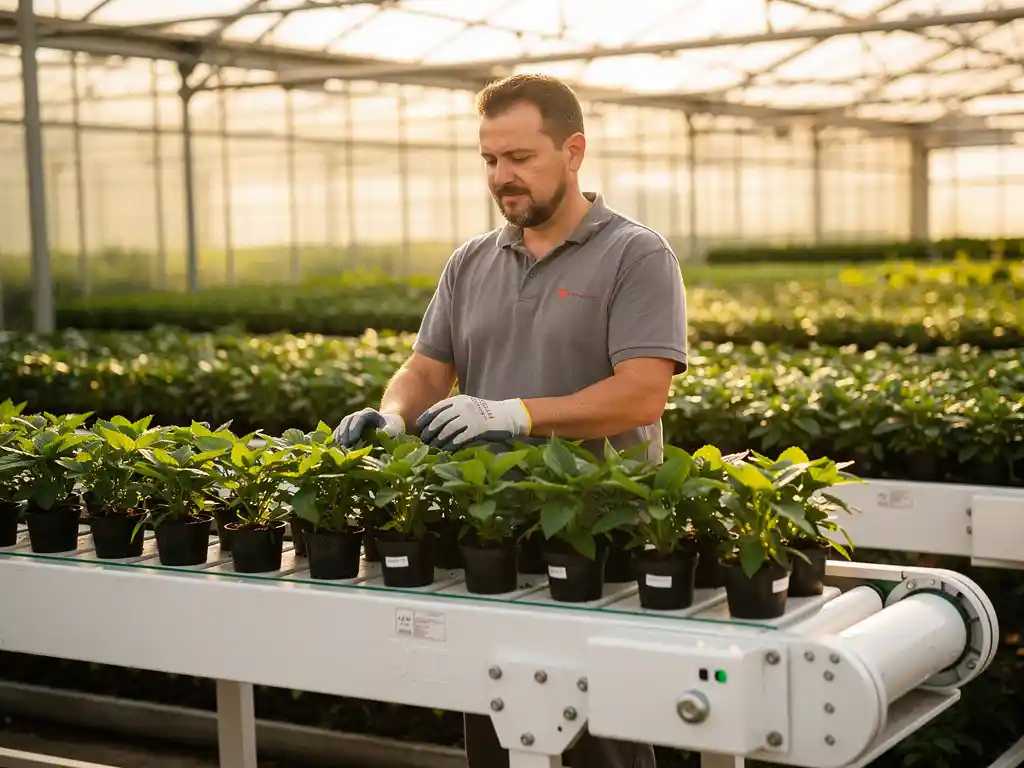
Conveyor belt automation reduces physical workload by taking over the movement of products between workstations, eliminating the need for workers to carry, push, or move loads across the production floor. Instead of moving to the product, workers stay in one place while the conveyor brings the product to them.
This shift in how work is organised has a direct impact on ergonomics. Workers can be positioned at a comfortable working height, reducing bending and reaching. The number of steps taken per shift drops dramatically, which reduces fatigue and the risk of lower-limb injuries. Repetitive strain from pushing trolleys or carrying trays is eliminated entirely in well-designed systems.
Beyond the ergonomic benefits, conveyor systems also improve the pace and consistency of production. Products move at a steady, controlled speed, reducing bottlenecks and rush periods that often push workers into unsafe manual-handling behaviour. The result is a calmer, more sustainable working environment where physical effort is focused on skilled tasks rather than transport.
Our conveyor belts are built specifically for horticultural environments—designed to handle the moisture, soil, and operational demands of greenhouses and processing centres, rather than being adapted from standard industrial equipment.
What’s the difference between fixed and mobile conveyor systems in horticulture?
Fixed conveyor systems are permanently installed along a set production route, while mobile conveyor systems can be repositioned across different areas of a greenhouse or facility. The right choice depends on whether your transport needs are consistent and predictable or vary across seasons and growing cycles.
Fixed conveyor systems
Fixed systems are ideal for operations with a stable, high-volume production flow where the layout does not change. They offer maximum throughput and can be integrated directly with other machinery such as potting machines, sorting lines, and packaging equipment. Because they are anchored in place, they can be engineered to precise heights and angles to optimise ergonomics at every workstation along the line.
Mobile conveyor systems
Mobile systems give growers flexibility. They can be moved between departments, repositioned for different crops, or deployed during peak periods and stored when not needed. This makes them particularly well suited to nurseries and distributors whose internal transport requirements shift throughout the year. Our mobile range—including the EasyMax and Wevab models—is designed to be manoeuvred easily without requiring specialist tools or dismantling.
Many businesses use a combination of both: fixed lines for the core production route and mobile units to handle overflow, seasonal demand, or areas where permanent installation is not practical.
How do you integrate conveyor belts with other greenhouse machinery?
Conveyor belts integrate with other greenhouse machinery by connecting directly to potting machines, watering stations, sorting lines, robots, and packaging equipment to form a continuous, automated production flow. Integration is achieved through matched belt heights, speed synchronisation, and custom transition pieces that allow products to move seamlessly from one machine to the next.
Effective integration starts at the design stage. The layout of the entire production line needs to be considered as a whole, not as a series of individual machines. Factors such as belt speed, product type, throughput volume, and the sequence of operations all influence how components connect. When these elements are engineered together, the result is a line where products move without manual intervention from one end to the other.
We handle the full integration process in-house—from engineering and production through to installation and commissioning. This single-source approach means that all components are designed to work together from the outset, and any adjustments during installation are resolved by the same team that built the system.
When should a greenhouse business consider renting instead of buying automation equipment?
A greenhouse business should consider renting automation equipment when it wants to test a system before committing to a purchase, needs extra capacity during a peak season, or is not yet ready for a permanent installation due to budget or facility constraints. Renting removes the financial risk of investing in equipment that may not fit the operation.
Renting is particularly useful for businesses that are new to conveyor belt automation. Rather than making a large capital investment based on a brochure, renting allows managers and production teams to experience the practical impact of automation firsthand—how it changes workflow, how workers respond to it, and whether the throughput gains justify a permanent solution.
Seasonal peaks are another strong case for rental. A distribution centre handling significantly higher volumes during harvest periods, for example, may not need a permanent system year-round but can benefit greatly from temporary capacity. Rental also makes sense when a facility is planning a larger renovation or layout change and wants an interim solution while permanent systems are being designed and installed.
We offer rental as a straightforward entry point for businesses that want to experience the benefits of conveyor automation without an immediate long-term commitment—making it easier to take the first step toward a more ergonomic, efficient production environment.
Frequently Asked Questions
How long does it typically take to install a conveyor system in an existing greenhouse?
Installation timelines vary depending on the complexity and scale of the system, but most standard conveyor installations in existing greenhouses are completed within a few days to a couple of weeks. Fixed systems integrated with multiple machines will naturally take longer than a single mobile unit deployment. To minimise disruption to your production schedule, installation is typically planned around quieter periods in your growing cycle, and a detailed project timeline is agreed upon before work begins.
How do I know which conveyor system is the right fit for my specific greenhouse operation?
The best starting point is a thorough assessment of your current production flow—mapping out where products move, how far they travel, and where manual handling is most intensive. From there, factors such as your facility's layout, product types, throughput volumes, and whether your needs are seasonal or year-round will determine whether a fixed, mobile, or hybrid system makes the most sense. Working with a specialist who can visit your site and evaluate your specific situation will give you far more accurate guidance than a generic product recommendation.
What happens if a conveyor belt breaks down during a busy production period?
Minimising downtime starts with choosing equipment built specifically for horticultural environments, as these systems are engineered to handle the moisture, soil, and continuous operational demands that cause generic industrial equipment to fail prematurely. Reliable after-sales support and access to spare parts are equally important factors to confirm before purchasing or renting any system. Many operations also benefit from having at least one mobile unit available as a backup, ensuring that production can continue even if a section of the fixed line requires maintenance.
Can conveyor systems be used effectively in smaller greenhouse operations, or are they only practical at scale?
Conveyor automation is not exclusively for large-scale operations—smaller and mid-sized greenhouses can see significant ergonomic and efficiency benefits even from a single mobile conveyor unit. The key question is not the size of your facility but the intensity of manual handling within it; if your workers are regularly moving products across the floor for several hours a day, automation can reduce strain and improve output regardless of total square footage. Starting with a rental unit is an ideal way for smaller operations to evaluate the practical impact before committing to a purchase.
Will workers need specialist training to operate conveyor belt systems?
Most conveyor systems used in horticulture are designed to be straightforward to operate, and the learning curve for day-to-day use is typically short—most workers adapt within a shift or two. That said, team members responsible for adjusting settings, performing basic maintenance, or reconfiguring mobile units should receive proper hands-on instruction during the commissioning phase. A good supplier will include operator training as part of the installation and handover process, ensuring your team feels confident from day one.
Are there any common mistakes businesses make when implementing conveyor automation for the first time?
One of the most frequent mistakes is treating conveyor automation as a standalone addition rather than redesigning the production flow around it—simply placing a belt into an existing layout without adjusting workstation heights, worker positions, or process sequencing often delivers far less benefit than a properly integrated system. Another common oversight is underestimating throughput requirements, which leads to bottlenecks at the points where the conveyor connects to manual tasks or other machines. Taking the time to map your full production process before specifying equipment, and involving your production team in the planning stage, will help you avoid both of these pitfalls.
How quickly can a business expect to see a return on investment from conveyor belt automation?
Return on investment timelines vary by operation, but businesses typically begin to see measurable gains relatively quickly through reduced absenteeism, lower temporary staffing costs, and improved production throughput. Fewer workplace injuries also translate into reduced costs related to worker compensation, recruitment, and retraining—expenses that are often underestimated when calculating the true cost of manual handling. A realistic ROI assessment should account for both the direct productivity gains and the indirect savings from a healthier, more stable workforce.
Related Articles
- Where should a topping machine be positioned in a production line?
- How do you reduce physical strain on staff during potting season?
- Why is horticulture-specific equipment better than repurposed industrial machinery?
- What are the most common internal transport problems in horticulture?
- What causes downtime in greenhouse processing lines?