

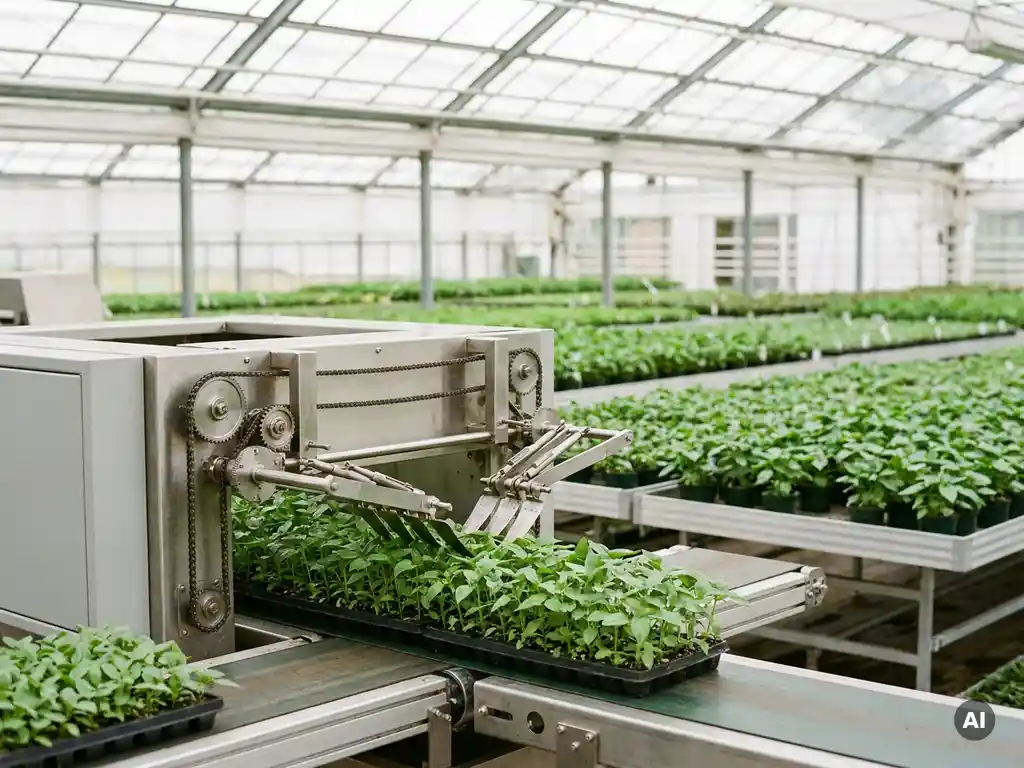
How do you synchronize a topping machine with other nursery equipment?
To synchronize a potting machine with other nursery equipment, you connect it to the surrounding line through matched conveyor speeds, sensor-based communication, and a shared control system that keeps every station moving at the same pace. The goal is simple: every pot that leaves the potting machine should arrive at the next station at exactly the right moment, without gaps, jams, or waiting time. The questions below walk through the practical details of making that happen.
What equipment is typically connected to a potting machine in a nursery line?
A potting machine sits at the heart of a nursery production line and connects directly to conveyor belts, buffer tables, topping machines, tray fillers, and sorting lines. Together, these stations form a continuous flow from empty pot to finished, filled plant ready for transport or the auction clock.
In a typical setup, empty pots or trays arrive at the potting machine via an infeed conveyor. Once filled with growing medium, the pots move onto an outfeed conveyor belt that carries them toward the next workstation. Depending on the operation, that next station might be:
- A topping machine that adds a layer of cover soil or bark on top of the filled pot
- A planting station where cuttings or plugs are inserted
- A watering station that gives each pot its first drink immediately after filling
- A buffer table that absorbs speed differences between stations and prevents bottlenecks
- A sorting or labeling line that routes finished pots to the right growing area or delivery zone
The more stations you add, the more important it becomes that each one communicates with the others. A line where every machine runs independently will inevitably create jams at one end and empty gaps at the other.
How does a potting machine communicate with conveyor belts and transport systems?
A potting machine communicates with connected conveyor belts and transport systems through sensors, PLC (programmable logic controller) signals, and speed-matched drive settings. When a sensor detects a blockage or a gap downstream, it sends a signal to the potting machine to pause, slow down, or speed up accordingly.
Modern potting machines use a PLC as the central brain. This controller reads input from sensors placed at key points along the line, such as a sensor that detects when the outfeed belt is full or when the next station is ready to receive. Based on those inputs, the PLC adjusts the machine’s output speed in real time.
Conveyor belts are typically connected to this same control loop. Their drive motors run at a speed that is either set manually to match the potting machine’s output or controlled dynamically by the same PLC. In more advanced setups, the entire line runs on a single integrated control system, where one touchscreen gives the operator visibility over every station at once. This makes it straightforward to adjust the line speed for a new crop or pot size without having to reprogram each machine separately.
What happens when a potting machine runs faster or slower than the rest of the line?
When a potting machine runs out of sync with the rest of the line, pots either pile up and jam at the slowest station, or gaps appear in the flow and downstream stations sit idle. Both situations reduce output, increase the risk of damage, and put unnecessary pressure on staff to intervene manually.
If the potting machine runs faster than the conveyor or the next workstation can handle, filled pots accumulate. On a belt without a buffer, this leads to pots tipping, colliding, or falling off the line entirely. Staff end up repositioning pots by hand, which defeats the purpose of automation.
If the potting machine runs slower than the downstream stations expect, those stations run empty. A topping machine waiting for pots that are not arriving wastes energy and cycle time. During peak season, even a few minutes of idle time per hour adds up to a meaningful loss of output by the end of the day.
Buffer tables exist precisely to absorb these mismatches. A well-placed buffer between the potting machine and the next station gives the line a small reservoir of pots to draw from when speeds temporarily diverge. This buys time for the operator to adjust settings without stopping the entire line.
Should you buy all nursery automation equipment from one supplier?
Buying all nursery automation equipment from one supplier is not strictly necessary, but it significantly simplifies integration, support, and long-term maintenance. When every machine in the line comes from the same manufacturer, the control systems, communication protocols, and mechanical interfaces are designed to work together from the start.
With mixed-supplier lines, integration is possible but requires additional engineering work. Each supplier uses its own control logic, connector types, and sensor standards. Getting two machines from different manufacturers to communicate reliably often means custom cabling, software bridges, and a longer commissioning period. When something goes wrong, responsibility can fall between two suppliers, each pointing at the other’s equipment.
A single-supplier approach also makes software updates and spare parts management more straightforward. When one supplier is responsible for the entire line, a service technician arrives with knowledge of every station, not just one piece of it.
That said, the most important criterion is always whether the equipment fits your specific crop, pot size range, and production volume. If one supplier offers the best potting machine but a weaker topping machine, it is worth evaluating the trade-off carefully rather than defaulting to a full package that does not fully meet your needs.
How do you set up a potting machine for a new plant variety or pot size?
To set up a potting machine for a new plant variety or pot size, you adjust the bore depth, soil fill volume, rotation speed, and conveyor timing to match the new specifications. On machines with a touchscreen interface, these settings can be saved as named programs and recalled instantly when you switch crops.
The key parameters to adjust when switching to a new pot size or variety include:
- Pot diameter and height: The machine’s guides and chain spacing need to match the physical dimensions of the new pot so it moves through the line without wobbling or tipping.
- Bore depth: Different plant types need different planting depths. Adjusting the bore depth ensures the hole in the growing medium is the right size for the cutting or plug being inserted.
- Soil fill volume: Larger pots need more growing medium per cycle. The fill volume setting controls how much soil the machine deposits before the bore is made.
- Conveyor speed: A larger or heavier pot may need a slightly slower belt speed to stay stable during transport to the next station.
- Rotation speed: The drum or filling mechanism speed affects how evenly the growing medium is distributed. Fine-tuning this for a new soil mix or pot size prevents underfilling or overfilling.
On machines equipped with automatic soil detection, the system reads the fill level in real time and compensates for variations in the growing medium without manual intervention. This is particularly useful when switching between different soil mixes that have different densities or moisture levels.
Running a short test batch of ten to twenty pots after each changeover is good practice. It lets you verify that the fill is consistent, the bore depth is correct, and the pots move through the line without interruption before you commit to a full production run.
How MartinStolze helps you synchronize your potting line
We design and build complete, integrated potting lines where every component is developed to work together from day one. Our Stolze 3030 and Stolze 3030 PRO potting machines connect directly to our own conveyor belts and transport systems, with shared PLC control that keeps the entire line running at a consistent, adjustable pace. Key advantages of working with us include:
- Touchscreen programming that lets you save and recall settings for different pot sizes, bore depths, and soil mixes in seconds
- Automatic soil detection on the 3030 PRO for consistent fill levels across every pot, even when the growing medium varies
- Fully guided chain systems for stable pot transport and fewer interruptions during high-volume runs
- Our own installation and service technicians who know every station in the line, so support is fast and responsibility never falls between suppliers
- Rental options with a trial period so you can test the line in your own operation before committing to a purchase
Whether you are setting up a new potting line or upgrading an existing one, we are happy to think through the right configuration with you. Get in touch with our team and we will help you find a setup that matches your crop, your volumes, and your production goals.
Frequently Asked Questions
How long does it typically take to commission a fully integrated potting line?
Commissioning time depends on the number of stations and whether the equipment comes from a single supplier or multiple manufacturers. A fully integrated single-supplier line can typically be installed and commissioned within one to three days, while mixed-supplier lines may require a week or more due to custom cabling, software configuration, and compatibility testing. Running a supervised test batch before full production begins is always recommended to catch any timing or sensor issues early.
What type of sensors are best suited for detecting pot flow on a nursery conveyor line?
Photoelectric sensors and inductive proximity sensors are the most common choices for detecting pot presence and flow on nursery conveyor lines. Photoelectric sensors work well for detecting pots at specific positions, such as at the infeed or outfeed of a potting machine, while inductive sensors are better suited for detecting metal components like chain links or drive mechanisms. For reliable operation in a nursery environment, choose sensors with an IP67 or higher dust and moisture protection rating, since growing medium, water, and humidity are constant factors.
Can an older potting machine be retrofitted to communicate with a modern PLC-controlled line?
In many cases, yes — older potting machines can be retrofitted with modern PLC controls, updated sensors, and compatible communication interfaces to integrate them into a synchronized line. The feasibility depends on the machine’s existing electrical architecture and whether the manufacturer or a qualified systems integrator can supply compatible components. However, it is worth weighing the retrofit cost against the price of a current machine, since newer models often include touchscreen programming, automatic soil detection, and native integration capabilities that deliver a faster return on investment.
What is the most common mistake growers make when first synchronizing a potting line?
The most common mistake is setting every station to run at maximum speed without accounting for the slowest machine in the line, which immediately creates bottlenecks and pot jams. A well-synchronized line should be calibrated to the pace of the limiting station, with buffer tables positioned to absorb temporary speed differences rather than forcing every machine to keep up at all times. Starting at a conservative line speed during the first production runs and gradually increasing it once stability is confirmed will save significant time and frustration.
How much buffer capacity should I plan for between the potting machine and the next station?
As a practical rule, a buffer table should hold enough pots to keep the downstream station running for at least two to three minutes if the potting machine pauses unexpectedly — for example, to refill the soil hopper or clear a minor blockage. The exact number of pots depends on your line speed and pot size, but a buffer that is too small will cause frequent downstream stoppages, while an oversized buffer takes up valuable floor space. Discuss your target output per hour with your equipment supplier so they can size the buffer correctly for your specific configuration.
Is it possible to run different pot sizes on the same potting line in a single production day?
Yes, modern potting machines with touchscreen programming make it practical to switch between pot sizes within a single production day by recalling saved programs that adjust bore depth, fill volume, conveyor speed, and guide spacing automatically. The changeover itself typically takes between five and fifteen minutes depending on whether physical guide adjustments are also needed. Running a short test batch of ten to twenty pots after each changeover is the best way to confirm that settings are correct before resuming full production.
What should I check if pots are consistently underfilled or overfilled despite using the same settings?
Inconsistent fill levels despite unchanged machine settings are most often caused by variations in the growing medium itself — differences in moisture content, density, or particle size between batches affect how the soil flows through the filling mechanism. First, check whether the growing medium has changed suppliers or been stored under different conditions. If the machine is equipped with automatic soil detection, verify that the sensor is clean and calibrated correctly; on machines without this feature, manually adjusting the fill volume setting to compensate for the new medium density is the most reliable fix.