

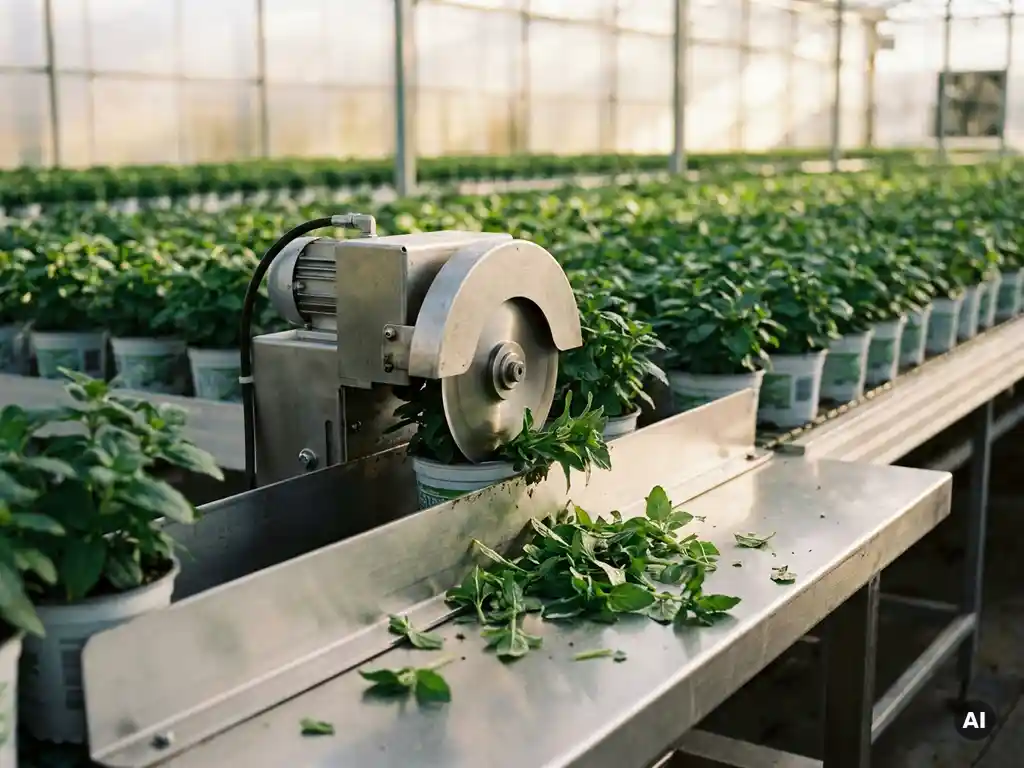
How does a topping machine work in a pot plant production line?
A topping machine in a pot plant production line applies a thin layer of finishing substrate, such as decorative bark, white peat, or coarse grit, on top of a freshly filled pot, giving plants a clean, professional appearance. It works directly after the potting machine in the line, receiving filled pots on a conveyor and distributing the topping material evenly before pots move on to the next stage. The sections below answer the most common questions about how potting and topping machines work together in a complete, automated production line.
What steps happen inside a potting machine during production?
A potting machine fills empty pots with growing substrate in a continuous, automated cycle. Pots are fed onto the machine, a drill or auger bores a planting hole to a preset depth, the pot is filled with the correct volume of substrate, and it exits onto a conveyor ready for planting or further processing. The whole sequence happens in one pass, at high speed, with consistent results every time.
Breaking the process down into its core steps makes it easier to understand where precision matters most:
- Pot infeed: Empty pots are placed on the infeed belt, either manually or via an automated tray feeder, and guided into the machine at a controlled pace.
- Substrate filling: A hopper stores the growing mix and a metering system delivers the right volume into each pot. The fill level is adjusted to match the pot size programmed into the control panel.
- Hole boring: A drill presses down into the filled substrate to create a planting hole at the correct depth for the crop type. Depth is programmable and repeatable across every pot.
- Outfeed: Filled, bored pots exit onto a conveyor belt, ready for a planting operator or the next automated station, such as a topping machine or sorting line.
On more advanced machines, sensors monitor substrate levels in the hopper and detect whether each pot has been correctly filled before it moves forward. This prevents underfilled or empty pots from reaching the planting station, which saves time and reduces waste.
How does a potting machine fit into a full pot plant production line?
A potting machine sits at the heart of a pot plant production line, receiving empty pots at one end and delivering filled, bored pots to the next workstation at the other. It connects upstream to pot or tray feeders and downstream to planting stations, topping machines, conveyor systems, and sorting or spacing lines. The potting machine sets the pace for the entire line.
In a fully integrated line, the flow typically looks like this:
- Tray or pot feeder supplies empty pots to the potting machine
- Potting machine fills and bores each pot
- Planting station where operators or automated arms insert cuttings or plugs
- Topping machine applies a layer of decorative or protective substrate on top
- Conveyor system transports pots to spacing or sorting equipment
- Sorting or spacing line arranges pots for greenhouse benches or trolleys
The key to a smooth line is making sure every machine runs at compatible speeds. A potting machine capable of 8,000 pots per hour needs conveyor capacity and downstream stations that can keep up, otherwise bottlenecks form quickly. Well-designed production lines are built around the potting machine’s output rate, with each connected station matched to that throughput. You can explore our range of conveyor systems to see how transport solutions integrate with potting lines.
What’s the difference between a standard and an automated potting machine?
A standard potting machine fills and bores pots at a fixed, manually set speed and volume, while an automated potting machine uses sensors, PLC controls, and programmable settings to adjust fill depth, bore depth, and conveyor speed automatically for different pot sizes and substrate types. The core function is the same, the difference lies in precision, flexibility, and how much the machine manages itself.
On a standard machine, the operator adjusts mechanical settings by hand when switching between pot sizes or substrate mixes. This works well for nurseries running one or two consistent configurations, but it slows things down when variety is needed.
An automated machine stores multiple programmes for different pot sizes, drilling depths, and fill volumes. Switching between configurations takes seconds via a touchscreen rather than manual adjustment. Automated machines also tend to include features such as:
- Automatic substrate detection: sensors confirm each pot is correctly filled before it advances
- Fully guided chain systems: for smoother, quieter operation and less mechanical wear
- Touchscreen programming: operators set parameters digitally, reducing setup errors
- Lower maintenance requirements: fewer manual adjustments mean fewer points of failure
For high-volume nurseries or growers handling multiple crop types, the time saved on changeovers and the consistency gained from automated filling typically justify the higher initial investment.
How many pots per hour can a potting machine realistically produce?
A professional potting machine can realistically produce between 3,000 and 8,000 pots per hour, depending on the machine model, pot size, substrate type, and how the line is configured. Smaller pots on a well-tuned automated line reach the upper end of that range; larger pots or denser substrate mixes naturally reduce throughput.
Several factors influence the real-world output you can expect:
- Pot size: smaller pots cycle faster through the machine than larger ones
- Substrate consistency: fibrous or chunky mixes can slow the metering system compared to fine, uniform substrates
- Line configuration: a single-row machine produces less than a double-row setup running simultaneously
- Operator efficiency: on semi-automated lines, the speed of manual planting often becomes the limiting factor, not the machine itself
It is worth being realistic when planning your line. A machine rated at 8,000 pots per hour delivers that figure under optimal conditions. Building some buffer into your production planning accounts for substrate refills, brief operator pauses, and minor adjustments during a shift.
What types of plants and pot sizes can a potting machine handle?
Most professional potting machines handle a wide range of ornamental and pot plant crops, including bedding plants, herbs, perennials, and shrubs. Pot sizes typically range from 7 cm to 30 cm in diameter, covering the vast majority of commercial pot plant production. The machine is adjusted, either manually or via programmed settings, to match the specific pot diameter, fill volume, and bore depth required for each crop.
Substrate compatibility is equally important. A well-built potting machine should handle standard peat-based mixes, coir substrates, bark-enriched composts, and blended growing media without jamming or inconsistent filling. Machines that struggle with coarser or more fibrous mixes are a common pain point in production, particularly during peak season when downtime is most costly.
For nurseries growing multiple crop types across different pot sizes, programmable machines offer a clear advantage. Storing separate programmes for each configuration means switching between a 9 cm herb pot and a 17 cm perennial takes moments rather than a lengthy manual reset.
Should you buy or rent a potting machine for your nursery?
Buying a potting machine makes sense for nurseries with consistent, high-volume production needs, while renting is a smart option for growers who want to test a machine before committing, manage seasonal peaks without a large capital outlay, or are new to automated potting. Both routes are valid, the right choice depends on your production volume, budget, and how certain you are about the configuration you need.
Consider buying when:
- You run automated potting year-round or across long seasonal windows
- You have a clear, stable production setup and know which machine fits your line
- The long-term cost of ownership is lower than recurring rental fees at your volume
Consider renting when:
- You want to trial a specific model before making a purchase decision
- Your peak potting season is short and a full investment is hard to justify
- You are scaling up and want flexibility while your production requirements are still evolving
A trial or rental period also gives your team time to learn the machine in a real production context, which reduces the risk of investing in the wrong configuration.
How MartinStolze supports your potting line from start to finish
We design, build, and install potting machines and complete production lines entirely in-house, which means every component is engineered to work together. Here is what that means in practice for your nursery:
- Two machine options to match your scale: the Stolze 3030 for reliable, high-capacity potting, and the Stolze 3030 PRO with automatic substrate detection, a fully guided chain, and touchscreen programming for more demanding environments
- Pot sizes from 7 to 30 cm and capacity up to 8,000 pots per hour
- Seamless integration with our own conveyor belts, topping machines, tray fillers, and sorting lines for a complete, matched production line
- Buy or rent – including a trial period – so you can make a confident decision before committing
- Training and support from our own technicians, including hands-on demos at our facility in De Lier
Whether you are setting up your first automated line or upgrading an existing one, we are happy to help you find the right configuration for your crop, your substrate, and your production goals. Get in touch with our team to discuss your situation and get tailored advice.
Frequently Asked Questions
How do I know which potting machine configuration is right for my nursery?
Start by mapping out your production requirements: the pot sizes you use most, your target output per hour, the substrate types you work with, and whether you run one crop type or many. From there, you can match those requirements to a machine model and line configuration. If you are unsure, a hands-on demo or a rental trial period is one of the best ways to validate your choice in a real production setting before committing to a purchase.
What maintenance does a potting machine typically require to keep it running reliably?
Routine maintenance on a potting machine generally includes cleaning the hopper and metering system to prevent substrate build-up, inspecting and lubricating the chain drive, and checking drill bits or augers for wear. On automated machines with guided chain systems, mechanical wear points are reduced, which lowers the frequency of hands-on maintenance. Following the manufacturer's recommended service schedule and training your operators to spot early warning signs — such as inconsistent fill levels or unusual noise — will prevent most unplanned downtime.
Can a potting machine handle peat-free or alternative substrates reliably?
Most modern professional potting machines can handle peat-free alternatives such as coir, wood fibre, and bark-enriched blends, but performance depends heavily on the consistency and particle size of the mix. Coarser or more fibrous substrates can slow the metering system or cause bridging in the hopper if the machine is not set up correctly for them. If you are transitioning to peat-free growing media, it is worth testing your specific substrate mix on the machine before peak season to identify any adjustments needed to fill volume or conveyor speed.
What happens if the topping machine runs out of material mid-production?
On basic topping machines, running out of material means pots continue moving through without a topping layer applied, which only becomes apparent downstream — often too late to correct without manual rework. More advanced setups include hopper-level sensors that trigger an alert or pause the line before the material runs out entirely. Building a regular material check into your operator routine, and sizing your topping hopper appropriately for your shift length, is the simplest way to avoid this disruption.
How much space does a complete potting line typically require in a production facility?
A complete potting line including a pot feeder, potting machine, planting station, topping machine, and outfeed conveyor can range from roughly 10 to 25 metres in length depending on the number of stations, the conveyor runs between them, and whether the line is configured straight or with bends to fit the available floor space. Ceiling height, aisle access for substrate refilling, and operator working positions all need to be factored in alongside the machine footprint. Sharing a floor plan and your production requirements with your machine supplier early in the planning process allows them to propose a layout that fits your building practically.
Is it possible to expand or upgrade a potting line later without replacing the entire setup?
Yes, a well-designed potting line is modular by nature, which means individual stations such as the topping machine, conveyor sections, or sorting equipment can be added or upgraded independently as your production grows. The key is ensuring that any new components are compatible in terms of conveyor height, belt width, and throughput speed with the machines already in your line. Working with a supplier who builds both the potting machine and the surrounding line equipment makes future upgrades significantly simpler, as compatibility is already engineered in.
What should I check before buying a second-hand potting machine?
Before purchasing a used potting machine, inspect the hopper and metering system for wear or corrosion, check the chain drive and drill mechanism for signs of excessive use, and ask for the machine's service history and total operating hours. It is also worth verifying that spare parts are still available for that model, as older machines can become difficult and costly to maintain if components are discontinued. If possible, run the machine on your own substrate and pot sizes during a viewing to confirm it performs consistently before agreeing to a purchase.
Related Articles
- How do you balance labor capacity with machine capacity?
- Why should you calculate effective output before choosing a potting machine?
- How do you scale up pot plant production without hiring more staff?
- How do soil mix properties affect potting machine performance?
- When should a nursery invest in a conveyor belt system?