

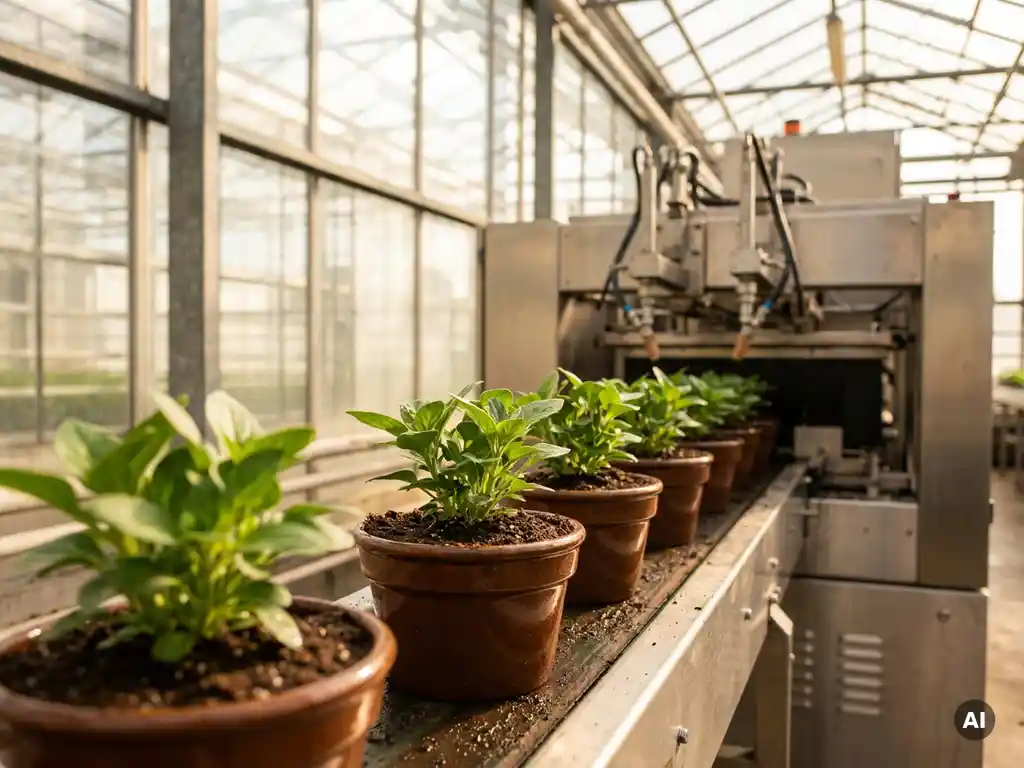
How does automated topping improve consistency between pots?
Automated topping improves consistency between pots by applying a controlled, uniform layer of substrate to every pot at the same depth and density, regardless of operator fatigue or variation. Where hand-filling produces visible differences in soil level from pot to pot, a topping machine delivers the same fill height every cycle. The sections below unpack why that gap exists, how the technology closes it, and when the investment makes practical sense for your operation.
Why do pots end up with different soil levels when filled by hand?
When pots are filled by hand, soil levels vary because every scoop, press, and placement is a manual judgment call. The amount of substrate picked up changes with each handful, operator fatigue accumulates across a shift, and no two people apply the same compaction pressure. The result is a tray of pots where some are overfilled, some are shallow, and almost none match exactly.
This inconsistency compounds quickly at scale. A grower producing thousands of pots per day is not dealing with a few millimetres of variation; they are dealing with a pattern of inconsistency that affects irrigation run-off, root development, and presentation on the sales floor. Seasonal peaks make the problem worse: when staff are working faster under deadline pressure, the natural variation in manual filling increases rather than decreases.
There is also a substrate factor. Heavier or coarser mixes behave differently from fine, peat-based substrates. A worker who has found a rhythm with one mix will lose it when the material changes, introducing another layer of unpredictability into the fill level.
How does automated topping control soil fill levels?
An automated topping machine controls soil fill levels by delivering substrate through a mechanically regulated feed system that applies the same volume and pressure to every pot passing through the line. The pot moves at a fixed speed beneath the topping unit, and the substrate is distributed in a consistent band across the top of the pot, eliminating the human variability that causes uneven fills.
The key control points in the process are conveyor speed, feed rate, and the height at which the topping is applied. These parameters are set once for a given pot size and substrate type, then held constant for the entire run. Operators do not need to monitor or adjust during production, which means the fill level at pot number 7,000 is the same as at pot number one.
When the topping function is integrated directly into a potting line rather than added as a separate step, the coordination between potting and topping is tighter still. The pot arrives at the topping station already positioned and oriented correctly, so there is no manual handling between the two stages that could introduce variation.
What is the difference between a standard potting machine and one with automatic soil detection?
A standard potting machine fills pots according to preset parameters: the operator programs a fill depth and the machine runs to that setting. A machine with automatic soil detection actively measures the substrate level in each pot as it moves through the cycle and adjusts the fill in real time. This means that variations in pot geometry, substrate compression, or feed irregularities are corrected before the pot leaves the machine.
The practical difference shows up most clearly when working with inconsistent raw material. If a batch of substrate is drier than usual and compresses less, a standard machine will produce slightly overfilled pots until someone notices and intervenes. A machine with automatic soil detection catches that drift and compensates immediately, keeping every pot within the target range without operator input.
Our Stolze 3030 PRO is built around this principle. Its automatic soil detection works alongside a fully guided chain for greater stability, a touchscreen for programming different pot sizes and bore depths, and quieter operation that reduces maintenance demands. For high-volume growers where a single shift can run to tens of thousands of pots, the difference between preset and adaptive filling is the difference between acceptable and genuinely reliable output.
How does consistent pot density affect plant growth and sales quality?
Consistent pot density directly affects plant growth because root development, water retention, and nutrient uptake all depend on the physical structure of the substrate around the root zone. A pot that is too loosely filled drains too quickly and leaves roots without adequate support. A pot that is overpacked restricts oxygen flow and can cause root suffocation. Both extremes reduce growth rate and increase the risk of crop loss.
On the sales side, uniform pot density produces a visually consistent product. Pots that sit at the same height, with the same soil level relative to the rim, present better at auction and in retail. Buyers and auction systems that grade on appearance will consistently score uniform trays higher than mixed ones. For growers selling through the veilings, this is not a cosmetic concern; it has a direct effect on price per unit.
There is also a downstream logistics benefit. Pots filled to a consistent density stack and transport more predictably. Overfilled pots shift during transit and can damage neighbouring plants. Uniform fills reduce that risk and lower the rate of presentation damage between the nursery and the point of sale.
Can a potting machine handle different substrate mixes without losing consistency?
Yes, a well-engineered potting machine can handle different substrate mixes without losing consistency, provided the machine’s feed system is designed to accommodate variation in particle size, moisture content, and bulk density. The critical requirement is that the operator reprogram the fill parameters when switching between mixes rather than running a new substrate through settings calibrated for a different material.
This is where machines with programmable touchscreen controls have a clear advantage. Instead of manually recalibrating the machine each time the substrate changes, operators can store preset profiles for each mix and recall them at the start of a run. The machine then applies the correct feed rate, compaction, and bore depth for that specific material from the first pot.
Coarser or heavier mixes, such as those containing bark, perlite, or coarse coir, present the greatest challenge for machines not built to handle them. A machine that jams or feeds inconsistently with demanding substrates will undermine consistency regardless of how well it performs with standard peat mixes. Choosing a machine with a robust feed mechanism from the outset avoids this failure point.
When does investing in a potting machine with topping automation pay off?
Investing in a potting machine with topping automation pays off when the cost of manual labour, crop inconsistency, and production downtime exceeds the annualised cost of the machine. For most professional growers operating at volumes above a few thousand pots per day, that threshold is reached faster than expected once labour costs, quality losses, and seasonal bottlenecks are accounted for together.
The clearest indicators that the investment is justified include:
- Seasonal labour shortages that force slower production or lower quality standards during peak periods
- Recurring quality complaints or auction downgrades linked to inconsistent pot fill
- High staff turnover that resets institutional knowledge about correct fill technique
- A current machine that cannot handle the substrate mixes required for the crop range
- Plans to expand volume without proportionally expanding headcount
Growers who are uncertain about committing to a purchase can reduce the risk by starting with a rental arrangement. Testing a machine on a real production run, with your own substrate and pot sizes, gives concrete data on throughput, fill consistency, and operator workload before any long-term decision is made.
How MartinStolze helps with automated topping and potting consistency
We develop and produce our potting machines entirely in-house, from design and programming through to assembly and installation. That means every component in the topping and filling system is built to work together, not assembled from third-party parts that may not align under production conditions. Here is what that means in practice for growers looking to improve consistency:
- Adaptive fill control: The Stolze 3030 PRO uses automatic soil detection to correct fill levels in real time, removing the dependency on operator judgment
- Programmable profiles: Pot size, bore depth, substrate feed rate, and rotation speed can all be stored and recalled via touchscreen, so switching between mixes does not disrupt output
- Full line integration: Our potting machines connect directly with conveyor systems and sorting lines, so the pot moves from filling to topping to transport without manual handling between stages
- Rental with trial period: Growers who want to validate performance before committing can rent a machine and run it on their own production before making a purchase decision
- On-site support: Our own technicians handle installation, training, and maintenance, so there is no gap between the machine as sold and the machine as it runs in your facility
If you are evaluating whether automated topping is the right step for your operation, get in touch with us and we will help you assess the right configuration for your crop, substrate, and production volume.
Frequently Asked Questions
How long does it take to set up a potting machine for a new substrate or pot size?
With a programmable touchscreen system, switching between saved profiles typically takes just a few minutes — the operator selects the stored preset for the new pot size or substrate and the machine adjusts automatically. For a completely new combination that has not been profiled before, an initial calibration run is needed, but once those settings are saved, future changeovers are near-instant. This makes multi-crop or multi-substrate operations far more practical than manually recalibrating a machine each time.
What volume of pots per day justifies moving from manual filling to automated topping?
While there is no universal threshold, most professional growers find the economics shift clearly in favour of automation somewhere between 2,000 and 5,000 pots per day, depending on labour costs, crop value, and quality requirements. At lower volumes, the upfront investment may take longer to recover, but factors like high staff turnover, premium auction pricing, or plans to scale can bring that break-even point forward significantly. Running a rental trial on your own production is the most reliable way to calculate the actual payback period for your specific operation.
Can automated topping handle pots of different shapes, not just round ones?
Most modern potting machines with topping functions are designed primarily around round pots, but many can be configured to handle square or rectangular containers by adjusting the conveyor guides and feed width. The key requirement is that the pot moves through the topping station in a stable, consistent orientation — irregular or tapered shapes may need custom fixtures or line adjustments to achieve the same fill uniformity as standard round pots. It is worth discussing your specific container range with the machine supplier before committing to a configuration.
What maintenance does a topping machine typically require to keep fill levels consistent over time?
The main maintenance priorities are keeping the feed mechanism clear of substrate build-up, checking conveyor belt tension and speed calibration at regular intervals, and inspecting any sensors used for automatic soil detection to ensure they remain accurate. A well-maintained machine should hold its fill consistency over long production runs without significant drift, but neglecting the feed system in particular can cause bridging or uneven flow that undermines the uniformity the machine is designed to deliver. Machines where the manufacturer provides on-site technical support make it easier to catch and resolve these issues before they affect output quality.
Does automated topping work with organic or specialty substrates like wood fibre or living moss?
Automated topping can work with a range of organic and specialty substrates, but the feed system needs to be robust enough to handle the specific characteristics of those materials — wood fibre and living moss, for example, can be fibrous, compressible, and prone to bridging in standard feed mechanisms. Machines built with heavy-duty feed systems and adjustable feed rates are better equipped to handle these materials consistently. If you work with unusual or demanding substrates, it is important to test the machine with your actual material before committing to a configuration, ideally through a rental trial.
How does inconsistent pot filling affect irrigation efficiency in a greenhouse?
When pots are filled to different depths and densities, they hold and drain water at different rates, which makes it impossible to set a single irrigation schedule that works correctly for every pot on the bench. Under-filled pots dry out faster and may be under-watered, while overpacked pots retain moisture longer and become prone to root disease — both outcomes increase crop loss risk. Consistent fill levels allow growers to optimise irrigation timing and volume once and apply it uniformly across the entire batch, reducing water waste and improving crop uniformity.
What should I look for when comparing potting machines from different suppliers?
The most important factors to evaluate are whether the machine uses adaptive fill control or only preset parameters, how it handles the specific substrates you use, how quickly and easily it can switch between pot sizes, and what after-sales support the supplier provides. A machine that performs well with standard peat but struggles with coarser mixes may not suit a mixed-crop operation, and a supplier who cannot provide on-site technical support will leave you managing problems alone during critical production periods. Asking for a trial or demonstration on your own substrate and pot sizes — rather than a controlled showroom setup — gives the most realistic picture of real-world performance.