

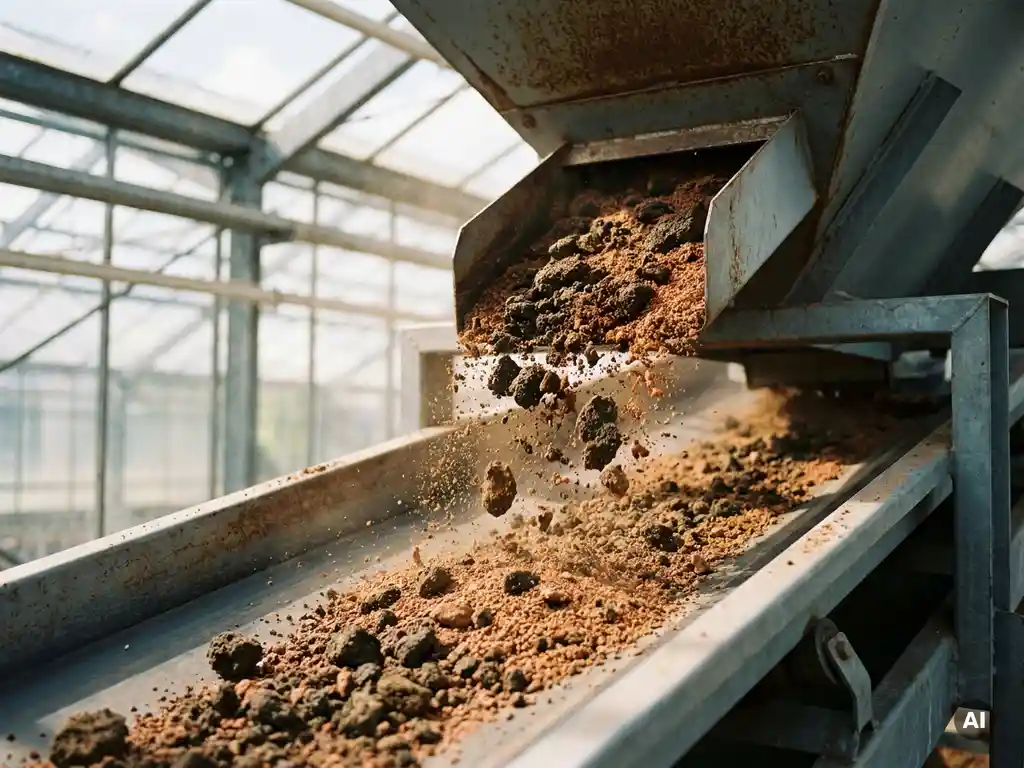
How does material particle size affect topping machine performance?
Particle size directly affects how well a potting machine fills pots – it controls how freely substrate flows through the machine’s auger, hopper, and filling mechanism. When particles are too large, they bridge and block; too fine, and they compact unevenly or create dust that interferes with sensors and moving parts. For growers running high volumes, getting the substrate specification right is just as important as choosing the right machine.
Below, we answer the most common questions about substrate particle size and potting machine performance, from optimal size ranges to pre-processing tips and machine selection.
Why does particle size affect how a potting machine fills pots?
Particle size determines how substrate moves through every stage of the filling process. A potting machine relies on consistent, gravity-assisted flow from the hopper down through the auger or conveyor into the pot. When particle size is inconsistent or outside the machine’s design range, that flow becomes unpredictable, and inconsistent flow means inconsistent pot fill.
Larger particles create air pockets and uneven distribution inside the pot, leaving some areas loosely filled and others dense. Very fine particles, on the other hand, tend to compact under their own weight, which can cause bridging in the hopper, where material clumps together and stops flowing, or produce pots that are overly dense and restrict root development. The auger or filling wheel inside the machine is calibrated for a specific material behaviour, and substrate that falls outside that behaviour puts mechanical stress on components and shortens service intervals.
In short: particle size is not just a substrate quality issue. It is a machine performance issue that affects output speed, fill consistency, and long-term reliability.
What particle size range works best in a potting machine?
For most professional potting machines, a particle size range of roughly 0 to 25 mm works reliably, with the majority of particles sitting between 2 and 15 mm. Substrates within this range flow freely, distribute evenly across pot diameters, and do not place excessive strain on augers or conveyor systems.
Peat-based mixes, coir blends, and bark-enriched substrates that fall within this window typically perform well without pre-processing. Problems arise at the extremes: particles above 25 to 30 mm, such as large bark chunks, uncomposted wood fibre, or unbroken perlite clumps, are the most common cause of jams and irregular fill. At the fine end, very high proportions of dust-sized particles (under 0.5 mm) reduce aeration and can clog sensors in machines equipped with automatic soil detection.
If your substrate supplier provides a particle size distribution curve, look for a relatively even spread across the middle range with minimal oversize material. A well-graded mix not only runs more smoothly through the machine but also delivers better agronomic results for the plant.
What causes a potting machine to block or jam?
Blockages in a potting machine are almost always caused by oversized particles, high moisture content, or a combination of both. When large chunks of bark, root residue, or clumped substrate enter the auger or filling mechanism, they cannot pass through the designed clearances and create a physical blockage that halts production.
The most frequent causes of jams include:
- Oversize particles – chunks larger than the machine’s clearance tolerance that physically wedge in the auger or outlet
- Wet or sticky substrate – high moisture causes material to clump together and bridge inside the hopper, stopping flow before it even reaches the filling mechanism
- Foreign objects – stones, plastic debris, or uncomposted organic matter that enter with the substrate
- Inconsistent particle distribution – sudden shifts from fine to coarse material within the same batch that cause the auger speed to become mismatched with actual flow rate
Preventing jams starts with substrate preparation. Screening out oversize material before loading, storing substrate under cover to manage moisture, and inspecting incoming batches for contamination are practical steps that significantly reduce downtime. Machines with robust auger designs and wider clearances are inherently more tolerant of variation, but no machine is immune to poorly prepared substrate.
How does substrate particle size affect pot density and plant quality?
Particle size directly influences the bulk density of the filled pot, which in turn affects root development, water retention, and aeration – three of the most critical factors for healthy plant growth. A substrate with a well-balanced particle size distribution creates a pot with the right combination of pore space and moisture-holding capacity.
When particles are too fine and uniform, the substrate packs tightly, leaving little air space for roots. This slows root development, increases the risk of waterlogging, and can lead to root disease in susceptible species. When particles are too coarse and irregular, the pot fills unevenly, some areas are dense, others barely filled, creating inconsistent growing conditions across a batch. For growers supplying auction markets or retail chains, that inconsistency translates directly into rejected batches or lower grading.
A potting machine that fills consistently, because the substrate particle size is appropriate, produces pots with uniform density across thousands of units. That uniformity is not just an agronomic benefit; it is a commercial one. Consistent pots mean predictable crop timing, uniform presentation, and fewer quality complaints down the line.
Should you sieve or pre-process substrate before potting?
Yes, sieving or pre-processing substrate before loading it into a potting machine is strongly recommended when working with bark-enriched mixes, recycled substrates, or any growing medium with variable particle size. A simple screen or trommel sieve removes oversize particles and foreign objects before they reach the machine, reducing jam frequency and protecting mechanical components.
The decision to pre-process depends on your substrate type and quality:
- Consistent, pre-graded peat or coir mixes from reputable suppliers often require no additional processing – they are manufactured to a specification that suits machine use
- Bark-enriched or wood fibre substrates frequently contain oversize chunks and benefit from passing through a 20 to 25 mm screen before use
- Recycled or composted substrates are the most variable and almost always benefit from sieving and moisture management before potting
- Wet substrate – regardless of particle size – should be allowed to drain or dry slightly before use, as excess moisture dramatically increases the risk of bridging and compaction
Pre-processing adds a step to your workflow, but the time saved on clearing jams, recalibrating fill depth, and maintaining consistent output far outweighs the preparation effort, especially during peak potting seasons when every hour of machine uptime counts.
Which potting machines handle difficult substrates best?
Potting machines with robust auger systems, wider material clearances, and active soil detection handle difficult substrates most reliably. Machines designed for professional, high-volume use are built to tolerate more variation in substrate composition than entry-level models, which are typically calibrated for clean, uniform peat mixes only.
Key features to look for in a machine intended for demanding substrates include:
- Automatic soil detection – sensors that adjust fill volume in real time compensate for variation in substrate flow rate, keeping pot density consistent even when the material behaves inconsistently
- Programmable fill settings – the ability to set and save parameters for different substrate types means you can switch mixes without recalibrating from scratch each time
- Heavy-duty auger construction – wider clearances and stronger drive components reduce the risk of jams and mechanical wear when running coarser or wetter material
- Easy-access service points – when a blockage does occur, machines that allow quick clearing without full disassembly minimise downtime
How MartinStolze helps with substrate and potting machine performance
At MartinStolze, we have been developing and building professional potting machines for over three decades, and substrate handling is one of the most common challenges we help growers solve. Our Stolze 3030 and Stolze 3030 PRO are designed for exactly the kind of demanding, high-volume potting environments where substrate quality varies and downtime is not an option.
Here is what sets our approach apart:
- The Stolze 3030 PRO features automatic soil detection that adjusts fill volume in real time, compensating for particle size variation and keeping every pot consistent, even across different substrate batches
- Programmable touchscreen controls let you save settings for different pot sizes, boring depths, soil feed rates, and rotation speeds, so switching substrates does not mean starting from zero
- Built and serviced in-house – our machines are produced entirely in our own workshop in De Lier, and our own technicians handle installation, training, and service, meaning we know exactly how each machine behaves with different substrates
- Trial and rental options – not sure which model suits your substrate and workflow? You can rent before you commit, including a trial period to test performance with your own growing medium
- Seamless integration with our conveyor systems and sorting lines, so your entire potting line runs as one efficient, coordinated system
If you are dealing with substrate-related performance issues or planning a new potting line, we are happy to think along with you. Get in touch with our team and we will help you find the right machine and configuration for your specific substrate and production goals.
Frequently Asked Questions
How do I know if my substrate is causing my potting machine to underperform?
The most common signs are inconsistent pot fill weights, frequent blockages in the hopper or auger, and noticeable variation in pot density across a batch. If your machine’s output speed has dropped or you are clearing jams more than once per shift, substrate quality — particularly particle size or moisture content — is usually the first place to investigate. Weighing a sample of filled pots across a production run is a quick, practical way to confirm whether fill consistency is the problem.
What moisture level should my substrate be at before loading it into a potting machine?
Most professional potting machines perform best with substrate at a moisture content of around 50–60%, often described as ‘wringing wet’ — where the material holds its shape when squeezed but does not drip freely. Substrate that is too wet will clump, bridge in the hopper, and compact excessively in the pot, while substrate that is too dry becomes dusty and flows unpredictably. If your substrate has been stored outdoors or delivered after heavy rain, allow it to drain under cover for 12–24 hours before use.
Can I mix different substrate types in the same potting run, and will that cause problems?
Mixing substrate types mid-run is possible but requires care, as differences in particle size distribution, bulk density, and moisture content between mixes can cause the machine’s fill settings to become mismatched. If you need to switch substrates, it is best to clear the hopper fully, recalibrate fill depth and auger speed for the new material, and run a short test batch before resuming full production. Machines with programmable fill settings, such as the Stolze 3030 PRO, allow you to save and recall parameters for different substrate types, which makes transitions significantly faster.
How often should I screen or sieve my substrate, and is there a quick way to do it on-site?
For bark-enriched or composted substrates, screening every batch before potting is the safest approach, particularly if your supplier or storage conditions introduce variability. A trommel sieve or vibrating screen set to a 20–25 mm mesh is the most practical on-site solution for high-volume operations and can be integrated directly into your substrate loading workflow. For pre-graded peat or coir mixes from consistent suppliers, periodic spot-checks — examining a sample for oversize particles or foreign material — are usually sufficient.
What should I do if my potting machine keeps jamming even after I have screened the substrate?
If jams persist after screening, moisture content is the most likely remaining cause — wet material can bridge and block even when particle size is within the correct range. Check whether the substrate is clumping when handled and, if so, allow it to dry slightly before use. It is also worth inspecting the auger clearances and hopper geometry for wear or material build-up, as degraded components can reduce the machine’s tolerance for normal substrate variation; contacting your machine supplier for a service check is advisable if mechanical wear is suspected.
Are there specific substrate types that professional potting machines struggle with the most?
Recycled and composted substrates are consistently the most challenging, as they tend to combine high moisture content, variable particle size, and contamination from uncomposted organic matter — all of which increase jam risk and fill inconsistency. Heavily bark-enriched mixes with a high proportion of particles above 20 mm also require careful pre-processing. Coir and peat-based mixes from quality suppliers are generally the most machine-friendly, provided they are stored correctly and not allowed to dry out completely, which causes them to become hydrophobic and flow unevenly.
Is it worth investing in a higher-spec potting machine if I only use one substrate type?
Even with a single, consistent substrate, a higher-specification machine with programmable controls and automatic soil detection delivers long-term value through improved fill accuracy, reduced calibration time, and greater resilience to natural batch-to-batch variation in your growing medium. Substrate characteristics can shift seasonally — moisture content, bulk density, and particle distribution all vary depending on production lot and storage conditions — and a machine built to handle that variation will maintain output quality more reliably over time. For high-volume growers where every hour of uptime matters, the operational consistency of a professional-grade machine typically justifies the investment.