

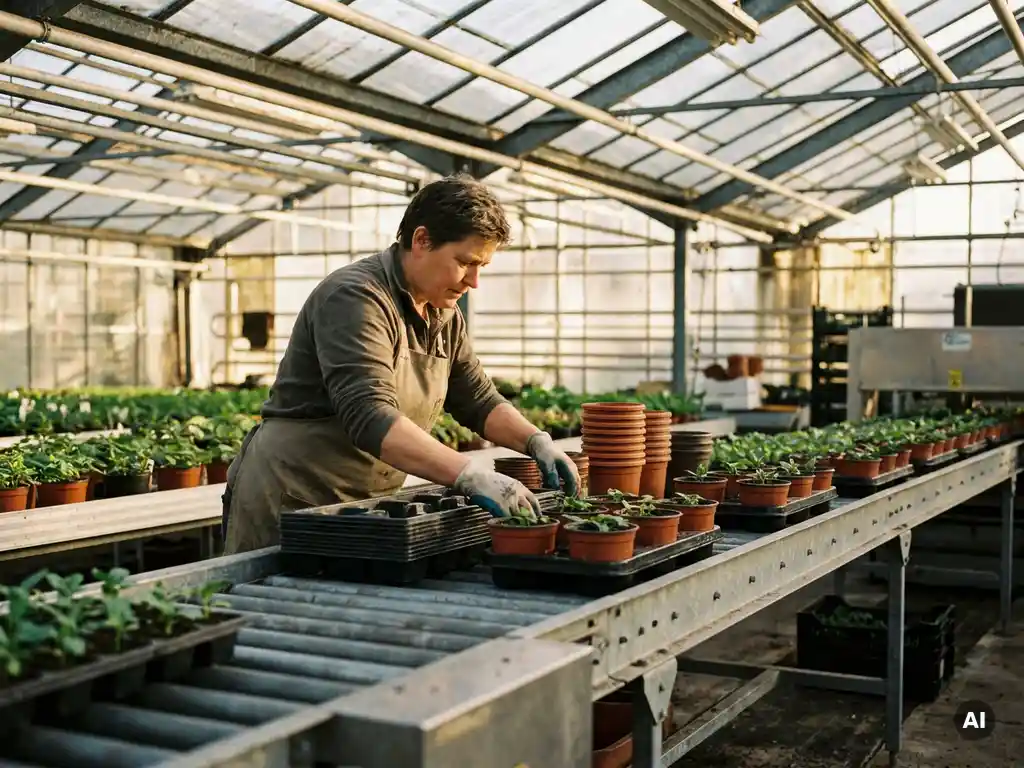
How does operator organization affect potting machine pots per hour?
Operator organization directly affects potting machine pots per hour by determining how smoothly trays, pots, and soil flow through the line without interruption. A well-organized team working at a properly configured workstation can sustain peak output across a full shift, while poor setup causes bottlenecks that cut effective capacity by a significant margin, even on a high-performance machine.
The machine’s rated capacity only tells part of the story. Whether you actually reach those numbers in practice depends on how your team is positioned, how fatigue is managed, and whether the surrounding layout supports a continuous rhythm rather than constant stops and corrections.
Below, we work through the most common questions growers and production managers ask when trying to close the gap between rated capacity and real-world output.
What factors in operator setup reduce potting machine output?
The most common factors that reduce potting machine pots per hour are poor tray supply, misaligned pot feeding, insufficient soil flow, and unclear task division between operators. Any one of these creates a micro-interruption that compounds across thousands of cycles, pulling actual throughput well below the machine’s rated capacity.
Even the most capable machine cannot compensate for a disorganized setup upstream or downstream. The most frequent culprits include:
- Tray supply gaps: When operators must walk to retrieve trays rather than having them within arm’s reach, the machine idles between cycles.
- Inconsistent pot placement: Pots placed at irregular angles or spacing cause the machine to misfire, requiring manual correction and restarting the rhythm.
- Soil mix interruptions: Running low on substrate mid-run forces a pause that breaks the entire line’s momentum.
- Unclear role division: When two operators are both doing the same task, or neither is covering a critical one, handoffs fail and output drops.
Addressing these factors does not require a machine upgrade. Often, a structured pre-shift checklist and clearly assigned roles are enough to recover a meaningful share of lost capacity.
How many operators does a potting machine actually need?
Most professional potting machines require between two and four operators to run at full capacity. The exact number depends on the level of automation in the line, pot size, and whether downstream tasks like tray transport and plant placement are handled manually or by conveyor.
A common baseline for a standard single- or double-row potting line looks like this:
- One operator at the machine: Monitoring soil fill, adjusting settings, and catching any misfires at the potting head.
- One operator feeding trays or pots: Keeping the input side continuously stocked to prevent idle time at the head.
- One or two operators at the output: Receiving filled pots, placing plants if required, and moving trays onto transport conveyors or trolleys.
With a more automated line, including automatic tray feeding and conveyor-based output, you can often run a high-capacity machine with two operators rather than four. That reduction in labor is one of the primary financial arguments for investing in a more complete line rather than a standalone machine.
What is the ideal workstation layout around a potting machine?
The ideal workstation layout positions all consumables, including pots, trays, and substrate, within one step of the operator’s station, with a clear and unobstructed flow path from input to output. The goal is to eliminate any movement that does not directly contribute to filling pots.
Think of the layout in three zones:
The input zone
Pots or trays should be staged immediately adjacent to the feed point, not stacked across the room. If operators are walking more than a step or two to retrieve pots, the layout is costing you cycles. A rolling cart or automated tray feeder positioned directly at the machine’s intake is the most effective solution.
The output zone
Filled trays need a clear, immediate destination. A buffer table or short conveyor run directly off the machine’s exit gives the output operator time to handle each tray without rushing and prevents backups that force the machine to pause. Crowded or cluttered output zones are one of the most overlooked causes of reduced potting machine pots per hour.
Ergonomics matter here too. Working height, reach distance, and the direction of tray movement should all reduce physical strain rather than add to it, which connects directly to the next question about fatigue.
How does operator fatigue affect potting speed over a full shift?
Operator fatigue reduces effective potting speed progressively across a shift, with output typically declining most sharply in the final two hours. Repetitive bending, awkward reach angles, and sustained standing on hard floors accelerate fatigue, causing slower reaction times, more handling errors, and more frequent micro-pauses that accumulate into measurable throughput loss.
The practical impact is easy to underestimate. A team running at full pace for the first four hours but slowing by even ten percent in the final three hours loses a significant share of daily capacity. Over a week, that adds up to a real production shortfall.
Several layout and scheduling adjustments reduce the fatigue effect:
- Anti-fatigue matting at every standing position reduces physical strain during long runs.
- Adjustable working height at the output station means operators are not bending or overreaching to handle filled trays.
- Rotating roles mid-shift spreads the physical load and keeps attention levels higher across the team.
- Scheduled micro-breaks of two to three minutes every 90 minutes help sustain pace without significantly reducing total output.
Ergonomic design is not a luxury in high-volume potting operations, it is a production variable. Machines built with ergonomic integration in mind, where conveyor heights and operator positions are coordinated, make a measurable difference over the course of a full season.
When should you consider upgrading to a more automated potting machine?
You should consider upgrading to a more automated potting machine when your current setup consistently falls short of seasonal demand, requires more than four operators to run at capacity, or causes frequent stoppages due to soil mix inconsistencies or mechanical limitations. These are signs that the bottleneck is the machine itself, not the team around it.
Specific triggers that justify evaluating an upgrade include:
- Your current machine cannot handle your soil or substrate mix reliably, leading to stoppages at peak moments.
- You are spending significant labor hours on tasks, such as tray feeding or soil monitoring, that could be automated.
- Quality inconsistencies in pot fill density are causing downstream problems at the auction or with buyers.
- Your rated capacity is not being reached even with a well-organized team, suggesting the machine is the limiting factor.
- Maintenance downtime is increasing on an aging machine, with no clear path to improvement.
The decision is not only about capacity. Machines with automatic soil detection, programmable settings for different pot sizes, and quieter drive systems reduce the cognitive and physical load on operators, which directly supports the sustained throughput discussed above.
How we help you maximize potting machine pots per hour
At MartinStolze, we build and configure potting lines designed to close the gap between rated capacity and real-world output. Our approach covers both the machine and the line around it:
- The Stolze 3030 and 3030 PRO are produced entirely in-house, with PLC control and a touchscreen that lets you pre-program settings for different pot sizes, soil types, and fill depths, eliminating setup errors that cost you cycles.
- The 3030 PRO adds automatic soil detection for consistent fill quality across every pot, a fully guided chain for greater stability, and quieter operation that reduces operator fatigue over long shifts.
- Both machines integrate directly with our own transport conveyors and buffer tables, so the layout around the machine supports continuous flow rather than creating new bottlenecks.
- We support you from configuration through installation, with training available at our demo facility in De Lier.
- Both purchase and rental, including a trial period, are available, so the investment threshold stays manageable.
If you want to find out which configuration fits your operation, get in touch with our team and we will work through it with you.
Frequently Asked Questions
How do I calculate whether my current potting machine is actually the bottleneck, or if the issue is my team's setup?
Start by tracking your actual pots per hour in 30-minute intervals across a full shift and comparing those numbers to your machine's rated capacity. If output is consistently low from the first hour onward, the issue is likely setup, staffing, or layout. If output starts strong and declines, fatigue or supply interruptions are the more likely cause. Only if a well-organized team with a solid layout still cannot approach rated capacity should the machine itself be considered the limiting factor.
What is the fastest way to improve pots per hour without buying new equipment?
The highest-impact, zero-cost change is assigning clearly defined roles to each operator before the shift starts, so no task is doubled up or left uncovered. Paired with a simple pre-shift checklist covering substrate levels, pot supply staging, and output zone clearance, most operations can recover a meaningful share of lost capacity within the first week. Repositioning your tray and pot supply to within one step of the feed point is the next quickest win and requires nothing more than reorganizing your floor layout.
How do pot size and substrate type affect how many operators I need on the line?
Larger pots take longer to fill and are heavier to handle at the output station, which typically means you need at least one dedicated output operator rather than splitting that role. Heavier or coarser substrate mixes are also more prone to bridging or inconsistent flow, which requires closer monitoring at the machine head and more frequent manual corrections. If you are regularly switching between pot sizes or substrate types in a single shift, the added setup and adjustment time effectively reduces your available run time, making clear role assignment and pre-programmed machine settings even more important.
What should I look for when evaluating whether a potting machine integrates well with my existing greenhouse layout?
The key factors are input and output clearance, conveyor compatibility, and working height alignment. A machine that forces operators to work at an awkward height, or whose output direction conflicts with your existing transport flow, will create ergonomic and logistical problems regardless of its rated capacity. Before committing to any machine, map out the three zones described in this post — input, machine, and output — and confirm that tray and pot movement follows a single, uninterrupted direction without requiring operators to cross paths or double back.
Is it worth running a potting machine with fewer operators to save on labor costs?
Running understaffed is one of the most common ways operations leave capacity on the table. The labor cost saved by removing one operator is almost always outweighed by the throughput loss caused by supply gaps, slower output handling, and increased fatigue on the remaining team. A better approach is to invest in automation — such as automatic tray feeding or conveyor-based output — that genuinely reduces the number of operators needed without creating bottlenecks, rather than simply removing a person from a line that still requires their role to be filled.
How often should potting machine settings be reviewed or recalibrated during a season?
Settings should be reviewed any time you switch pot sizes, change your substrate mix, or notice a drop in fill consistency that cannot be explained by operator or supply issues. For operations running the same configuration continuously, a brief check at the start of each week is a reasonable baseline. Machines with programmable PLC settings make this easier by storing presets for different configurations, reducing the risk of calibration errors when switching between runs and ensuring you are not losing cycles to manual trial-and-adjustment at the start of each shift.
What is a realistic timeline for seeing throughput improvements after reorganizing an existing potting line?
Most operations see measurable improvement within the first one to three shifts after implementing structured role assignments, a pre-shift checklist, and layout adjustments to the input and output zones. The gains from ergonomic changes, such as anti-fatigue matting and adjusted working heights, tend to show up more gradually over the following weeks as cumulative fatigue decreases and the team sustains a more consistent pace into the final hours of each shift. Tracking pots per hour in intervals before and after changes is the most reliable way to confirm whether adjustments are producing the expected results.
Related Articles
- How does automated topping improve consistency between pots?
- How long does it take to pot 25,000 plants with an automated potting machine?
- What is the payback period for investing in a potting machine in 2026?
- How do you reduce physical strain on staff during potting season?
- What is the difference between a conveyor belt and a roller conveyor in horticulture?