

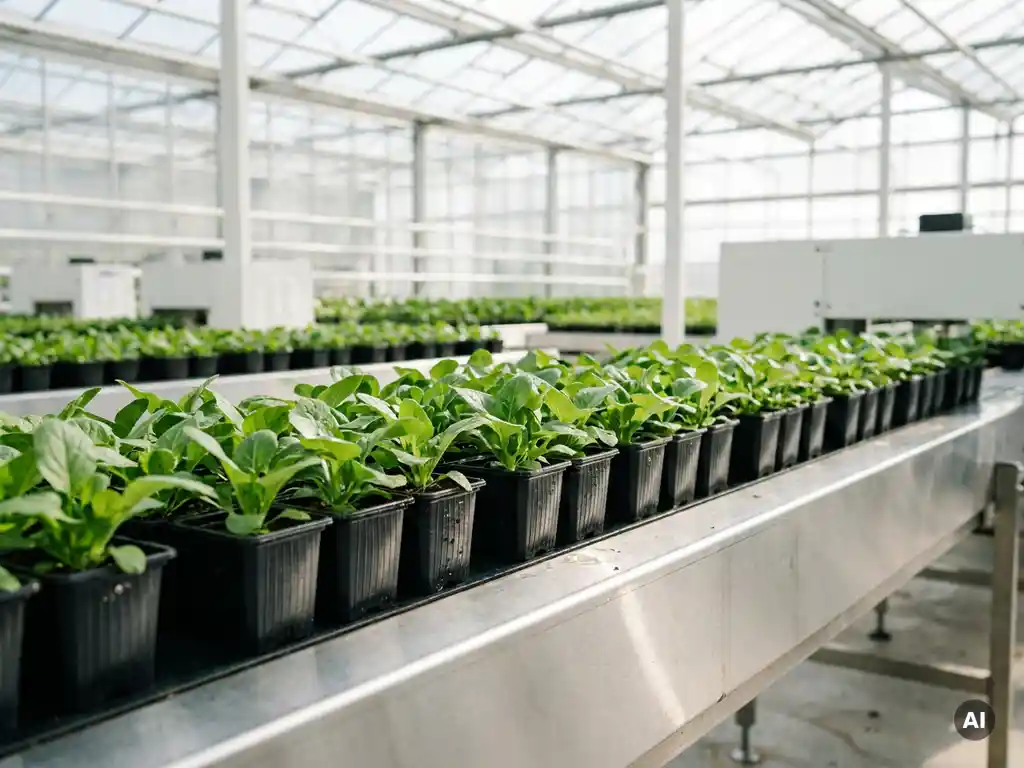
How does pot spacing influence achievable pots per hour?
Pot spacing directly influences achievable pots per hour: the closer the spacing, the higher the throughput, up to the physical limits of the potting machine and its chain or conveyor system. For most professional potting lines, tighter spacing means more pots pass through the filling and drilling station per minute, which is the primary driver of output capacity. The sections below unpack exactly how spacing, pot size, machine design, and soil detection interact to determine your real-world pots-per-hour figure.
What happens to throughput when pot spacing increases?
When pot spacing increases, throughput drops. More distance between pots means fewer pots travel through the filling station per unit of time, even if the chain or conveyor runs at the same speed. In practical terms, every extra centimeter of gap between pots is a centimeter of lost capacity, directly reducing your potting machine’s pots-per-hour figure.
The relationship is close to linear: if you double the center-to-center distance between pots while keeping belt speed constant, you roughly halve the number of pots processed per hour. This is why spacing is one of the first variables growers and production managers should evaluate when diagnosing underperformance on a potting line. Wider spacing is sometimes unavoidable, particularly with larger pot diameters or when handling delicate root systems, but it always comes at a throughput cost that needs to be factored into planning.
How does pot size affect the spacing needed on a potting line?
Larger pots require more center-to-center spacing because the physical diameter of the pot itself takes up more of the available belt or chain length. A 7 cm pot can run at very tight intervals, while a 25 or 30 cm pot needs substantially more room just to sit stably on the conveyor without touching adjacent pots.
Beyond the pot’s footprint, larger pots also need more soil volume per fill cycle. This means the filling and drilling station needs slightly more dwell time per pot to deliver an accurate, consistent fill. Both factors, the physical size and the fill time, push spacing outward as pot diameter increases. Growers working across a range of pot sizes need a machine that can be quickly reconfigured for different spacing settings, otherwise they lose either throughput or fill quality every time they switch formats.
What’s the difference between fixed and adjustable spacing on a potting machine?
Fixed spacing means the machine is set to one center-to-center distance and cannot be changed without mechanical intervention. Adjustable spacing allows the operator to change the interval between pots, either manually or through a programmable control system, to match different pot sizes or production requirements without stopping the line for extended periods.
For growers who run a single pot size year-round, fixed spacing is simple and reliable. But most professional ornamental and pot plant growers work with multiple formats across the season, and fixed spacing becomes a significant limitation. Adjustable spacing systems, especially those controlled via a touchscreen interface, allow production teams to switch between saved programs for different pot sizes quickly. This flexibility protects throughput across format changes and reduces the risk of operator error when reconfiguring the line.
How does chain guidance affect spacing consistency and output speed?
Chain guidance determines how precisely and stably pots are held in position as they move through the potting machine. A fully guided chain keeps each pot correctly oriented and evenly spaced throughout the entire cycle, from soil filling to drilling to exit. Poor or partial guidance allows pots to shift, which disrupts spacing consistency and forces operators to either slow the line or accept irregular fills.
At higher output speeds, the importance of chain guidance increases significantly. When a potting line runs at or near its maximum capacity, even small positional deviations can cause pots to miss the drill, receive uneven soil, or collide with adjacent pots. A fully guided chain system reduces these failure modes, allowing the machine to sustain higher speeds reliably. The result is a more consistent pots-per-hour figure across a full production shift, not just during ideal conditions. This is one of the key engineering differences between entry-level and professional-grade potting machines.
Can automatic soil detection improve pots-per-hour at tighter spacing?
Yes. Automatic soil detection allows the machine to confirm that each pot has received the correct soil fill before advancing, without relying on fixed timing cycles. At tighter spacing, this matters because there is less margin for error between pots. A machine that adjusts fill delivery in real time based on actual soil level, rather than a preset timer, can run at tighter intervals without sacrificing fill consistency.
Without automatic detection, operators often compensate for uncertainty by widening spacing or slowing the belt, both of which reduce throughput. With automatic soil detection, the machine handles this adjustment itself, maintaining consistent fill quality even at the tighter spacing needed for high pots-per-hour output. This technology is particularly valuable when working with variable soil mixes, which can behave differently depending on moisture content and composition. Consistent fill quality also means more uniform pot weight and plant density, which matters downstream at the auction or during sorting.
What pot spacing settings deliver the highest pots per hour in practice?
The highest pots-per-hour figures are achieved with the smallest pot size the machine supports, running at the tightest spacing the chain guidance system can maintain reliably, combined with a belt or chain speed set to the machine’s rated maximum. In practice, this typically means smaller pot formats in the 9 to 13 cm range, where center-to-center spacing can be kept tight without fill quality suffering.
Real-world output depends on the interaction between spacing, belt speed, soil consistency, and machine stability. Growers who pre-program their spacing and speed settings for each pot size, rather than adjusting manually each time, consistently achieve higher and more repeatable throughput. Saving these parameters in the machine’s control system eliminates guesswork and ensures that every operator runs the line at the correct settings for the format in production. The difference between an optimized spacing configuration and a rough estimate can easily account for hundreds of pots per hour over a full shift.
How we help you get the most pots per hour from your potting line
At MartinStolze, we have spent more than three decades engineering potting machines specifically for professional ornamental and pot plant growers who need reliable, high-volume output. Our approach to spacing, chain guidance, and soil detection is built around the real production challenges our customers face. Here is what we offer:
- Adjustable spacing with programmable presets via an intuitive touchscreen, so switching between pot sizes is fast and consistent across operators
- Fully guided chain systems on our Stolze 3030 and Stolze 3030 PRO, maintaining precise pot positioning at speeds up to 8,000 pots per hour
- Automatic soil detection on the Stolze 3030 PRO, enabling tighter spacing without compromising fill accuracy, even with variable soil mixes
- Seamless integration with our conveyor systems and sorting lines, so the entire potting line works as one optimized system
- Buy or rent, including trial periods, so you can validate performance before committing
- Full support from our own technicians, from configuration and installation to operator training at our demo facility in De Lier
Want to know which spacing configuration will deliver the best pots-per-hour result for your specific pot sizes and soil mix? Contact us and we will work through the right setup with you.
Frequently Asked Questions
How do I know if my current pot spacing is costing me throughput?
The clearest sign is a gap between your machine's rated pots-per-hour capacity and what you're actually achieving during a full production shift. Start by measuring your actual center-to-center spacing and comparing it against the minimum your chain guidance system can reliably maintain for that pot size. If your spacing is wider than necessary — even by a few centimeters — you may be leaving hundreds of pots per hour on the table without realizing it.
What is the most common mistake growers make when configuring spacing on a potting line?
The most common mistake is setting spacing by feel or rough estimate rather than using pre-programmed, validated settings for each pot format. This leads to inconsistent throughput between operators and shifts, and often results in spacing that's wider than it needs to be as a safety buffer. Saving optimized spacing and speed parameters directly in the machine's control system for each pot size eliminates this variability and ensures every run starts at the correct configuration.
Can I run different pot sizes on the same potting line without losing efficiency?
Yes, but only if your machine supports adjustable spacing with programmable presets. If you're manually reconfiguring spacing each time you switch formats, you risk operator error and inconsistent settings — both of which hurt throughput and fill quality. A machine with a touchscreen-controlled spacing system lets you switch between saved programs for different pot sizes quickly, so format changes don't become a bottleneck in your production schedule.
How does soil mix variability affect my pots-per-hour output, and what can I do about it?
Variable soil mixes — particularly those that change in moisture content or composition across a batch — can cause inconsistent fill volumes, which forces operators to slow the belt or widen spacing to compensate. Automatic soil detection solves this by adjusting fill delivery in real time based on actual soil level rather than a fixed timer. This means your machine can maintain tight spacing and consistent throughput even when the soil behaves differently from one bag to the next.
At what point does increasing belt speed stop improving pots per hour?
Belt speed improvements stop translating into higher throughput once the chain guidance system can no longer maintain precise pot positioning at that speed. Beyond that threshold, pots begin to shift, miss the drill, or receive uneven fills — which either forces a slowdown or results in quality rejects that cost you time downstream. This is why chain guidance quality is just as important as belt speed when targeting maximum pots-per-hour output.
Is it worth investing in a professional-grade potting machine if I only grow one or two pot sizes?
Even with a single pot size, a professional-grade machine pays off through the consistency and reliability of its chain guidance and soil detection systems, which sustain high throughput across a full production shift rather than just under ideal conditions. Entry-level machines may reach similar peak speeds briefly, but their real-world output over an eight-hour shift is typically lower due to positional errors, fill inconsistencies, and unplanned stoppages. If you're running high volumes, the difference in daily output adds up quickly.
What should I ask a potting machine supplier before buying to make sure I'm getting the right spacing configuration for my operation?
Ask for a demonstration using your specific pot sizes and soil mix, and request the actual pots-per-hour figures achieved at the tightest spacing the machine can reliably maintain for each format. Also ask whether spacing settings can be saved and recalled per pot size, and whether the machine can be tested in a real or simulated production environment before you commit. A supplier who can validate performance with your exact conditions — rather than quoting only theoretical maximums — gives you a much more reliable basis for your investment decision.
Related Articles
- What are the benefits of using a topping machine after potting?
- How do you balance labor capacity with machine capacity?
- How many pots per hour do you need to reach your daily production target?
- How do you train staff to operate a new potting machine quickly?
- Why do standard industrial conveyor belts fail in greenhouses?