
How greenhouse efficiency improves when you cut manual handling
Where Manual Handling Quietly Drains Your Hours
Manual handling drains hours because moving product is constant, repetitive work that adds no value to the plant itself. Walking, lifting, stacking and waiting add up to a surprisingly large share of the working day.
Most of this time loss goes unnoticed because it is spread across dozens of small actions. A grower rarely sees a line in the budget called “carrying trays”, yet it shows up in overtime, temporary staff and slower throughput during peak weeks.
The hidden costs behind every carried tray
Physical work has a cost beyond the hours themselves. Heavy lifting leads to fatigue, and fatigue leads to mistakes, a slower pace and, over time, sick leave. Employees who spend the day on strenuous tasks are also more likely to look for work elsewhere, which means constant training of new people.
Seasonal peaks make this worse. When the workload jumps, nurseries often rely on temporary staff who need time to learn the routines. That learning curve is paid for in lower efficiency right when speed matters most.
How Automated Internal Transport Lifts Output
Automated internal transport lifts output by letting machines handle the movement of product, so people can focus on tasks that truly need human judgement, such as quality control, potting and packing. The flow becomes steady instead of depending on how many people are available that day.
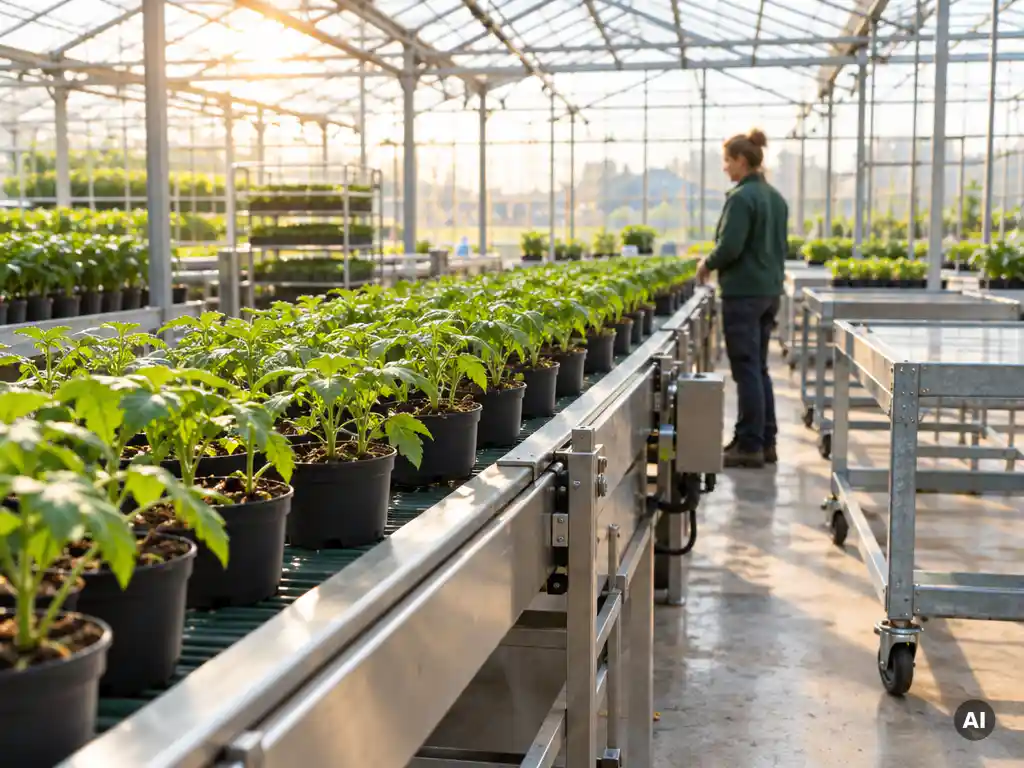
A well-planned line of conveyor belts moves product at a constant pace from one workstation to the next. Buffer tables absorb small differences in speed between steps, and potting machines or watering stations can be linked into the same flow. Because the components can be combined, the line can match the way a specific nursery works.
The effect on staffing can be dramatic. Fewer people are needed to move the same volume, and the people who remain work in a more ergonomic position, often at a worktable instead of walking and lifting. In our experience, customers have gone from 26 to 6 FTE for the same output after automating their internal transport. Results depend on the starting point, but the direction is consistent: less handling, more throughput.
Smarter Workflows Beyond the Labor Savings
The benefits of automation go beyond payroll, because a mechanized flow makes the whole process more predictable and easier to manage. Fewer manual steps mean fewer places where things can go wrong.
Consistency is the first gain. A conveyor does not slow down at the end of a long shift, so output per hour stays level, and planning becomes easier. When you know how many trays a line can process, you can promise delivery dates with more confidence.
Quality improves as well. Plants that are moved gently and consistently suffer less damage than those handled in a rush, and fewer touches mean less risk of mixing up batches. Add integrated scales or lighting at the worktable, and checks can be built right into the flow instead of being an extra step.
There is also a human side. Ergonomic workstations make the job more attractive, which helps with the recruitment and retention problems many nurseries face. A workplace that is easier on the body is simply easier to staff.
Starting Small With Mobile Conveyors and Rental
The easiest way to begin is with one mobile conveyor at one bottleneck, ideally rented first so the benefit can be measured before any larger investment. There is no need to redesign the entire nursery on day one.
Mobile belts are flexible by nature. They can be placed where the pressure is highest, moved when the season changes, and connected to other equipment later. Renting during a peak period gives a realistic picture of the time saved, using your own product, your own crew and your own layout.
From there, growth can follow a natural path. Many growers start with a mobile belt, add a buffer table or watering station after a season, and eventually move to fixed systems that form the backbone of the production process. Each step builds on the previous one, so nothing is wasted. If you are unsure where your biggest bottleneck is, we are happy to think along with you, since we know the practical side of nursery work well after more than three decades in the sector.
Common Pitfalls When Reducing Manual Handling
The most common pitfalls are automating the wrong step, ignoring the surrounding workflow and underestimating how much the team needs to be involved. Most of these are easy to avoid with a bit of preparation.
One frequent mistake is starting with the most visible task instead of the biggest bottleneck. Speeding up one station only helps if the stations before and after can keep up; otherwise, the problem just moves down the line. Mapping the full flow first shows where time is truly lost.
Another is buying separate components from different suppliers without considering how they fit together. Compatibility, software and installation all need to work as one system, which is why a single point of contact for hardware, software and installation saves coordination effort. Finally, involve the people who will work with the line. Their daily experience reveals practical details that no drawing will show, and their support makes the transition far smoother.
Reducing manual handling is not a single big leap but a series of well-chosen steps. Start with the bottleneck that costs the most hours, test it in practice, and let the results guide the next move. That way, greenhouse efficiency becomes something you build gradually in 2026 and beyond, rather than a project you postpone until the labor market solves itself.
Frequently Asked Questions
How do I identify the biggest manual handling bottleneck in my nursery?
Start by mapping the full flow of product from arrival to dispatch, then time each transport step over a typical day and a peak day. Note where people walk, lift or wait, and where trays pile up. The step that consumes the most labor hours or causes queues before and after it is usually the best place to start automating.
How do I get started with automated internal transport if I have a limited budget?
Begin with a single mobile conveyor at your most time-consuming bottleneck, and rent it first if possible. Renting lets you measure the time saved with your own product, crew and layout before committing to a larger investment. Keep a simple before-and-after record of hours spent and trays processed so the business case is clear.
What should I measure to know whether automation is actually paying off?
Track trays or pots moved per labor hour, overtime and temporary staff hours, and any product damage or batch mix-ups before and after the change. Compare similar periods, ideally peak week to peak week, so seasonal effects don’t distort the results. Also ask your team for feedback on physical strain, as reduced fatigue is a real benefit that doesn’t show up directly in output numbers.
What if my nursery layout changes from season to season?
Mobile conveyors are designed for exactly this situation. They can be repositioned to where the pressure is highest and later connected to buffer tables, watering stations or other equipment. This lets you adapt the setup each season and only move to fixed systems once your core flow is stable.
How do I prevent just moving the bottleneck down the line?
Check the capacity of the steps before and after the one you are speeding up. A buffer table can absorb small differences in pace between stations, but if a downstream step is much slower, it will simply become the new constraint. Plan the line as a whole, even if you implement it in stages.
How can I get my team on board with a new conveyor setup?
Involve the people who will work with the line from the start, for example by asking them where they lose the most time or feel the most strain. Run a trial period so they can try the setup and suggest practical adjustments to workstation height, spacing and flow. When employees see that the change makes their work easier rather than replacing it, acceptance is much higher.
Is it better to buy components from different suppliers or from one partner?
Working with a single partner for hardware, software and installation usually saves coordination effort and avoids compatibility problems between components. With multiple suppliers, you risk mismatched interfaces, unclear responsibility when something fails and longer commissioning times. If you do combine suppliers, agree upfront on interfaces and who is responsible for the integrated result.