
How growers went from 26 to 6 FTE and improved greenhouse efficiency
The Labor Bottlenecks Behind a 26-FTE Operation
A 26-FTE operation usually does not exist because the grower wants a large team. It exists because manual internal transport demands a lot of hands: carrying trays, pushing carts, moving pots from the potting line to the greenhouse and back again.
For many family-run nurseries between 10 and 200 hectares, this model hits a wall. Vacancies stay open for months, seasonal peaks force the use of expensive temporary workers, and physically heavy work leads to sick leave and high turnover. Meanwhile, wages climb every year and margins shrink, while competitors with more automation produce faster and cheaper.
The real problem is often invisible on the payroll. Much of that workforce is not growing plants at all. They are moving them. Recognizing that gap between skilled crop care and repetitive transport is the first step toward better greenhouse efficiency.
Starting Small With Mobile Conveyor Belts and Rental
The easiest way to begin automating is with a mobile conveyor belt, ideally rented first, so the grower can test the effect on real daily work before committing to a large investment.
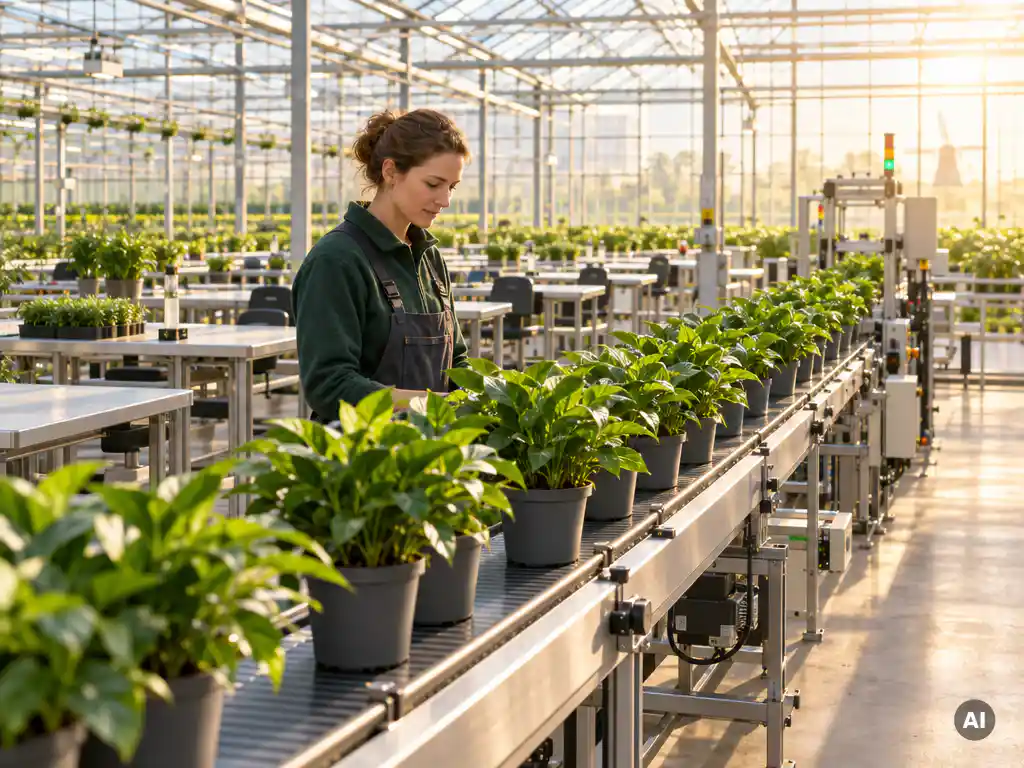
Mobile belts are flexible. They can be placed where the bottleneck is worst, used during a peak period, and moved when the situation changes. Many growers start by renting equipment for a busy season and quickly notice how many walking and carrying movements disappear. That hands-on experience removes the uncertainty that often blocks automation decisions.
This low-threshold approach also answers a common worry: too many options and too little time. Instead of designing a perfect system on paper, the grower learns what actually works in their own greenhouse. Our range of conveyor belts is built with exactly this step-by-step start in mind, and the products can be combined with work tables, scales and lighting as the process evolves.
Scaling Up to Fixed Transport Systems
Once a mobile belt has proven its value, the logical next step is a fixed transport system that becomes the backbone of the production process.
At this stage, the grower knows which flows matter most. Fixed conveyor lines, roller tracks, buffer tables, potting machines and watering stations can then be linked into one continuous line. Because the machines are designed to work together, plants move through the process with far fewer handling steps and far less waiting time.
Why one supplier makes the difference
Fixed systems work best when hardware, software and installation fit together from the start. Coordinating several suppliers often leads to delays, interface problems and finger-pointing when something fails. Having a single partner who designs, builds in its own workshop and installs the system keeps the implementation smooth and the downtime low.
Growth also stays manageable. A line can be extended piece by piece as the business develops, so the automation grows alongside the nursery rather than ahead of it.
How 20 Fewer FTE Still Delivered the Same Output
The drop from 26 to 6 FTE was possible because automation took over the repetitive transport and handling work, while output stayed the same.
Think of everything that used to require people: moving trays between stations, feeding the potting machine, buffering plants during peaks, hauling soil and watering by hand. When conveyors, buffer tables and automated stations handle these tasks continuously, the process no longer depends on how many people are available that day. The line simply keeps running at a steady pace.
The remaining team shifts toward higher-value work such as supervision, quality control and crop care. Work becomes more ergonomic, absenteeism tends to fall, and the grower is less exposed to seasonal labor shortages. Fewer people, fewer errors and a steadier flow all contribute to better margins and stronger greenhouse efficiency overall.
Lessons for Growers Planning Their Own Automation
The clearest lesson is to start where the labor pain is greatest, test it with minimal risk, and expand only when the results are visible.
A few practical takeaways stand out from this journey:
- Map the movement first. Identify where people spend their time carrying and pushing rather than growing.
- Try before you buy. Renting a mobile belt for a peak period turns assumptions into real experience.
- Build in steps. Grow from mobile solutions to fixed lines as confidence and volume increase.
- Choose compatible components. Systems that combine easily keep future expansion simple and affordable.
- Keep it in one hand. A single partner for hardware, software and installation reduces risk.
Every nursery is different, so the best route depends on your layout, crops and peak periods. If you want to explore what a first step could look like for your own greenhouse, get in touch with us and we will gladly think it through with you. With more than 30 years of experience in horticulture, we know the work floor well, and a short conversation can already show where the biggest savings are hiding.
Frequently Asked Questions
How do I identify which transport steps in my nursery are costing the most labor?
Start by observing one full production day and logging where people are carrying, pushing or waiting rather than doing crop care. Typical hotspots are the potting line, the transfer to the greenhouse, and buffering during peak periods. Count the number of handling steps per tray or pot and the minutes spent on each; the step with the most repetitive movements is usually the best candidate for your first automation.
How long should I rent a mobile conveyor belt before deciding to invest in a fixed system?
Aim to rent for at least one full busy period or peak season, so you can compare real workloads, walking distances and staffing needs with and without the belt. Track a few simple numbers before and during the trial, such as hours spent on transport and the number of trays handled per hour. If you see a clear, repeatable gain, you have solid evidence for the next step.
What if my greenhouse layout is not ideal for a fixed transport line?
An imperfect layout is rarely a dealbreaker, because fixed lines can be designed around existing structures and extended in phases. Begin by automating the busiest flow and leave room in the design for future extensions. A supplier who designs and builds in their own workshop can usually tailor the line to your greenhouse instead of forcing you to rebuild it.
Will my current employees accept automation, and how do I involve them?
Staff are generally more positive when they understand that automation removes the heavy, repetitive work rather than their role in the business. Involve them early by asking where they lose the most time or strain themselves, and let them test a rented belt. Offer a shift toward supervision, quality control and crop care, which is more skilled and more ergonomic work.
What are common mistakes growers make when automating internal transport?
The most common mistakes are buying a large system before testing the real flows, mixing components from several suppliers that do not connect well, and ignoring buffer capacity for peak periods. Another pitfall is automating one station without considering the machines before and after it, which only moves the bottleneck. Building step by step with compatible components helps you avoid these problems.
How do I know whether automation will pay off for my nursery size?
Compare your yearly cost of transport-related labor, including temporary workers, sick leave and turnover, with the cost of the equipment and its expected lifespan. Mobile belts and rental options keep the initial investment low, so even smaller or mid-sized nurseries can see a return quickly. A short consultation with a supplier who knows horticulture can help you estimate the savings for your specific crops and volumes.
Can I combine conveyor belts with other equipment like work tables, scales or potting machines later on?
Yes, if you choose a modular, compatible system from the start. Mobile belts can be combined with work tables, scales and lighting, and later linked to roller tracks, buffer tables, potting machines and watering stations. Ask your supplier about interface compatibility before your first purchase so future expansion stays simple and affordable.