

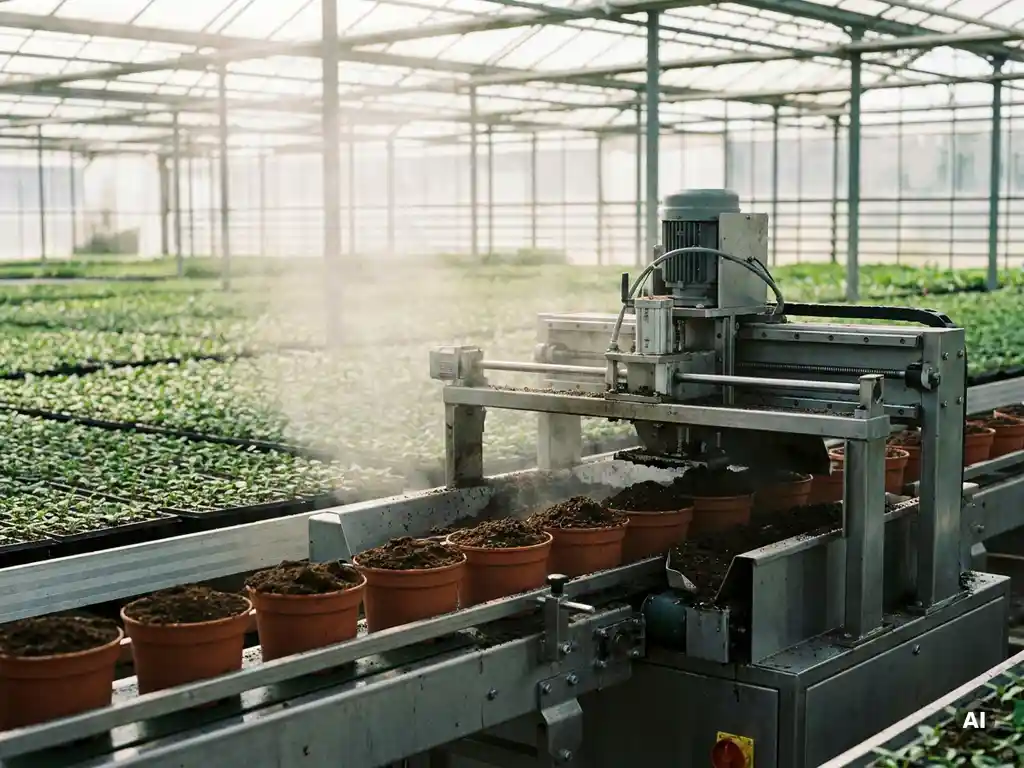
How long does it take to pot 25,000 plants with an automated potting machine?
With an automated potting machine running at full capacity, potting 25,000 plants takes roughly 3 to 4 hours. At a throughput of up to 8,000 pots per hour, a well-configured machine can handle that volume in a single shift, compared to days of manual labor for the same job. The exact time depends on pot size, soil mix, and how the machine is integrated into your production line. Below, we break down the key questions growers ask before investing in automated potting.
How fast can an automated potting machine actually work?
A professional potting machine can fill and compact between 3,000 and 8,000 pots per hour, depending on the model, pot size, and configuration. At the higher end of that range, you are looking at more than 130 pots per minute, a throughput that no manual team can match consistently over a full working day.
The Stolze 3030, for example, handles pots from 7 to 30 cm and runs in single, double, or alternating mode. The 3030 PRO pushes capacity further with automatic soil detection, which ensures every pot is filled precisely and consistently without operator adjustment. That precision matters not just for speed, but for product quality: uniform soil density across every pot in the batch.
It is worth noting that rated capacity assumes a steady soil supply and a well-integrated conveyor system. If soil delivery is manual or the output line creates bottlenecks, actual throughput will be lower. A complete potting line, machine, conveyor, and soil feed, is what unlocks the full pots-per-hour figure.
How long does it take to pot 25,000 plants by hand?
Manual potting typically yields around 200 to 400 pots per person per hour, depending on pot size, soil type, and worker experience. To pot 25,000 plants by hand, a team of five experienced workers would need between 12 and 25 hours of combined labor, spread across two to three full working days.
That estimate does not account for fatigue. Repetitive bending, lifting, and compressing soil takes a physical toll, and output per worker drops noticeably after the first few hours. Quality also varies: different workers apply different compaction pressure, leading to inconsistent soil density and uneven plant development across the batch.
For smaller nurseries doing occasional runs, manual potting is manageable. But for any grower regularly handling volumes of 10,000 pots or more, especially during seasonal peaks, the labor cost and physical strain make manual potting increasingly difficult to justify.
What factors affect how quickly a potting machine finishes a batch?
Several variables determine how fast a potting machine moves through a batch. The most important ones are pot size, soil mix consistency, machine configuration, and line integration. Understanding each factor helps you set realistic throughput expectations before starting a run.
- Pot size: Smaller pots fill faster. A machine running 9 cm pots will complete a batch of 25,000 more quickly than the same machine running 17 cm pots, simply because each cycle moves more units.
- Soil mix: Coarse or fibrous mixes with large chunks of bark or perlite can slow filling speed or cause inconsistencies. Machines designed for horticultural use, like those built for Dutch growing conditions, handle mixed substrates better than general-purpose equipment.
- Machine settings: Drill depth, rotation speed, and soil feed rate all affect cycle time. Pre-programmed settings for different pot sizes (available via touchscreen on advanced models) eliminate manual adjustment time between batches.
- Conveyor and output line: If pots back up on the output side, the machine slows or stops. A matched conveyor system keeps flow continuous and prevents the potting machine from becoming the bottleneck.
- Operator experience: Even on automated machines, the operator manages soil supply, monitors fill quality, and handles exceptions. A trained operator keeps the line running; an inexperienced one introduces unnecessary downtime.
How does a potting machine compare to manual potting for large volumes?
For volumes above 5,000 pots per run, an automated potting machine is significantly faster, more consistent, and more cost-effective than manual potting. The gap widens as volume increases: labor costs scale linearly with manual work, while machine costs stay largely fixed per run.
Beyond raw speed, automated potting delivers two advantages that manual work cannot replicate at scale. First, soil density is consistent from the first pot to the last, the machine applies the same compaction every time, regardless of how long the shift has been running. Second, the physical burden on workers is dramatically reduced. Potting is one of the most ergonomically demanding tasks in a nursery, and removing it from the manual workload lowers injury risk and improves staff retention.
For smaller, irregular batches, say, a few hundred specialty plants in unusual pot sizes, manual potting remains practical. But for any grower running regular large batches, the productivity difference is not marginal. It is the difference between completing a 25,000-pot run in one shift versus stretching it across multiple days with a tired team.
Should you buy or rent a potting machine for a large potting run?
If you are running large batches regularly throughout the season, buying a potting machine is almost always the better long-term investment. Renting makes sense for one-off peaks, trial periods, or when you want to test a specific machine before committing to a purchase.
Renting gives you access to professional equipment without upfront capital outlay, useful if your volume is seasonal and concentrated in a few weeks per year. It also lets you evaluate whether a particular machine fits your soil mix, pot range, and line setup before you buy. For growers who are uncertain about the return on investment, a rental trial is a low-risk way to gather real data from your own operation.
Buying, on the other hand, means the machine is available whenever you need it, configured exactly for your workflow, and integrated into your permanent production line. Over multiple seasons, the cost per pot drops significantly compared to rental rates.
How MartinStolze helps you pot more in less time
We build and supply professional potting machines designed specifically for high-volume ornamental and pot plant growers. Our Stolze 3030 and 3030 PRO handle pots from 7 to 30 cm at up to 8,000 pots per hour, and both machines integrate directly into a complete potting line with conveyors and sorting equipment.
- Up to 8,000 pots per hour with consistent soil density on every pot
- Touchscreen programming for different pot sizes, drill depths, and soil feed rates, no manual recalibration between batches
- Automatic soil detection on the 3030 PRO for precise, uniform filling even with demanding substrate mixes
- Full line integration with our own conveyor systems to eliminate bottlenecks and keep throughput consistent
- Buy or rent, including trial periods, so you can validate the machine in your own operation before committing
- Installation, training, and service by our own technicians, based in De Lier
Whether you are replacing an aging machine or automating for the first time, we guide you from configuration to commissioning. Contact us to discuss your batch volumes, pot range, and soil mix, and we will help you find the right setup to get 25,000 pots done in a single shift.
Frequently Asked Questions
What is the minimum volume at which investing in an automated potting machine starts to make financial sense?
Most growers find the break-even point sits somewhere around 5,000 to 10,000 pots per season, though it depends heavily on your local labor costs and how frequently you run large batches. If you are regularly hitting that volume during seasonal peaks, the labor savings alone typically offset the machine cost within one or two seasons. A rental trial is a practical way to calculate your exact cost-per-pot before committing to a purchase.
Can a potting machine handle all types of substrate, including peat-free or bark-heavy mixes?
Most professional potting machines designed for horticultural use can handle a range of substrates, including peat-free blends and mixes with coarse bark or perlite, but performance does vary by machine. Fibrous or chunky mixes can cause inconsistent filling on general-purpose equipment, so it is worth confirming with the manufacturer that the machine is tested with substrates similar to yours. The Stolze 3030 PRO, for instance, uses automatic soil detection specifically to maintain fill consistency across demanding or variable substrate mixes.
How much space do I need in my nursery to set up a complete potting line?
The footprint depends on the length of your conveyor system and how much buffer space you need for incoming empty pots and outgoing filled ones, but most complete potting lines require a clear run of at least 8 to 15 meters. You will also want to account for soil storage and delivery near the machine to avoid interrupting the feed. Before installation, it is worth doing a floor plan review with the supplier so the line layout matches your existing workflow and building constraints.
How long does it take to switch a potting machine between different pot sizes?
On machines with touchscreen programming, switching between pre-configured pot size profiles takes only a minute or two — you select the profile and the machine adjusts drill depth, rotation speed, and soil feed rate automatically. On older or simpler machines, manual recalibration can take 15 to 30 minutes per changeover, which adds up quickly if you are running multiple pot sizes in a day. If you regularly switch between sizes, this is one of the most important features to evaluate before choosing a machine.
What kind of maintenance does a potting machine require, and how much downtime should I expect?
Routine maintenance on a professional potting machine typically involves cleaning soil buildup from the drill and filling mechanism, checking conveyor belts for wear, and lubricating moving parts — tasks that can usually be done in under an hour at the end of a shift. Scheduled servicing by a technician once or twice per season keeps the machine running reliably and catches wear before it becomes a breakdown. Choosing a machine supported by the manufacturer’s own service team, rather than a third-party dealer, significantly reduces the risk of extended downtime during peak production periods.
Can one operator run a fully automated potting line alone, or does it require a full crew?
A single trained operator can manage a complete potting line — monitoring soil supply, checking fill quality, and handling exceptions — while the machine handles the physical potting work. In practice, many growers run with one operator on the machine and one or two additional workers handling pot supply or downstream tasks like labeling and staging, but this depends on line speed and how automated the surrounding workflow is. The key shift from manual potting is that the operator role changes from physical labor to line supervision, which is less fatiguing and easier to sustain across a full shift.
What should I check or test during a rental trial to know if a potting machine is the right fit for my operation?
During a rental trial, focus on three things: fill consistency across your actual substrate mix, changeover time between the pot sizes you regularly use, and how the machine integrates with your existing conveyor or output setup. Run the machine at realistic batch volumes — not just a short test — so you can measure actual throughput and identify any bottlenecks in your line. Keep a note of any adjustments the operator needs to make mid-run, as frequent manual interventions are a sign the machine may not be well-matched to your soil mix or pot range.