
How many employees do you need around a high-capacity potting machine?
Most high-capacity potting machines running at 5,000 to 8,000 pots per hour require between two and four operators to keep the line running efficiently. The exact number depends on your machine’s output speed, how much of the surrounding process is automated, and the size and type of plants you are working with. The sections below break down each factor so you can plan your crew with confidence.
How many people does a potting line actually need?
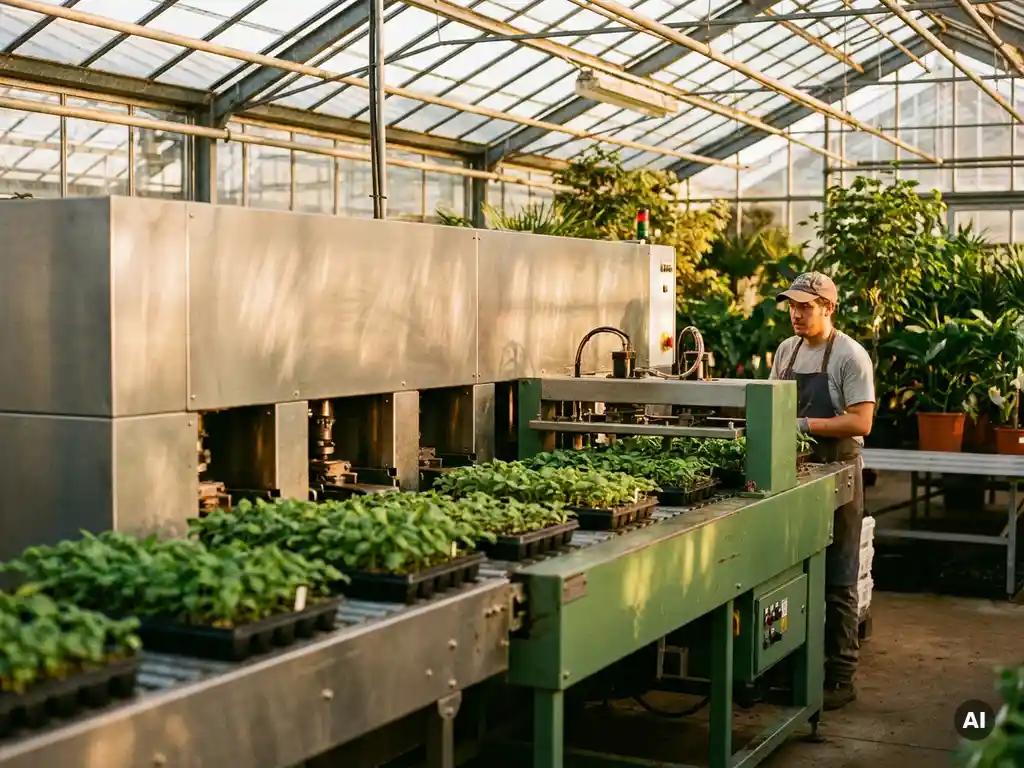
A fully equipped potting line typically needs two to four people to operate effectively at high capacity. At the machine itself, one operator manages the controls and monitors fill quality. One or two additional workers handle plant placement, tray management, or pot positioning, depending on your setup. A fourth person may be needed for quality checks or end-of-line handling during peak runs.
The key principle is that the machine handles the physically demanding and repetitive work, filling, pressing, and cycling pots, while your team focuses on tasks that still require human judgment and dexterity. A well-configured line does not eliminate people entirely, but it dramatically changes what those people are doing. Instead of bending, lifting, and scooping soil by hand for hours on end, your crew monitors, guides, and responds. That shift alone reduces fatigue, lowers injury risk, and keeps output consistent across a full working day.
For smaller nurseries running at lower speeds or with simpler plant types, two operators can often manage the entire line. Larger operations with complex plant handling, multiple pot sizes, or continuous shifts will typically need three to four.
What tasks still require human hands on an automated potting line?
Even on a highly automated potting line, several tasks consistently require human involvement. These include placing cuttings or young plants into filled pots, monitoring soil fill quality and consistency, clearing jams or adjusting pot flow, restocking substrate, and managing finished product at the end of the line.
Automation excels at repetitive, high-speed mechanical actions, filling pots, pressing substrate, and moving containers along the line. But plants themselves are biological and variable. A cutting that lands slightly off-center, a tray that does not seat correctly, or a pot size that shifts mid-batch all require a human eye and a human hand to correct quickly.
On lines equipped with advanced features like automatic soil detection, the machine itself compensates for inconsistencies in substrate fill without operator input. This reduces the monitoring burden significantly. Still, someone needs to be present to catch the exceptions that no sensor anticipates, a blocked conveyor, a plant variety that behaves differently, or a substrate mix that runs low. Human oversight is not a workaround for incomplete automation; it is a deliberate part of a well-designed line.
How does machine capacity affect the number of operators needed?
Higher machine capacity does not automatically mean more operators, but it does raise the stakes for each person on the line. A machine running at 8,000 pots per hour moves fast enough that a single bottleneck, whether a slow plant placer or an unattended jam, can cost hundreds of pots in minutes. At that speed, your crew needs to be positioned strategically, not just present.
At lower capacities, say 2,000 to 3,000 pots per hour, one experienced operator can often manage the machine and basic plant handling simultaneously. As output climbs toward 5,000 to 8,000 pots per hour, the pace demands dedicated roles. One person cannot realistically monitor the fill quality, place plants, and manage the end of the line at full speed without the process suffering somewhere.
The practical rule is this: match your crew size to the slowest human task on the line, not to the machine’s maximum output. If plant placement is the limiting step at your current capacity, adding a second person at that station will unlock more of the machine’s potential than any other change you can make.
Does adding transport automation reduce crew size further?
Yes, integrating conveyor and transport automation into your potting line can meaningfully reduce the number of people needed, particularly for moving filled pots away from the machine and into the next stage of your process. Without transport automation, you typically need one or more workers dedicated solely to moving product, a task that adds no value but consumes significant labor time.
When conveyor systems handle the movement of pots from the potting machine to staging, spacing, or dispatch areas, those workers can be redeployed to higher-value tasks or removed from the line entirely during steady-state operation. In practice, nurseries that combine a high-capacity potting machine with integrated transport often find they can run the same output with one fewer person compared to a standalone machine setup.
The efficiency gain compounds during peak season. When every hour counts and temporary staff are harder to find and train, a transport-automated line gives you more output per person, which is exactly the flexibility that matters most when the pressure is on.
What’s the difference between renting and buying a potting machine for staffing planning?
The main difference for staffing purposes is timing and commitment. Renting a potting machine lets you scale your crew around a known, short-term production window without committing to a permanent change in your workforce structure. Buying a machine means your staffing model needs to work across the full year, including slower periods when the machine is idle but your fixed labor costs remain.
For growers who face strong seasonal peaks, spring flush, holiday production runs, or auction deadlines, renting gives you the machine’s capacity exactly when you need it, without hiring permanent staff to support it year-round. You bring in temporary workers for the season, run the line at full capacity, and scale back when the peak passes.
Buying makes more sense when your production is consistent enough across the year that a permanent reduction in manual labor justifies the investment. In that scenario, the machine pays for itself through ongoing labor savings, and your staffing model stabilizes around a smaller, better-supported permanent crew.
Neither path is universally better, the right choice depends on your production calendar, your current team size, and how predictable your volumes are from year to year. A trial rental period is a practical way to test a machine’s impact on your line before committing to ownership.
How we help you plan your potting line and crew
At MartinStolze, we help nurseries and growers find the right combination of machine capacity and line configuration for their specific situation. Our potting machines, including the Stolze 3030 and the Stolze 3030 PRO, are designed to integrate directly with transport and sorting systems so you can build a line that works with the crew size you actually have.
- Capacity up to 8,000 pots per hour with consistent, sensor-controlled fill quality
- Touchscreen programming for different pot sizes, bore depths, and rotation speeds, less operator training time needed
- Seamless integration with conveyor systems to reduce manual transport tasks
- Both purchase and rental options available, including trial periods for growers evaluating the investment
- Full support from our own technicians, from installation and training to ongoing maintenance
If you want to work out exactly how many people your line needs, and where automation can take the pressure off, get in touch with our team and we will help you map it out.
Frequently Asked Questions
How long does it take to train new operators on a high-capacity potting machine?
Most operators can get up to speed on the core functions of a modern potting machine within one to two days, especially on machines with touchscreen programming that simplifies pot size and bore depth adjustments. Full confidence across different plant types, substrate mixes, and troubleshooting scenarios typically develops over two to four weeks of hands-on use. To reduce training time, look for machines that store programmable presets for different runs, so new operators are not reconfiguring settings from scratch each shift.
What happens to output if one operator is absent during a peak production run?
On a three- to four-person line running at full capacity, losing one operator will almost always create a bottleneck, most commonly at plant placement or end-of-line handling, which are the tasks most dependent on human speed and consistency. The practical response is to either slow the machine's output speed to match the reduced crew, or temporarily reassign a worker from a lower-priority task to cover the gap. This is one reason why cross-training every team member on at least two roles on the line is worth the upfront investment.
Can one potting machine handle multiple pot sizes in a single production day?
Yes, modern high-capacity potting machines are designed to switch between pot sizes, bore depths, and rotation speeds without requiring a full line reconfiguration. On machines with touchscreen programming, switching between presets can take as little as a few minutes, making it practical to run different pot sizes across the same shift. The key consideration for staffing is that changeovers still require an operator to verify fill quality and alignment after each switch, so factor that monitoring time into your crew schedule.
What are the most common mistakes nurseries make when first setting up an automated potting line?
The most frequent mistake is understaffing the human tasks while over-relying on the machine's speed, particularly at plant placement and end-of-line handling, which are the steps most likely to become bottlenecks at high output rates. Another common error is failing to integrate transport automation from the start, which forces workers into low-value moving tasks instead of monitoring and quality roles. Starting with a clear map of every task on the line, and assigning dedicated roles before the first production run, prevents most early efficiency problems.
How do I know whether my current substrate or soil mix is compatible with an automated potting machine?
Most commercial substrate mixes, including peat-based, coir-based, and bark-heavy blends, work well with high-capacity potting machines, but consistency of moisture content and particle size matters significantly for reliable fill quality. Very dry or very coarse mixes can cause bridging in the hopper, while overly wet mixes may clump and affect fill accuracy. The best approach is to run a trial with your specific substrate before committing to a full production schedule, and to consult with the machine supplier about any adjustments to settings that may be needed for your mix.
Is renting a potting machine a realistic option for a nursery that has never used one before?
Renting is actually one of the most practical entry points for nurseries new to automated potting, because it lets you test the machine's impact on your line, your crew, and your output quality before making a capital investment. A rental period during your peak season gives you real production data, how many operators you need, how your substrate performs, and how much output you can realistically achieve, all without the financial commitment of ownership. Many suppliers, including MartinStolze, offer trial rental periods specifically designed for growers who are evaluating the investment.
At what production volume does investing in a high-capacity potting machine typically start to pay off?
While the exact break-even point depends on your labor costs, machine price, and production calendar, most nurseries find that a high-capacity potting machine becomes financially justified when manual potting requires three or more full-time workers during peak season, or when inconsistent output quality is causing measurable plant losses or rework. At 5,000 to 8,000 pots per hour, the machine can replace the equivalent of several manual workers while improving consistency, which means the return on investment accelerates quickly during high-volume periods. A straightforward way to estimate your specific payback period is to calculate your current cost per pot manually and compare it against the machine's annualized cost at your expected annual volume.
Related Articles
- How does a topping machine work in a pot plant production line?
- When is a high-capacity potting machine unnecessary for your nursery?
- How does pot spacing influence achievable pots per hour?
- What happens when your potting machine capacity exceeds the rest of your line?
- Why do standard industrial conveyor belts fail in greenhouses?